Overview of Environmental Metabolomics
Environmental metabolomics represents a powerful analytical approach for understanding the biochemical responses of organisms to environmental stressors and contaminants. This emerging field combines the principles of traditional metabolomics with environmental monitoring to detect subtle changes in metabolite profiles resulting from exposure to pollutants, climate change, or other ecological disturbances. Unlike targeted environmental analysis focusing on specific contaminants, environmental metabolomics provides a comprehensive view of biological responses at the molecular level.
The fundamental goal of environmental metabolomics is to identify metabolic biomarkers that indicate exposure to environmental stressors before visible ecological damage occurs. This proactive approach enables early warning systems for environmental monitoring and helps establish causal relationships between contaminant exposure and biological effects. The technique has applications across diverse ecosystems, from aquatic environments to terrestrial systems, and can be applied to various organisms including fish, invertebrates, plants, and microorganisms.
Sample Types in Environmental Metabolomics
Water Samples
Water represents one of the most common sample matrices in environmental metabolomics, encompassing drinking water, groundwater, surface water, wastewater, and seawater. These samples present unique challenges due to their large volumes and the need for trace enrichment of metabolites typically present at part-per-billion or part-per-trillion levels. As noted in environmental SPE literature, “The trace enrichment aspect of SPE lends itself very well to the extraction of liquids, especially clean samples such as drinking water or groundwater.”
Particulate-laden samples like river water or wastewater require special handling to prevent SPE cartridge clogging. Researchers have employed various filtration strategies, including step-wise filtration through glass-fiber filters at 0.7 μm followed by 0.45 μm filtration to trap particulate matter. For non-homogeneous samples, depth filters consisting of diatomaceous earth (Hydromatrix™) have proven effective for SPE of complex environmental matrices.
Soil Extracts
Soil and sludge samples require liberation of analytes from solid matrices into liquid forms before SPE processing. As described in environmental SPE applications, “Much as for solid biological samples, a prerequisite for the successful extraction of soil or sludge samples is liberation of the analytes from a solid matrix into a liquid one.” Common approaches include Soxhlet extraction, homogenization in extraction buffers, or microwave-assisted extraction.
Soil extracts often contain high levels of humic and fulvic acids, sulfurous compounds, and other inorganics that complicate analysis. Traditional approaches have used Florisil cartridge clean-up as part of multi-step purification processes. However, modern environmental metabolomics often employs more sophisticated SPE strategies to handle these complex matrices effectively.
SPE Sorbent Selection for Broad Metabolite Capture
Mixed-Mode Sorbents for Comprehensive Coverage
For environmental metabolomics requiring broad metabolite capture, mixed-mode sorbents offer significant advantages. These materials combine hydrophobic interactions with ion exchange capabilities, allowing retention of metabolites across a wide polarity range. As research demonstrates, “The strategy of a mixed-mode cartridge providing hydrophobic and cation exchange interactions, combined with a pH-dependent sample application and extraction, can give high recoveries of analytes.”
For Poseidon Scientific applications, our MCX SPE cartridges (mixed-mode cation exchange) and MAX SPE cartridges (mixed-mode anion exchange) provide excellent platforms for environmental metabolomics. These sorbents retain compounds through multiple interaction mechanisms, ensuring comprehensive metabolite capture from complex environmental matrices.
Hydrophilic-Lipophilic Balanced (HLB) Sorbents
For non-targeted metabolomics where metabolite polarity varies widely, hydrophilic-lipophilic balanced sorbents like our HLB SPE cartridges offer exceptional versatility. These water-wettable polymers retain both polar and non-polar compounds without requiring conditioning, making them ideal for environmental samples containing diverse metabolite classes.
Specialized Sorbents for Specific Applications
For environmental samples with specific metabolite classes, specialized sorbents may be appropriate. Our WAX SPE cartridges (weak anion exchange) and WCX SPE cartridges (weak cation exchange) provide selective retention for acidic and basic metabolites, respectively. These can be particularly valuable when focusing on specific metabolic pathways or compound classes in environmental studies.
Example Workflow for Environmental Sample Enrichment
Sample Preparation and Pre-treatment
Effective environmental metabolomics begins with proper sample collection and preservation. Water samples should be collected in clean, contaminant-free containers and preserved immediately (typically by freezing or adding appropriate preservatives). Soil samples require homogenization and extraction using appropriate solvents or buffers. For solid samples, the conversion to liquid form is critical, as “Traditional SPE requires the sample to be liquefied, or at least that the analytes are solubilized and stripped from the bulk of the matrix solids.”
SPE Protocol for Environmental Metabolomics
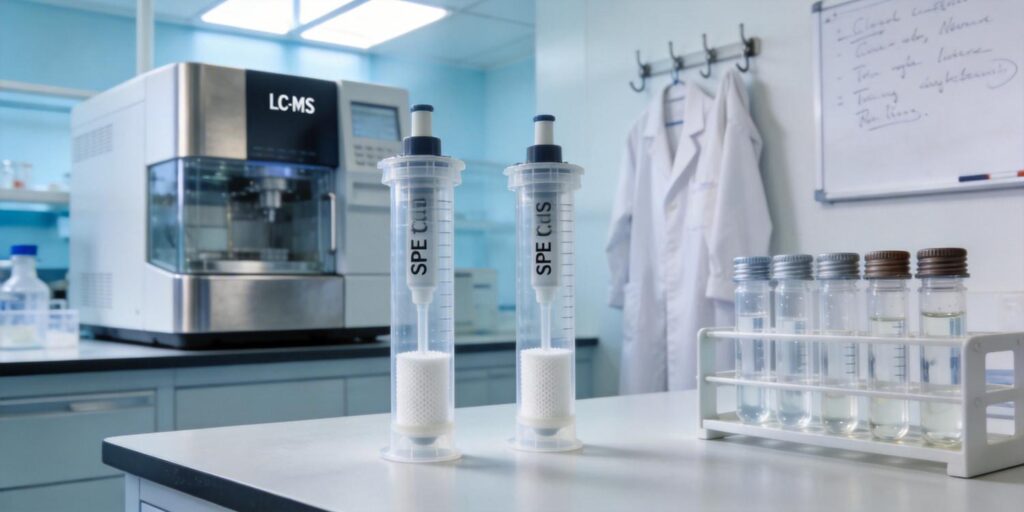
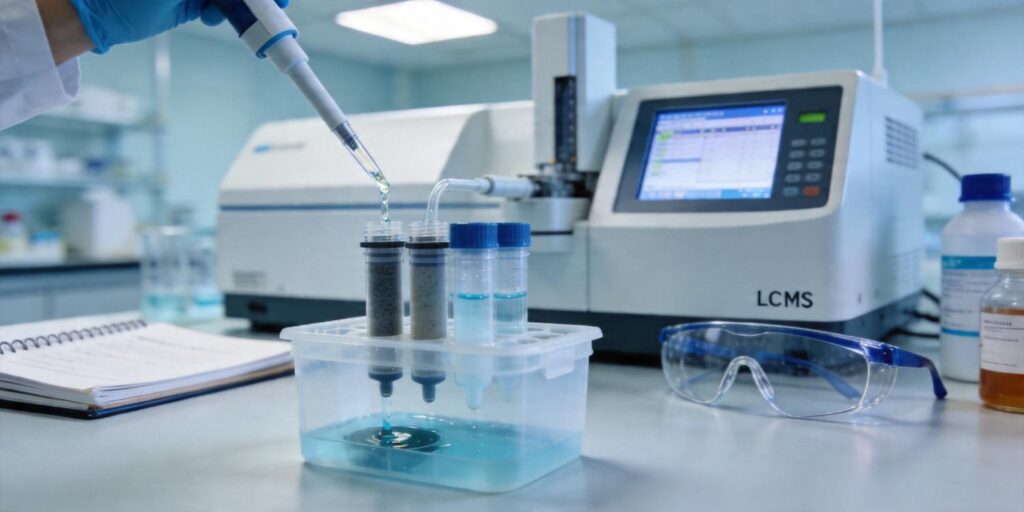
- Conditioning: For reversed-phase sorbents, condition with methanol followed by water or appropriate buffer. As noted in SPE fundamentals, “Methanol wets the surface of the sorbent & penetrates bonded alkyl phases, allowing water to wet the silica surface efficiently.”
- Sample Loading: Load samples at controlled flow rates (typically 1-3 drops per second for optimal recovery). For large volume environmental samples, consider using SPE disks or 96-well plates for higher throughput.
- Washing: Remove weakly retained matrix components using appropriate wash solvents. For environmental samples, this step is crucial for eliminating humic acids and other interfering compounds.
- Elution: Elute metabolites in the smallest possible volume of appropriate solvent. For comprehensive metabolomics, sequential elution with solvents of increasing strength may capture different metabolite classes.
High-Throughput Considerations
For large-scale environmental monitoring studies, our 96-well SPE plates offer significant advantages in throughput and reproducibility. These plates enable parallel processing of multiple samples, reducing analysis time and improving consistency across samples. As noted in SPE automation literature, “The method lends itself to automation, which can increase the throughput and substantially reduce the amount of manual labor.”
LC-MS Metabolomics Analysis
Chromatographic Separation Strategies
Following SPE enrichment, environmental metabolites require separation by liquid chromatography before mass spectrometric detection. Reversed-phase chromatography using C18 columns remains the workhorse for environmental metabolomics, providing good separation for a wide range of metabolites. However, hydrophilic interaction chromatography (HILIC) offers complementary separation for polar metabolites that may not retain well on reversed-phase columns.
For comprehensive coverage, many environmental metabolomics studies employ both reversed-phase and HILIC separations in parallel or sequential analyses. This dual-mode approach ensures detection of metabolites across the entire polarity spectrum.
Mass Spectrometric Detection
High-resolution mass spectrometry (HRMS) has revolutionized environmental metabolomics by enabling accurate mass measurements and structural elucidation. Time-of-flight (TOF) and Orbitrap instruments provide the resolution and mass accuracy needed for metabolite identification in complex environmental samples.
Data-dependent acquisition (DDA) and data-independent acquisition (DIA) strategies each offer advantages for environmental metabolomics. DDA provides MS/MS spectra for identification, while DIA offers more comprehensive coverage and better quantification across samples.
Quality Control Considerations
Environmental metabolomics requires rigorous quality control measures due to sample complexity and potential matrix effects. Quality control samples should include:
- Procedure blanks to monitor contamination
- Pooled quality control samples for system stability assessment
- Reference standards for retention time alignment and system performance
- Internal standards for quantification normalization
Data Interpretation Considerations
Metabolite Identification Challenges
Environmental metabolomics faces unique identification challenges due to the vast chemical space of potential metabolites and limited reference databases for environmental compounds. Confidence levels for metabolite identification should be clearly reported, following established guidelines:
- Level 1: Identified metabolites (confirmed with reference standards)
- Level 2: Putatively annotated compounds (based on spectral similarity)
- Level 3: Putatively characterized compound classes
- Level 4: Unknown compounds (distinguished by spectral features)
Statistical Analysis and Biomarker Discovery
Multivariate statistical methods are essential for identifying metabolic patterns in environmental samples. Principal component analysis (PCA) provides an overview of sample clustering and outliers, while partial least squares-discriminant analysis (PLS-DA) or orthogonal PLS-DA (OPLS-DA) helps identify metabolites contributing to group separations.
For biomarker discovery, univariate statistical tests (t-tests, ANOVA) combined with appropriate multiple testing corrections (false discovery rate) identify significantly altered metabolites. Pathway analysis tools then help interpret biological significance by mapping altered metabolites to known metabolic pathways.
Integration with Environmental Parameters
The true power of environmental metabolomics emerges when metabolic data integrates with environmental measurements. Correlation analyses between metabolite levels and environmental parameters (contaminant concentrations, pH, temperature, etc.) provide insights into exposure-response relationships. Multivariate approaches like redundancy analysis (RDA) or canonical correspondence analysis (CCA) can directly relate metabolic profiles to environmental gradients.
Quality Assurance and Reproducibility
Given the complexity of environmental samples and the sensitivity of metabolomic analyses, rigorous quality assurance protocols are essential. These should include:
- Standard operating procedures for sample collection, storage, and processing
- Batch randomization to avoid systematic biases
- Technical replicates to assess analytical variability
- Method validation using spiked samples or reference materials
- Comprehensive documentation of all processing steps
Environmental metabolomics represents a rapidly evolving field that benefits significantly from optimized SPE sample preparation. By selecting appropriate sorbents and protocols, researchers can enhance metabolite recovery, reduce matrix interference, and improve the quality of downstream LC-MS analyses. As environmental monitoring becomes increasingly important for understanding ecosystem health and human exposure risks, robust metabolomics workflows incorporating effective SPE will continue to play a crucial role in environmental science and regulation.