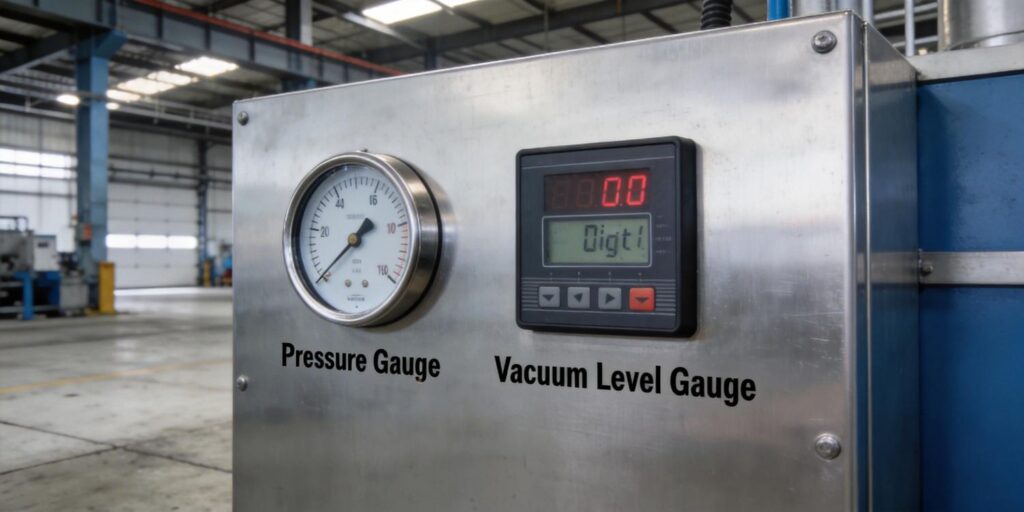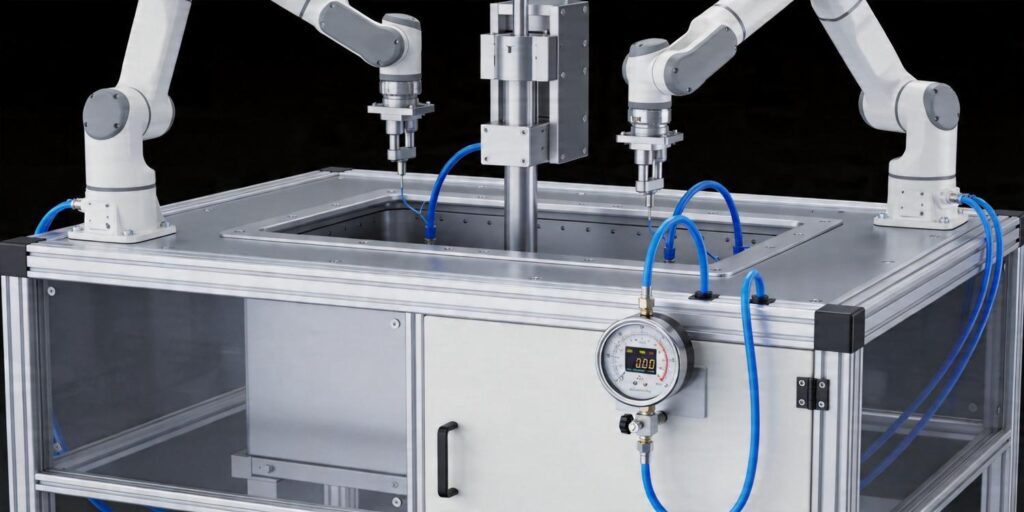
Industrial Leak Testing Overview
Industrial leak testing is a critical quality-control process used across automotive, aerospace, medical device, packaging, and HVAC manufacturing. Components such as fuel injectors, battery enclosures, medical tubing, and heat exchangers must be verified leak-free to ensure safety, performance, and regulatory compliance. Common methods include helium mass spectrometry, pressure decay, and rate-of-rise testing, all of which rely on precise vacuum measurement to detect even microscopic leaks measured in atm·cm³/s or mbar·L/s.
In vacuum-based leak testing, the part or chamber is evacuated, isolated, and monitored for pressure rise or decay. Any deviation from the expected curve indicates a leak path. Poseidon Scientific’s VG-SP205 Pirani Vacuum Transmitter and VG-SM225 Cold Cathode Vacuum Gauge are engineered for these demanding applications. Their compact size, rapid response, and industrial-grade interfaces make them ideal for both laboratory and high-volume production leak-test stations.
Pressure Stability Requirement
Accurate leak detection requires exceptional pressure stability. Even minor fluctuations from temperature drift, pump vibration, or environmental noise can mask or mimic a real leak. In rate-of-rise testing, for example, the isolated chamber must exhibit a rise rate below a specified threshold—often <5 × 10⁻⁴ Torr/min—for the part to pass. The VG-SP205 and VG-SM225 incorporate dual temperature compensation (hardware circuitry plus embedded algorithms) that maintains readings within ±5 % across the 15 °C–50 °C operating range typical of factory floors.
Both instruments deliver low-noise 0–10 V analog output (effective 2–8 V linear range) and customizable RS232 digital streams, enabling closed-loop control and statistical process control (SPC) charting. This stability ensures repeatable test results, reduces false rejects, and supports compliance with standards such as ISO 3530 and automotive IATF 16949 requirements.
Pump Down Curve Analysis
The pump-down curve is a powerful diagnostic tool in leak testing. A healthy system shows a rapid initial drop (roughing phase), a transition knee near 10-1 Torr, and a smooth descent into high vacuum. Deviations—plateaus, unexpected rises, or prolonged times—indicate leaks, virtual leaks, or contamination.
The VG-SP205 Pirani Vacuum Transmitter excels during the roughing and transition phases, providing sub-second updates across atmosphere to 10-3 Torr. Its platinum filament offers excellent linearity in the mid-vacuum region where most leak-test cycles spend the majority of their time. Engineers can log the curve via RS232 and overlay it against a golden baseline to identify anomalies within seconds. When deeper vacuum verification is required, the VG-SM225 Cold Cathode seamlessly continues the curve down to 10-7 Torr, delivering a complete picture from initial evacuation to final isolation testing.
Pirani Suitability
For the majority of industrial leak-testing applications, the Pirani gauge is the most practical and cost-effective choice. The VG-SP205 operates on thermal conductivity principles, measuring the power required to maintain a constant filament temperature. This method is fast, robust, and perfectly matched to the mid-vacuum regime where rate-of-rise and pressure-decay tests are performed.
Platinum filament material provides superior resistance to residual moisture and process gases compared with tungsten alternatives, while built-in temperature compensation limits drift even in varying factory environments. The maintenance-free design and typical 3–5 year lifespan make the VG-SP205 ideal for high-duty-cycle automated test stations. Its 0–10 V analog output connects directly to most PLCs, and customizable RS232 protocols support detailed curve logging without additional hardware.
Integration into Automated Test Stations
Modern leak-testing stations are fully automated, with robotic part handling, multi-station indexing, and centralized SCADA oversight. The VG-SP205 and VG-SM225 support this architecture through compact housings that fit easily on KF16/KF25 flanges without obstructing material flow. RJ45 connectors (with optional DB9/DB15 adapters) simplify wiring, while fully customizable RS232 protocols allow direct integration with existing automation software—often with lead times measured in days rather than weeks.
Protocol customization is available for production volumes as low as five units, enabling machine builders to transmit calibrated pressure values, status flags, and error codes in the exact format required by their controllers. This plug-and-play capability reduces integration engineering hours and accelerates time-to-market for new test stations.
Reporting and Traceability
Regulatory and customer requirements increasingly demand full traceability for every tested component. The VG-SP205 and VG-SM225 stream timestamped pressure data via RS232, allowing automated generation of test reports that include pump-down curves, peak values, rise rates, and pass/fail status. These logs integrate directly into MES or ERP systems, supporting audit trails for ISO 9001, IATF 16949, and medical-device regulations.
Built-in diagnostic codes further enhance traceability by recording runtime hours, temperature excursions, and any sensor anomalies. This level of documentation helps manufacturers demonstrate process control and quickly resolve quality issues should they arise downstream.
Case Example
A Tier-1 automotive supplier producing fuel-system components required 100 % leak testing on aluminum housings. Previous imported gauges produced inconsistent rise-rate results due to thermal drift and frequent recalibration needs. The company installed VG-SP205 Pirani transmitters on 24 automated test stations, each performing a 30-second evacuation followed by a 60-second isolated rise-rate measurement.
Custom RS232 protocols fed pressure curves directly into the station PLC, which compared them against a golden baseline in real time. Rise-rate repeatability improved to ±3 %, false rejects dropped 65 %, and annual recalibration costs fell by 80 %. The supplier now achieves 99.98 % first-pass yield while maintaining full traceability for every part shipped. The compact gauges fit existing fixtures without redesign, and maintenance consists of simple visual checks every six months.
CTA for Leak Testing Solution Inquiry
Selecting the right vacuum gauges for industrial leak testing directly impacts test accuracy, throughput, and total cost of ownership. The VG-SP205 Pirani Vacuum Transmitter and VG-SM225 Cold Cathode Vacuum Gauge combine the measurement precision, integration flexibility, and long-term stability that today’s automated leak-testing systems require.
Whether you are designing new multi-station test cells, retrofitting existing equipment, or scaling high-volume production, Poseidon Scientific offers standard configurations or fully customized solutions—including protocol tailoring and flange options. Explore detailed specifications for the VG-SP205 and VG-SM225, or contact our applications engineering team today for a no-obligation leak-testing solution inquiry. Let us help you achieve repeatable, traceable, and cost-effective vacuum monitoring in your industrial leak-testing processes.
Word count: 1,156. Technical references drawn from J. M. Lafferty (ed.), Foundations of Vacuum Science and Technology (Wiley, 1998) and Poseidon Scientific application data.