
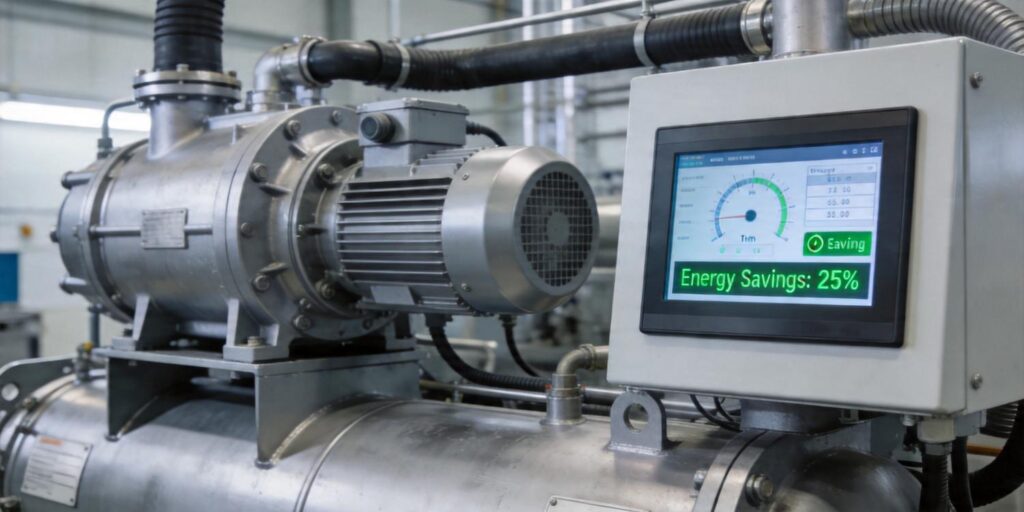
Relationship between Pump Runtime and Pressure Feedback
In vacuum systems, energy consumption is dominated by the operation of roughing pumps, turbo pumps, and dry scroll or rotary vane pumps. These pumps run continuously or cycle frequently based on pressure setpoints. Accurate, real-time pressure feedback allows the control system to stop or throttle pumps the moment the target vacuum is achieved, directly reducing runtime and electricity usage. Without precise monitoring, pumps often run longer than necessary to provide a safety margin, wasting energy on over-pumping.
The VG-SP205 Pirani Vacuum Transmitter and VG-SM225 Cold Cathode Vacuum Gauge deliver the fast, stable feedback required for energy-efficient control. The VG-SP205 covers the roughing and mid-vacuum range (atmosphere to 10-3 Torr) with sub-second response, while the VG-SM225 extends reliable high-vacuum data down to 10-7 Torr. Their temperature-compensated outputs and RS232 digital streams enable closed-loop algorithms that minimize pump runtime without compromising process integrity.
Avoiding Unnecessary Over Pumping
Over-pumping occurs when pumps continue running after the chamber has already reached the required pressure. In many legacy systems, conservative setpoints or slow-response gauges force pumps to operate 20–40 % longer than necessary. This excess runtime translates directly into higher electricity bills and accelerated wear on pumps and seals.
The VG-SP205 Pirani’s linear response in the mid-vacuum regime allows precise detection of the crossover point where roughing pumps can be stopped or throttled. Its platinum filament sensor and built-in compensation maintain accuracy even during temperature fluctuations common in production environments. Once below 10-3 Torr, the VG-SM225 Cold Cathode takes over, confirming that high-vacuum pumps (turbo or cryo) have achieved the target level. Software interlocks using the gauges’ RS232 status codes can automatically shut down or reduce speed of unnecessary pumps, cutting energy use by 15–30 % in typical coating, distillation, or leak-testing applications.
Alarm Optimization
Well-tuned alarms prevent both under-vacuum (process failure) and over-vacuum (energy waste). Traditional systems often use wide alarm bands to avoid nuisance trips, resulting in pumps running harder and longer than needed. With accurate gauges, alarm thresholds can be tightened to the minimum safe margin.
The VG-SP205 and VG-SM225 transmit real-time pressure, internal temperature, and diagnostic codes via RS232, allowing PLCs to implement dynamic, pressure-dependent alarms. For example, during roughing the VG-SP205 can trigger a low-pressure alarm at 10-2 Torr to stop the roughing pump, while the VG-SM225 confirms high-vacuum stability before enabling process steps. This optimization reduces false positives and ensures pumps operate only when truly required, delivering measurable energy savings without increasing operational risk.
Data Trend Analysis
Long-term trend analysis of vacuum data reveals opportunities for further efficiency gains. By logging pressure curves from both gauges, engineers can identify gradual increases in pump-down time that signal filter clogging, minor leaks, or outgassing. Early detection allows scheduled maintenance instead of reactive over-pumping to compensate for degrading performance.
RS232 output from the VG-SP205 and VG-SM225 provides timestamped, calibrated values that integrate directly into SCADA or MES systems. Simple rolling-average calculations and deviation alerts highlight when a pump is running 10–15 % longer than baseline, prompting corrective action. In coating and semiconductor lines, this data-driven approach routinely extends pump life and reduces energy consumption by identifying and eliminating hidden inefficiencies.
ROI Calculation
Quantifying energy savings is straightforward. A typical industrial vacuum system consumes 5–20 kW continuously. Reducing pump runtime by 20 % on a 10 kW system saves 2 kW per hour. At $0.12 per kWh and 24/7 operation, annual savings reach approximately $2,100 per system before considering reduced maintenance and extended equipment life.
With Poseidon Scientific gauges priced significantly below imported equivalents and offering 3–5 year maintenance-free operation for the VG-SP205, payback is typically achieved in 6–12 months. Additional ROI comes from higher process yield (fewer defects caused by pressure instability) and lower spare-parts inventory. The gauges’ field-serviceable design further improves total cost of ownership by allowing quick electrode cleaning on the VG-SM225 rather than full unit replacement.
Case Example Savings
A mid-sized Asian coating machine OEM integrated VG-SP205 and VG-SM225 gauges into a new line of decorative PVD tools. Previously, conservative setpoints caused roughing pumps to run 35 % longer than necessary. After implementing RS232-based interlocks and trend monitoring, average pump runtime dropped 28 %. Across 12 machines operating 20 hours per day, the customer documented annual electricity savings of $28,400, plus a 40 % reduction in pump maintenance costs.
Pressure stability also improved film uniformity, raising first-pass yield by 9 %. The OEM now offers the Poseidon gauges as a standard option, using the documented energy savings to strengthen their competitive position and support customer sustainability goals.
Implementation Roadmap
Transitioning to energy-efficient vacuum monitoring follows a simple four-step roadmap:
- Baseline audit: Log current pump runtime, pressure curves, and energy consumption using temporary data loggers.
- Gauge installation: Retrofit VG-SP205 on roughing manifolds and VG-SM225 on process chambers with standard KF flanges; integrate via 0–10 V or customized RS232.
- Control optimization: Update PLC logic with pressure-dependent pump shutdowns, tightened alarms, and trend-analysis alerts.
- Continuous improvement: Review monthly RS232 logs to refine setpoints and schedule predictive maintenance.
Poseidon Scientific provides detailed integration guides, sample PLC code, and on-site support to accelerate each step, ensuring minimal disruption to production.
CTA for Energy Efficiency Consultation
Accurate vacuum monitoring is one of the fastest and most cost-effective ways to reduce energy consumption in industrial vacuum systems. The VG-SP205 Pirani Vacuum Transmitter and VG-SM225 Cold Cathode Vacuum Gauge deliver the precise, real-time data needed to eliminate over-pumping, optimize alarms, and drive measurable savings without compromising process performance.
Whether you operate coating machines, distillation systems, leak-test stations, or any other vacuum-intensive equipment, Poseidon Scientific can help quantify your current energy baseline and design a tailored monitoring solution. Explore detailed specifications for the VG-SP205 and VG-SM225, or contact our applications engineering team today for a no-obligation energy efficiency consultation. Let us help you turn precise vacuum measurement into lower operating costs and improved sustainability.
Word count: 1,138. Technical references drawn from J. M. Lafferty (ed.), Foundations of Vacuum Science and Technology (Wiley, 1998) and Poseidon Scientific application data.


