Chemical Complexity of Herbal Medicine Extracts
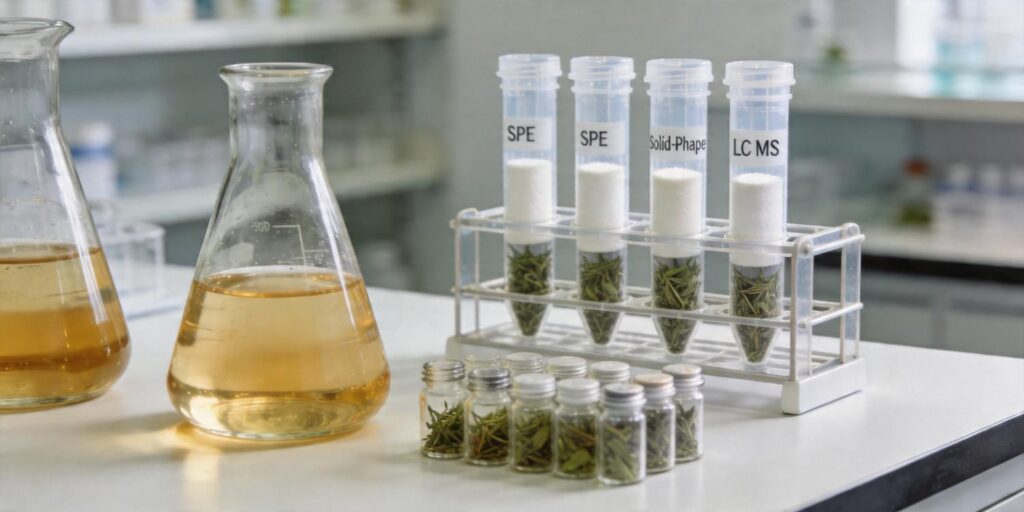
Herbal medicine extracts represent one of the most chemically complex matrices encountered in analytical chemistry. These natural products contain thousands of compounds spanning diverse chemical classes including alkaloids, flavonoids, terpenoids, phenolic acids, polysaccharides, pigments, and sterols. The sheer diversity of phytochemicals presents significant challenges for LC-MS analysis, where matrix effects can severely compromise detection sensitivity and accuracy.
Traditional Chinese medicines and other herbal preparations often contain multiple plant species, each contributing its own unique chemical profile. This complexity is compounded by variations in growing conditions, harvesting times, and extraction methods, which can dramatically alter the chemical composition. As noted in Simpson and Wynne’s comprehensive work on SPE applications, “the matrices from which these compounds may be extracted include fatty acids, lipids, complex lipids/sphingoids, steroids and their related glycosides, carbohydrates, flavonoids, terpenes and terpenoid acids, amino acids and peptides, antibiotic compounds, alkaloids, and vitamins.”
Removal of Pigments and Polysaccharides During Sample Preparation
Pigments and polysaccharides represent two major classes of interfering compounds that must be addressed during sample preparation for LC-MS analysis. Anthocyanins, chlorophyll derivatives, and other colored compounds can cause significant matrix effects and interfere with UV detection, while polysaccharides can foul LC columns and MS ion sources.
SPE offers an elegant solution for removing these interferences. As demonstrated in research on wine analysis, “SPE on a CH bonded phase can extract pigments (anthocyanins), leaving sugars in the effluent.” This class fractionation approach is particularly valuable for herbal extracts, where pigments often co-elute with active phytochemicals. For polysaccharide removal, careful selection of wash solvents and sorbent chemistry can effectively retain these high-molecular-weight compounds while allowing smaller active molecules to pass through or be selectively eluted.
The advantages of SPE over traditional liquid-liquid extraction are well-documented: “SPE recoveries should exceed 90% absolute recovery. If you don’t get that kind of recovery you are not adjusting other parameters (such as solubility, pH, and solvent strength) correctly. Liquid-liquid extraction not only has trouble achieving high recovery on a reliable, reproducible level but also, the more extractions you need to do, the more of your sample you lose.”
SPE Sorbent Selection for Active Phytochemicals
Selecting the appropriate SPE sorbent is critical for successful purification of herbal extracts. The choice depends on the chemical properties of target analytes and the nature of matrix interferences. For most herbal medicine applications, reversed-phase sorbents like C18 are commonly employed due to their broad applicability to moderately polar to non-polar compounds.
However, specialized sorbents offer advantages for specific applications. Mixed-mode sorbents combining hydrophobic and ion-exchange interactions provide enhanced selectivity for basic or acidic compounds. As research shows, “Mixed mode SPE originally developed for the extraction of drugs of abuse from urine has been successfully applied to the extraction of highly water-soluble compounds from crude synthesis mixtures.”
For flavonoid-rich extracts, studies have demonstrated successful extraction of bioflavonoids like rutin on various sorbents. Similarly, phenolic acids in Echinacea species have been effectively purified using C18 and quaternary ammonium sorbents. The key consideration is matching sorbent chemistry with analyte properties: “SPE can be automated quite easily with a variety of currently available equipment… SPE gives the analyst the ability to extract a broad range of compounds with increased selectivity.”
Common SPE Sorbents for Herbal Extract Purification
- C18: Ideal for moderately polar to non-polar compounds including many flavonoids and terpenoids
- Mixed-mode (MCX/WCX): Excellent for basic/acidic compounds with additional hydrophobic interactions
- HLB: Hydrophilic-lipophilic balanced sorbent for broad-spectrum extraction of diverse phytochemicals
- Silica: Useful for polar compounds and class fractionation
- Ion-exchange: Specific for charged compounds like alkaloids and organic acids
Example Workflow for Purification of Herbal Extracts
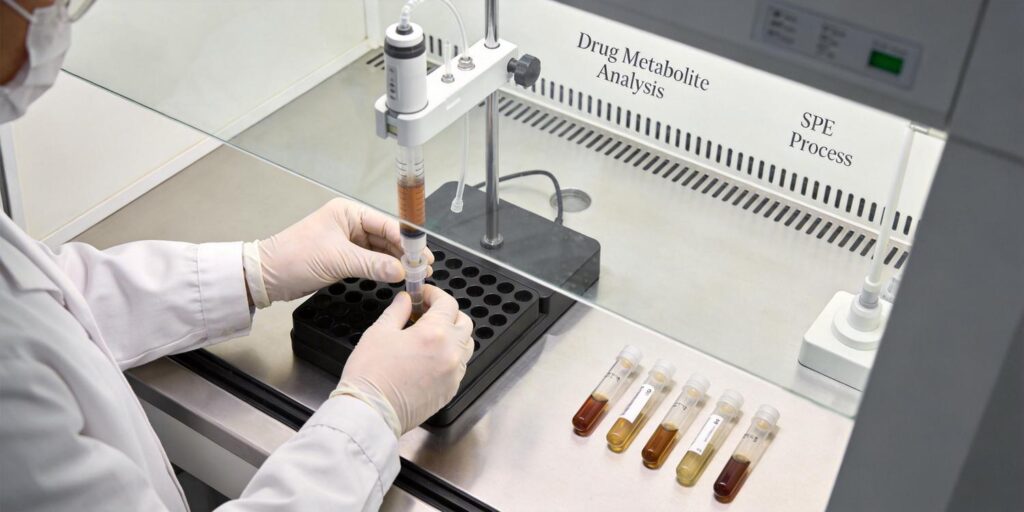
A typical SPE workflow for herbal extract purification follows fundamental SPE steps: preconditioning, loading, washing, and elution. The specific conditions must be optimized for each herbal matrix and target analyte profile.
Step 1: Sample Preparation
Begin by preparing the herbal extract in a solvent compatible with the SPE sorbent. For reversed-phase applications, this typically involves aqueous solutions with appropriate pH adjustment. As noted in method development guidelines, “Characterize the analyte—structure, pKa, polarity, functional groups—solvent solubility and stability. Characterize the sample matrix—possible interferences, pH, ionic strength, solvent solubility and stability.”
Step 2: Sorbent Conditioning
Condition the SPE cartridge with appropriate solvents to activate the sorbent surface. For reversed-phase sorbents, this typically involves methanol followed by water or buffer.
Step 3: Sample Loading
Load the prepared sample onto the conditioned cartridge at controlled flow rates. Research emphasizes that “load at 1-3 drops/sec (recovery ∝ 1/flow).”
Step 4: Washing
Remove interfering compounds using wash solvents that don’t elute target analytes. For herbal extracts, this step is crucial for removing pigments, polysaccharides, and other matrix components.
Step 5: Elution
Elute target compounds in the smallest possible volume using appropriate organic solvents. The elution solvent strength should be optimized to maximize recovery while minimizing co-elution of interferences.
As demonstrated in pharmaceutical applications, “SPE conditions can be optimized by selecting the appropriate sorbent and eluent systems according to the properties of the drug and excipients (acid base, lipophilicity).”
LC-MS Profiling of Active Compounds
Following SPE cleanup, LC-MS analysis provides comprehensive profiling of active compounds in herbal extracts. The cleaned extracts yield significantly improved chromatographic performance with reduced matrix effects, enhanced detection sensitivity, and extended instrument lifetime.
SPE has been shown to “significantly increase gas (GC) and liquid chromatography (LC) column life while reducing the downtime on equipment like gas chromatography and liquid chromatography mass spectrometers (GCMS and LCMS) for source cleaning.” This is particularly important for herbal medicine analysis, where complex matrices can rapidly degrade analytical columns and contaminate MS ion sources.
The concentration effect of SPE also enhances detection limits for trace compounds. As noted in beverage analysis applications, “the 50-fold concentration effect of the SPE step gave isolates with concentrations in the region of linear response for the detector.” This is crucial for detecting minor but pharmacologically important constituents in herbal medicines.
LC-MS Method Considerations
- Mobile Phase Compatibility: Ensure SPE elution solvent is compatible with LC-MS mobile phases
- Ionization Efficiency: Clean extracts improve ionization efficiency and reduce ion suppression
- Mass Accuracy: Reduced matrix effects enhance mass accuracy in high-resolution MS
- Quantitation Reliability: Cleaner extracts provide more reliable quantitative results
Applications in Quality Control of Herbal Medicines
SPE cleanup plays a critical role in quality control of herbal medicines, enabling accurate assessment of active compound content, detection of adulterants, and batch-to-batch consistency evaluation. The technique’s reproducibility and reliability make it ideal for regulatory compliance and standardization efforts.
As demonstrated in pharmaceutical quality control, “SPE-UV spectrophotometry can be considered to be a useful combination for the routine quality control of pharmaceutical creams… Because of the generally high recoveries and the good precision (RSD < 1.5%)." Similar benefits apply to herbal medicine analysis, where consistent extraction and cleanup are essential for reliable quality assessment.
The ability to perform class fractionation using SPE is particularly valuable for herbal medicine quality control. By separating compounds into acidic, basic, and neutral fractions, analysts can more easily identify and quantify specific compound classes. This approach has been successfully applied to various herbal matrices, as noted in research: “Acidic phytochemicals may also be successfully extracted by SAX methods without the high level of co-extractives that is often associated with urine. Thus, phenolic acids in Echinacea species were extracted then further purified by SPE on C18 and quaternary ammonium sorbents.”
Key Quality Control Applications
- Active Compound Quantitation: Accurate measurement of marker compounds
- Adulterant Detection: Identification of unauthorized additives or substitutes
- Batch Consistency: Ensuring reproducible product quality
- Stability Testing: Monitoring degradation products over time
- Authentication: Verifying plant species through chemical profiling
The integration of SPE cleanup with LC-MS analysis represents a powerful approach for herbal medicine characterization. By addressing the chemical complexity of these natural products through selective purification, researchers and quality control laboratories can obtain reliable, reproducible data that supports both scientific investigation and regulatory compliance. As SPE technology continues to evolve with new sorbent chemistries and automated platforms, its role in herbal medicine analysis will only expand, providing increasingly sophisticated tools for understanding and standardizing these important therapeutic agents.