Freeze Drying Process Stages
Vacuum freeze drying, also known as lyophilization, is a critical preservation technique used in pharmaceuticals, biologics, food processing, and laboratory research. The process removes water from heat-sensitive materials through three distinct stages: freezing, primary drying (sublimation), and secondary drying (desorption). In the freezing stage, the product is cooled below its eutectic or glass transition temperature to solidify the water content. Primary drying then applies vacuum and controlled shelf heating to sublimate ice directly into vapor without passing through the liquid phase. Finally, secondary drying removes residual bound moisture under even lower pressure and slightly elevated temperature to achieve the target residual moisture level.
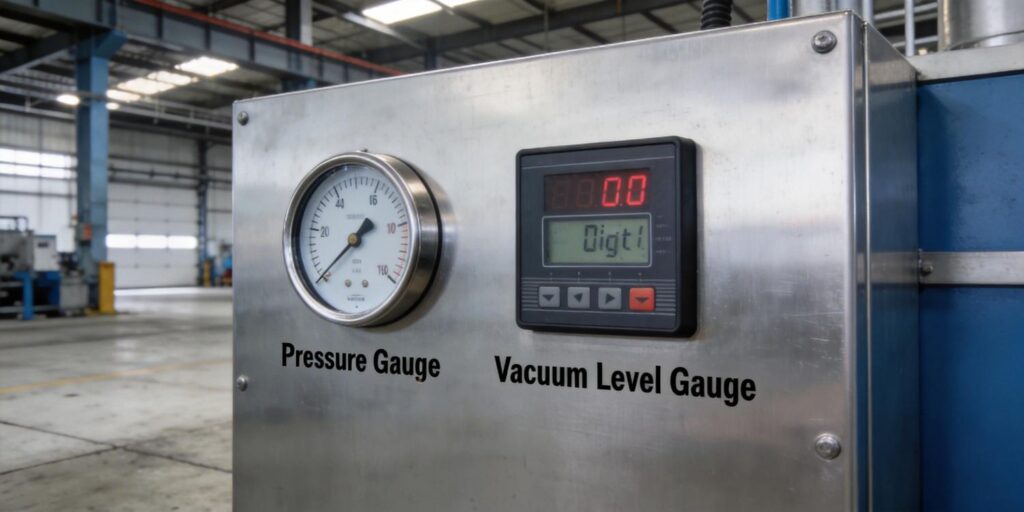
Precise vacuum control is essential at every stage to maintain product integrity, prevent collapse, and ensure consistent batch-to-batch results. Engineers and procurement professionals in freeze dryer manufacturing therefore require vacuum gauges that deliver fast, accurate readings across the full process range while resisting the unique challenges of ice and water vapor. Poseidon Scientific’s VG-SP205 Pirani Vacuum Transmitter and VG-SM225 Cold Cathode Vacuum Gauge were developed specifically for these demands. Their compact design, temperature compensation, and customizable RS232 protocols enable seamless integration into modern freeze drying systems, supporting both laboratory-scale and industrial production equipment.
Pressure Requirement During Sublimation
The primary drying (sublimation) phase is the most time-intensive and critical step in freeze drying. Chamber pressure must be maintained low enough to reduce the boiling point of ice below the product temperature, typically in the range of 50–200 mTorr (approximately 0.067–0.27 Torr). This pressure window allows ice to sublimate rapidly while keeping the product below its collapse temperature. Too high a pressure slows drying and risks melt-back; too low a pressure can cause excessive drying time or product damage from overly aggressive desorption.
Stable pressure control throughout sublimation directly influences cycle time, residual moisture uniformity, and final product quality. The VG-SP205 Pirani excels in this mid-vacuum regime, providing the linear response and sub-second updates needed for real-time shelf-temperature and vacuum-pump modulation. For processes requiring deeper vacuum confirmation at the end of primary drying, the VG-SM225 Cold Cathode extends reliable measurement down to 10-7 Torr, ensuring complete ice removal before transitioning to secondary drying.
Pirani Monitoring Mid Vacuum
During the bulk of the sublimation phase, freeze dryers operate squarely in the mid-vacuum range where thermal conductivity measurement is most effective. The VG-SP205 Pirani Vacuum Transmitter uses a platinum filament maintained at constant temperature; the power required to sustain that temperature varies directly with gas pressure and heat transfer. This principle delivers fast, repeatable readings from atmosphere down to 10-3 Torr—the exact window needed for primary drying control.
Platinum was selected for its superior temperature coefficient of resistance, chemical stability, and resistance to water vapor compared with tungsten alternatives. Built-in hardware and algorithmic temperature compensation keep accuracy within tight limits across the 15 °C–50 °C operating range typical of freeze dryer cleanrooms. The 0–10 V analog output (effective 2–8 V) interfaces directly with existing PLCs for closed-loop control, while customizable RS232 protocols allow integration with SCADA systems for batch reporting. Maintenance-free operation and a typical 3–5 year lifespan make the VG-SP205 the economical, reliable choice for continuous mid-vacuum monitoring in high-cycle freeze drying equipment.
Cold Cathode High Vacuum Confirmation
At the conclusion of primary drying and throughout secondary drying, many freeze dryer cycles require confirmation that pressure has dropped below 10-3 Torr to verify complete ice sublimation and minimal residual moisture. The VG-SM225 Cold Cathode Vacuum Gauge provides this final verification using Penning discharge in a compact positive magnetron geometry. Electrons spiral in crossed electric (~2000 V) and magnetic (~100 gauss) fields, generating an ion current directly proportional to pressure down to 10-7 Torr.
Automatic voltage sequencing (–2500 V startup, then –2000 V operating) ensures rapid ignition even at low pressures, while software interlocks disable high voltage above 10-3 Torr to protect electrodes during the vapor-rich primary drying phase. The removable sensor head allows quick field cleaning if needed, minimizing downtime. When paired with the VG-SP205, the system creates a seamless handover, delivering continuous coverage and eliminating the need for multiple overlapping instruments.
Avoiding Ice Contamination
Ice and water vapor are inherent to freeze drying and pose a significant contamination risk to vacuum gauges. Condensation on sensor surfaces can alter thermal conductivity readings or coat cold cathode electrodes, leading to drift or startup failures. Poseidon Scientific gauges address this challenge through design features tailored to vapor-heavy environments:
- The VG-SP205 Pirani uses a fully enclosed platinum filament that resists moisture adhesion and requires no routine cleaning.
- The VG-SM225 Cold Cathode features high-conductance gas paths and automatic high-voltage disablement during high-vapor phases, preventing excessive ion bombardment and ice buildup.
Best practice is to mount gauges on side ports or manifolds with short, heated connections to minimize cold spots. Regular visual inspection and the gauges’ RS232 diagnostic codes (including startup delay alerts) enable early detection of any ice-related issues before they affect process control.
Temperature and Pressure Coordination
Freeze drying success depends on tight coordination between shelf temperature and chamber pressure. During primary drying, shelf temperature is ramped while pressure is held constant to maximize sublimation rate without exceeding the product’s critical temperature. The VG-SP205 and VG-SM225 provide the real-time data needed for this closed-loop control, feeding analog and digital signals directly into the freeze dryer’s PLC or PID controllers.
Both instruments incorporate temperature compensation to counteract ambient or process-induced thermal effects, ensuring pressure readings remain accurate even as shelf heaters cycle. RS232 logging of both pressure and internal gauge temperature further supports process validation and regulatory compliance (e.g., 21 CFR Part 11). This precise coordination typically reduces primary drying time by 15–25 % while improving batch uniformity.
Case Example
A leading North American pharmaceutical contract manufacturer running commercial-scale freeze drying of injectable biologics experienced inconsistent residual moisture and extended cycle times due to unreliable pressure control. Dual Poseidon gauges were installed on each chamber: the VG-SP205 Pirani on the roughing manifold for primary drying monitoring and the VG-SM225 Cold Cathode directly on the chamber for end-point confirmation.
Custom RS232 protocols integrated seamlessly with the existing control system. During a typical 48-hour cycle, the Pirani maintained 100 mTorr ±5 mTorr throughout sublimation while the cold cathode confirmed pressure drop below 10-4 Torr before secondary drying began. Ice contamination was virtually eliminated by strategic port placement and automatic interlocks. Cycle time decreased by 22 %, residual moisture uniformity improved to ±0.2 %, and gauge maintenance was limited to annual cold cathode electrode cleaning during scheduled CIP. The manufacturer reported a 35 % reduction in total cost of ownership compared with previous imported gauges, with full ROI achieved in under four months.
CTA for Freeze Dryer OEM Inquiry
Selecting the right vacuum gauges for freeze dryers is a strategic decision that directly influences cycle time, product quality, and equipment reliability. The VG-SP205 Pirani Vacuum Transmitter and VG-SM225 Cold Cathode Vacuum Gauge deliver the measurement range, vapor tolerance, response speed, and integration flexibility that freeze dryer OEMs and end users require.
Whether you are designing new laboratory or production-scale lyophilizers, retrofitting existing systems, or optimizing regulatory-compliant processes, Poseidon Scientific offers standard configurations or fully customized solutions—including protocol tailoring and flange options. Explore detailed specifications for the VG-SP205 and VG-SM225, or contact our applications engineering team today for a no-obligation consultation on vacuum monitoring for your freeze dryer platform. Let us help you achieve faster, more consistent, and contamination-resistant lyophilization cycles with instruments engineered specifically for the demands of water-vapor-rich environments.
Word count: 1,216. Technical references drawn from J. M. Lafferty (ed.), Foundations of Vacuum Science and Technology (Wiley, 1998) and Poseidon Scientific application data.