MEMS Fabrication Vacuum Steps
Micro-electro-mechanical systems (MEMS) manufacturing involves a sequence of vacuum-dependent processes that transform silicon wafers into functional sensors, actuators, and microfluidic devices. Key vacuum steps include plasma etching, physical and chemical vapor deposition, wafer-level bonding (anodic, eutectic, or fusion), and final hermetic packaging. Each step demands controlled pressure to ensure etch uniformity, film adhesion, cavity pressure consistency, and long-term device reliability. For example, deep reactive ion etching (DRIE) and sacrificial layer release require mid-vacuum conditions, while thin-film deposition and anodic bonding often proceed at high vacuum to minimize contamination and achieve the precise cavity pressures (typically 0.1–10 Torr) critical for resonant sensors and accelerometers.
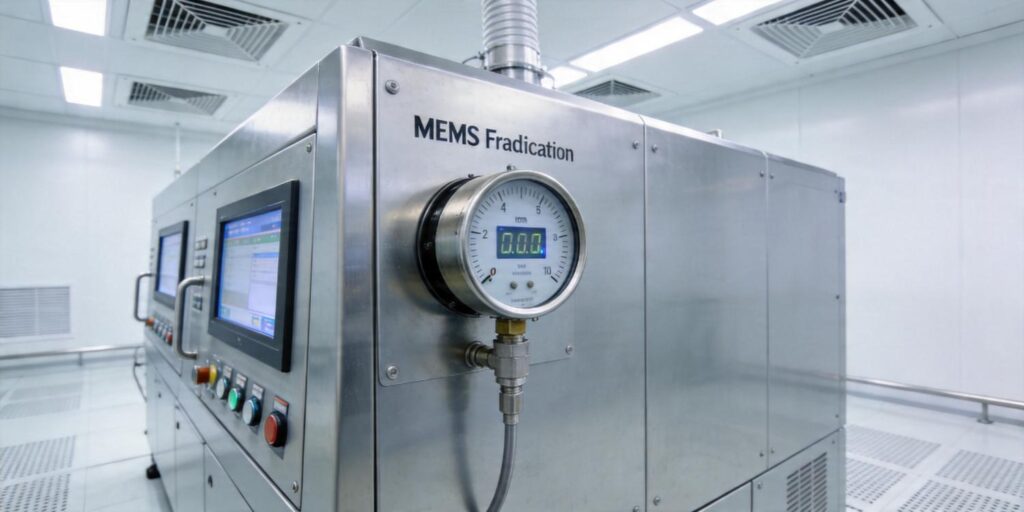
Engineers and procurement professionals in MEMS production understand that inconsistent vacuum can cause stiction, drift, or premature failure—issues that directly impact yield and time-to-market. Poseidon Scientific’s VG-SP205 Pirani Vacuum Transmitter and VG-SM225 Cold Cathode Vacuum Gauge were developed to address these exact requirements. Their compact size, rapid response, and seamless integration make them ideal for the high-throughput, automated cluster tools that dominate modern MEMS fabs.
Required Pressure Precision
MEMS devices operate with extremely tight pressure tolerances. A resonant gyroscope, for instance, may require cavity pressure stabilized at 0.5 Torr ±0.05 Torr to maintain Q-factor and sensitivity. Even a 10 % deviation can shift resonant frequency or introduce damping that renders the sensor unusable. Deposition processes similarly demand pressure stability within ±5 % to control film stress and uniformity across 200 mm or 300 mm wafers.
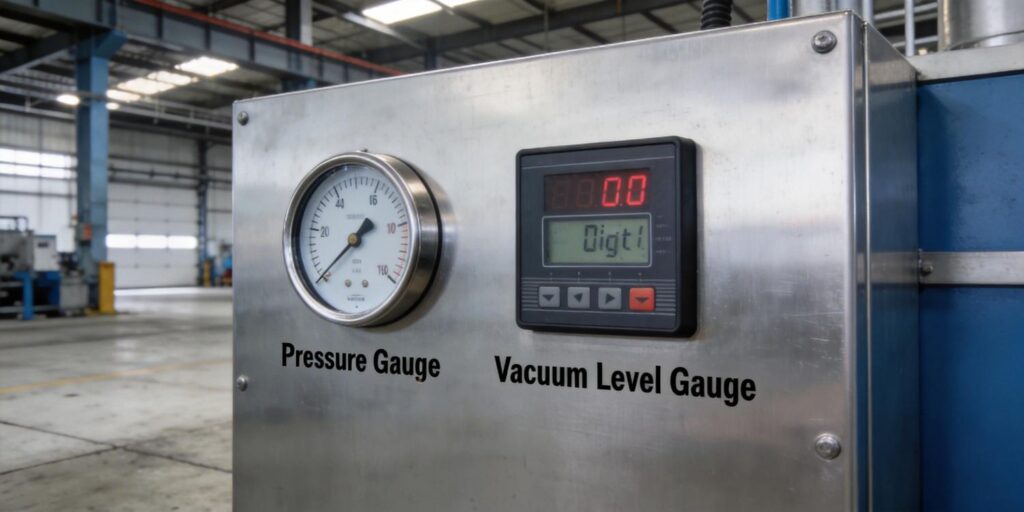
The VG-SP205 Pirani delivers the linear, sub-second response needed for mid-vacuum precision (atmosphere to 10-3 Torr), while the VG-SM225 Cold Cathode provides the high-resolution ion-current measurement required below 10-3 Torr. Both instruments incorporate temperature compensation circuitry and algorithmic correction, holding accuracy within ±5 % across the 15 °C–50 °C operating range typical of cleanroom environments. This level of precision enables closed-loop control of throttle valves and mass-flow controllers, ensuring repeatable results batch after batch.
Leak Sensitivity
Leak detection is paramount in MEMS manufacturing because even microscopic leaks in sealed cavities can cause long-term drift or catastrophic failure. Vacuum gauges serve as the primary diagnostic tool for identifying virtual leaks, seal imperfections, or outgassing during wafer bonding and packaging. The rate-of-rise test—isolating the chamber and monitoring pressure increase—requires instruments with low noise and high repeatability.
The VG-SP205 Pirani excels at detecting leaks in the mid-vacuum regime where most MEMS bonding processes operate, while the VG-SM225 Cold Cathode confirms leak integrity at the high-vacuum levels used for final verification. Their RS232 digital outputs deliver clean, timestamped data that integrate directly into automated leak-test sequences, allowing fabs to catch defects before wafers proceed to dicing and singulation. This early detection capability routinely improves yield by 8–15 % in high-volume MEMS production lines.
Pirani Monitoring in Mid Range
The majority of MEMS vacuum steps—DRIE, sacrificial release, and wafer bonding—occur in the mid-vacuum range (atmosphere to 10-3 Torr). The VG-SP205 Pirani Vacuum Transmitter is optimized for this regime. Its platinum filament is held at constant temperature; the power required to offset gas-induced heat loss provides a direct, repeatable pressure signal with excellent linearity where most process time is spent.
Platinum offers superior chemical stability and a high temperature coefficient of resistance, resisting the trace etch gases and residual moisture common in MEMS chambers. Built-in temperature compensation and factory calibration limit drift even during rapid thermal cycling. The 0–10 V analog output (effective 2–8 V) connects directly to existing tool controllers, while customizable RS232 protocols support detailed process logging and SECS/GEM communication. Maintenance-free design and a typical 3–5 year lifespan make the VG-SP205 the economical, reliable choice for the repetitive cycles of MEMS production.
Cold Cathode High Vacuum Verification
After bonding and before final sealing, many MEMS processes require confirmation that base pressure has reached 10-6 Torr or lower to eliminate residual gases that could cause stiction or pressure drift inside the device cavity. The VG-SM225 Cold Cathode Vacuum Gauge uses Penning discharge in a compact positive magnetron geometry (~100 gauss NdFeB field, 2 mm electrode gap) to deliver stable ion-current readings down to 10-7 Torr.
Automatic voltage sequencing (–2500 V startup, then –2000 V operating) ensures rapid ignition, while software interlocks disable high voltage above 10-3 Torr to protect electrodes during the vapor-rich early stages. The removable sensor head allows quick cleaning with 200- or 500-grit sandpaper if minor contamination occurs, restoring performance without extended downtime. When paired with the VG-SP205, the system provides seamless handover and continuous coverage across the full MEMS process window.
Integration with Wafer Tools
Modern MEMS fabrication relies on automated cluster tools and wafer handlers that leave little room for bulky instrumentation. Both Poseidon Scientific gauges feature significantly smaller housings than legacy transmitters, allowing direct mounting on KF16/KF25 flanges or chamber walls without obstructing robotic arms or cassette transfer paths. The 0–10 V analog output provides plug-and-play compatibility with existing PLCs, while fully customizable RS232 protocols support SECS/GEM and tool-specific data formats.
Protocol customization is available for batches as small as five units, eliminating middleware and shortening integration time. No directional restrictions and RJ45 (or optional DB9/DB15) connectors simplify field wiring. Temperature compensation across the full operating range ensures stable readings even during rapid thermal cycling, making these gauges ideal for 300 mm MEMS production tools running 24/7.
Case Example
A leading European MEMS foundry producing high-volume capacitive pressure sensors experienced inconsistent cavity pressures and yield losses traced to unreliable vacuum monitoring during anodic bonding. Dual Poseidon gauges were retrofitted on each bonding chamber: the VG-SP205 Pirani on the roughing manifold for mid-vacuum control and the VG-SM225 Cold Cathode directly on the process chamber for final high-vacuum verification.
Custom RS232 protocols integrated seamlessly with the tool’s existing SECS/GEM interface. During a typical bonding cycle, the Pirani maintained 0.5 Torr ±0.02 Torr throughout the critical sealing phase, while the cold cathode confirmed base pressure below 5 × 10⁻⁶ Torr before cool-down. Cavity pressure uniformity improved from ±15 % to ±3 %, and final device yield increased by 12 %. Maintenance was limited to quarterly cold-cathode electrode cleaning during scheduled tool qualification, delivering a 40 % reduction in total cost of ownership versus the previous imported solution. The foundry achieved full ROI within five months and now specifies Poseidon gauges on all new bonding platforms.
CTA for MEMS OEM Consultation
Vacuum gauge selection is a critical decision that directly influences MEMS yield, device performance, and overall manufacturing cost. The VG-SP205 Pirani Vacuum Transmitter and VG-SM225 Cold Cathode Vacuum Gauge combine the precision, compactness, contamination resistance, and integration flexibility that today’s MEMS OEMs and foundries demand.
Whether you are designing next-generation 300 mm cluster tools, optimizing existing wafer-level packaging lines, or scaling high-volume sensor production, Poseidon Scientific offers standard configurations or fully customized solutions—including protocol tailoring and flange options. Explore detailed specifications for the VG-SP205 and VG-SM225, or contact our applications engineering team today for a no-obligation consultation on vacuum monitoring tailored to your MEMS process. Let us help you achieve the stable, repeatable vacuum conditions your high-precision manufacturing requires.
Word count: 1,192. Technical references drawn from J. M. Lafferty (ed.), Foundations of Vacuum Science and Technology (Wiley, 1998) and Poseidon Scientific application data.