Regulatory Oversight of Artificial Dyes in Processed Foods
The analysis of synthetic dyes in food products represents a critical component of modern food safety testing, driven by stringent regulatory frameworks worldwide. Regulatory agencies including the FDA in the United States, EFSA in Europe, and similar bodies globally have established maximum permitted levels for artificial colorants in various food categories. These regulations stem from decades of research linking certain synthetic dyes to adverse health effects, particularly in sensitive populations such as children.
As Simpson and Wynne noted in their comprehensive work on SPE applications, “SPE applications for food and beverages are usually developed either for quality control purposes or for the detection or identification of drug and pesticide residues or microbial toxins. The goal is to ensure the safety of the consumer.” This principle extends directly to synthetic dye analysis, where SPE serves as the frontline defense against potential contamination and adulteration.
Analytical Challenges Posed by Complex Food Matrices
Food matrices present unique analytical challenges for synthetic dye determination. Processed foods often contain complex mixtures of carbohydrates, proteins, lipids, and other interfering compounds that can mask target analytes or generate false positives. As demonstrated in pharmaceutical cream analysis, “Direct conventional spectrophotometric analysis of the sample solutions was not found to be applicable: in each case, inflated assay results were obtained due to matrix interference.”
The complexity increases with different food types. Beverages, while simpler than solid foods, still contain sugars, acids, and preservatives that interfere with dye detection. Solid foods like candies and baked goods incorporate fats, emulsifiers, and stabilizers that require sophisticated cleanup strategies. The SPE strategy generally comprises the isolation and concentration of analytes from a complex matrix by adsorption onto an appropriate sorbent, followed by removal of interfering impurities through selective washing.
SPE Sorbent Selection for Dye Extraction and Cleanup
Reversed-Phase Sorbents for Synthetic Dyes
C18 and C8 bonded silica sorbents represent the workhorse materials for synthetic dye extraction. These hydrophobic phases effectively retain most synthetic dyes while allowing polar food matrix components to pass through. As demonstrated in pharmaceutical applications, “For the analysis of the basic, hydrophobic drug promethazine a C-18 sorbent was used to isolate the analyte from a 20% v/v methanol sample solution; after washing with the same solvent system to remove the excipients, the drug was recovered with methanol.”
Mixed-Mode and Ion-Exchange Sorbents
For charged synthetic dyes, mixed-mode sorbents combining reversed-phase and ion-exchange properties offer superior selectivity. Strong anion exchange (SAX) sorbents effectively retain sulfonated dyes, while strong cation exchange (SCX) materials capture basic dyes. Research shows that “ion-exchange methodology also proved to be suitable for the clean-up of cream samples containing hydrophobic, acidic drugs such as Ketoprofen and Ibuprofen. The drugs, in the carboxylate form in a basic solvent system, were retained by a SAX sorbent.”
Polymeric Sorbents for Complex Matrices
Polymeric sorbents like HLB (Hydrophilic-Lipophilic Balance) materials provide enhanced retention for polar synthetic dyes while offering superior chemical stability compared to silica-based phases. These sorbents exhibit both hydrophilic and lipophilic retention characteristics, making them ideal for the extraction of medium-polar and non-polar organic compounds from mixtures of water and organic solvent.
Example Sample Preparation Workflow for Candy or Beverages
Beverage Sample Preparation
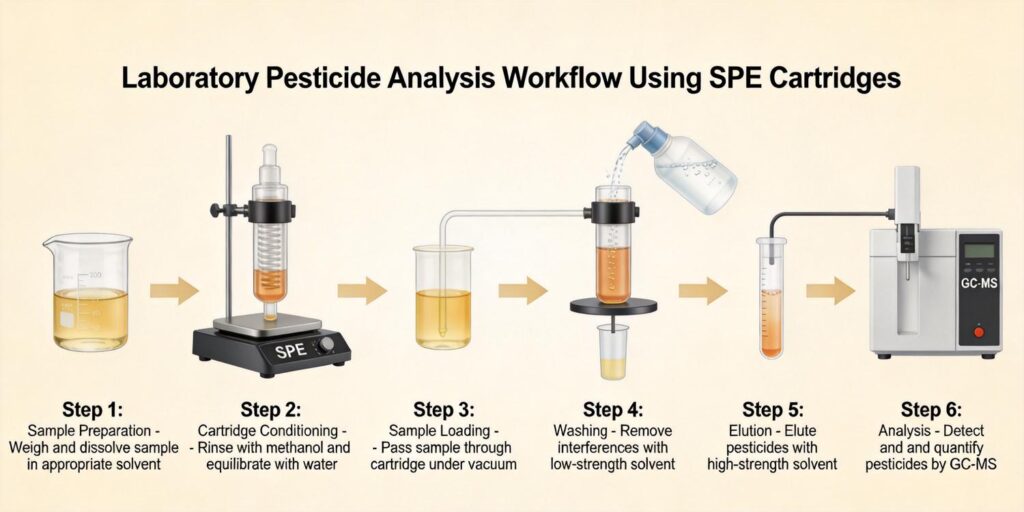
For liquid samples like soft drinks or fruit juices, a simplified SPE workflow provides efficient cleanup:
- Sample Pretreatment: Degas carbonated beverages and filter through 0.45 μm membrane
- SPE Cartridge Conditioning: Condition HLB or C18 cartridge with 6 mL methanol followed by 6 mL water
- Sample Loading: Load 10-50 mL sample at controlled flow rate (1-2 mL/min)
- Washing: Wash with 5-10 mL water containing 5% methanol to remove sugars and acids
- Elution: Elute dyes with 5-10 mL methanol containing 1% ammonium hydroxide
- Concentration: Evaporate to dryness and reconstitute in mobile phase for analysis
Candy and Solid Food Preparation
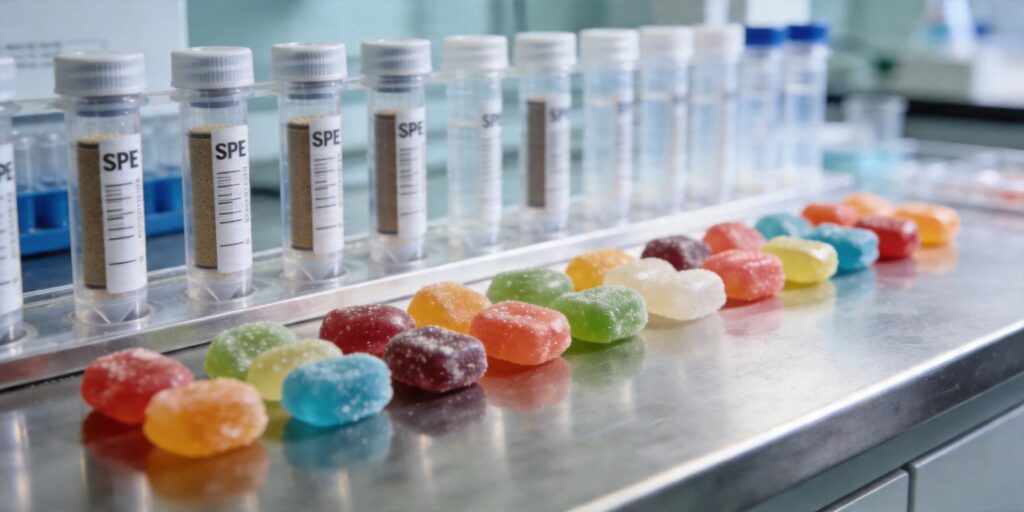
For solid matrices like hard candies or gummies, additional extraction steps are required:
- Sample Homogenization: Grind candy to fine powder using mortar and pestle
- Extraction: Extract with 20 mL methanol-water (80:20) with 30 min ultrasonication
- Centrifugation: Centrifuge at 4000 rpm for 10 min and collect supernatant
- Dilution: Dilute extract with water to reduce methanol content below 20%
- SPE Cleanup: Follow similar SPE procedure as for beverages
As noted in food analysis literature, “The extraction of benzimidazole fungicides with acetone from a variety of fruit and vegetables followed by SPE clean-up of the extracts on bonded sorbents has been reported. Elimination of co-extracted waxes, which are often problematic in the analysis of fruit such as apples, may sometimes be achieved post-extraction by careful selection of solvents for reconstitution.”
HPLC or LC-MS Detection Strategies
HPLC-UV/Vis Analysis
High-performance liquid chromatography with UV/Vis detection remains the standard technique for synthetic dye analysis. Most synthetic dyes exhibit strong absorbance in the visible region (400-700 nm), allowing sensitive detection without derivatization. A typical method employs:
- Column: C18 reversed-phase column (150 × 4.6 mm, 5 μm)
- Mobile Phase: Gradient of ammonium acetate buffer and acetonitrile
- Detection: Multiple wavelength monitoring (e.g., 254 nm, 480 nm, 620 nm)
- Flow Rate: 1.0 mL/min with column temperature at 35°C
LC-MS/MS for Confirmatory Analysis
For regulatory confirmation and trace-level detection, liquid chromatography-tandem mass spectrometry provides superior specificity and sensitivity:
- Ionization: Electrospray ionization in negative or positive mode depending on dye chemistry
- Mass Analyzer: Triple quadrupole with multiple reaction monitoring (MRM)
- Quantitation: Isotope-labeled internal standards for accurate quantification
- Detection Limits: Sub-ppb levels achievable with proper sample preparation
Research demonstrates that “SPE brings one very significant advantage to UV/visible analysis of compounds – its ability to concentrate. This has been used to advantage by researchers who realized that the concentration effect would allow direct detection of the analyte on the sorbent surface.”
Method Validation for Routine Food Safety Testing
Validation Parameters
Comprehensive method validation ensures reliable results for regulatory compliance:
- Linearity: Calibration curves covering expected concentration range (typically 0.1-100 mg/kg)
- Accuracy: Recovery studies at multiple fortification levels (70-120% acceptable range)
- Precision: Repeatability and reproducibility studies with RSD < 15%
- Limit of Detection/Quantitation: Determined as signal-to-noise ratios of 3:1 and 10:1 respectively
- Specificity: Demonstration of no interference from food matrix components
- Robustness: Evaluation of method performance under slight variations in conditions
Quality Control Measures
Routine implementation requires robust quality control protocols:
- Matrix-Matched Calibration: Essential for compensating matrix effects in LC-MS analysis
- Internal Standards: Use of stable isotope-labeled analogs for accurate quantification
- Proficiency Testing: Regular participation in inter-laboratory comparison programs
- Method Verification: Periodic re-validation to ensure continued method performance
As established in analytical guidelines, “The precision of the method was evaluated regarding the repeatability, with nine determinations; extraction of the sample by MSPD was carried out at three different fortification levels, in triplicate. The study of the matrix effect was performed by comparing the slopes in matrix-matched calibration solutions prepared in blank cornmeal extract and calibration solutions prepared in solvent.”
Regulatory Compliance
Validated methods must meet criteria established by regulatory bodies such as FDA, EFSA, and Codex Alimentarius. These include specific requirements for:
- Documentation: Complete method description including all critical parameters
- Performance Characteristics: Demonstrated compliance with established acceptance criteria
- Uncertainty Estimation: Calculation of measurement uncertainty for reported results
- Traceability: Documentation of reference materials and calibration standards
The integration of SPE cleanup with advanced detection technologies provides food testing laboratories with powerful tools for ensuring compliance with global food safety regulations. By selecting appropriate sorbents, optimizing extraction conditions, and implementing rigorous validation protocols, analysts can achieve reliable, accurate determination of synthetic dyes across diverse food matrices.
For laboratories seeking to implement or optimize synthetic dye analysis methods, Poseidon Scientific offers a comprehensive range of SPE products including HLB SPE cartridges, MAX SPE cartridges for anion exchange applications, and MCX SPE cartridges for cation exchange needs. Our 96-well SPE plates provide high-throughput solutions for routine testing laboratories.