Pharmaceutical Residues as Emerging Environmental Contaminants
The detection of pharmaceutical residues in treated wastewater has emerged as a critical environmental monitoring challenge over the past two decades. These compounds, including antibiotics, analgesics, antidepressants, and hormones, enter wastewater systems through human excretion, improper disposal, and manufacturing processes. Unlike traditional pollutants, pharmaceuticals are designed to be biologically active at low concentrations, making their environmental persistence particularly concerning.
Research indicates that conventional wastewater treatment plants (WWTPs) are not specifically designed to remove these micro-pollutants, leading to their discharge into receiving waters at concentrations ranging from ng/L to μg/L. The environmental impact of these residues includes antibiotic resistance development, endocrine disruption in aquatic organisms, and potential human health risks through drinking water contamination. As regulatory frameworks evolve to address these concerns, robust analytical methods for monitoring pharmaceutical residues have become essential for environmental scientists and regulatory agencies.
Impact of Wastewater Treatment Processes on Pharmaceutical Removal
Understanding the fate of pharmaceuticals during wastewater treatment is fundamental to developing effective monitoring strategies. Conventional activated sludge processes typically achieve variable removal efficiencies depending on the compound’s physicochemical properties. Hydrophobic compounds with high log Kow values tend to adsorb to sludge, while hydrophilic compounds remain in the aqueous phase.
Advanced treatment technologies, including ozonation, activated carbon filtration, and membrane bioreactors, show improved removal efficiencies but require careful optimization. The transformation products formed during treatment can sometimes be more persistent or toxic than the parent compounds, necessitating comprehensive analytical approaches that capture both parent pharmaceuticals and their metabolites.
Sample Collection and Filtration Protocols
Grab vs. Composite Sampling
For pharmaceutical monitoring in wastewater, 24-hour composite samples collected using automated refrigerated samplers provide the most representative data, capturing diurnal variations in pharmaceutical loads. Grab samples may be appropriate for specific research questions but generally underestimate average concentrations.
Filtration Considerations
Immediate filtration through 0.45-μm glass fiber or cellulose acetate membranes is crucial to separate dissolved pharmaceuticals from particulate matter. For samples containing high levels of suspended solids, pre-filtration through 1-μm filters may be necessary to prevent SPE cartridge clogging. Research by Wells et al. (1994) demonstrated that proper filtration protocols significantly improve SPE recovery rates for pesticides in environmental waters, with similar principles applying to pharmaceutical analysis.
Preservation and Storage
Sample preservation typically involves acidification to pH 2-3 with hydrochloric or sulfuric acid to inhibit microbial degradation. Refrigeration at 4°C is essential, with analysis ideally completed within 48 hours. For longer storage, freezing at -20°C is recommended, though freeze-thaw cycles should be minimized to prevent analyte degradation.
SPE Enrichment Techniques for ng/L Detection Levels
SPE Sorbent Selection
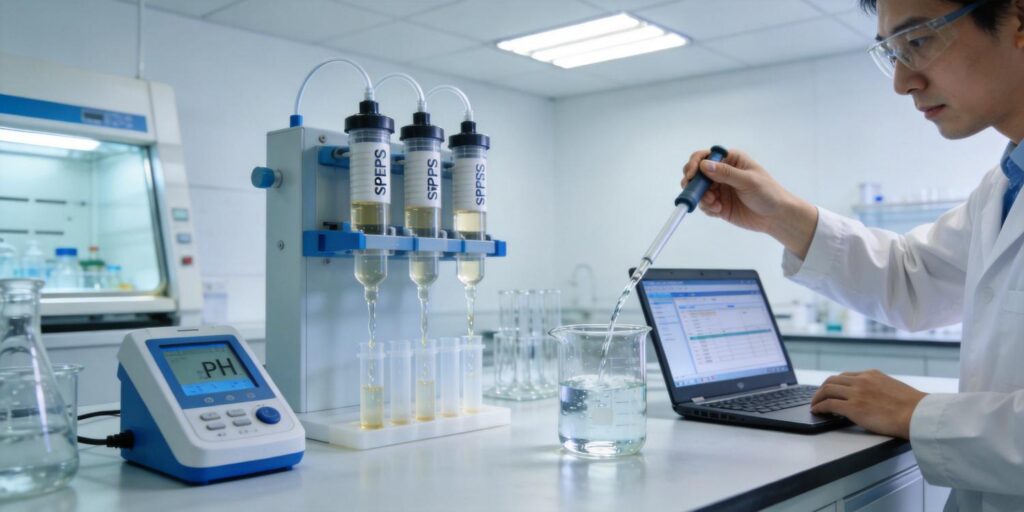
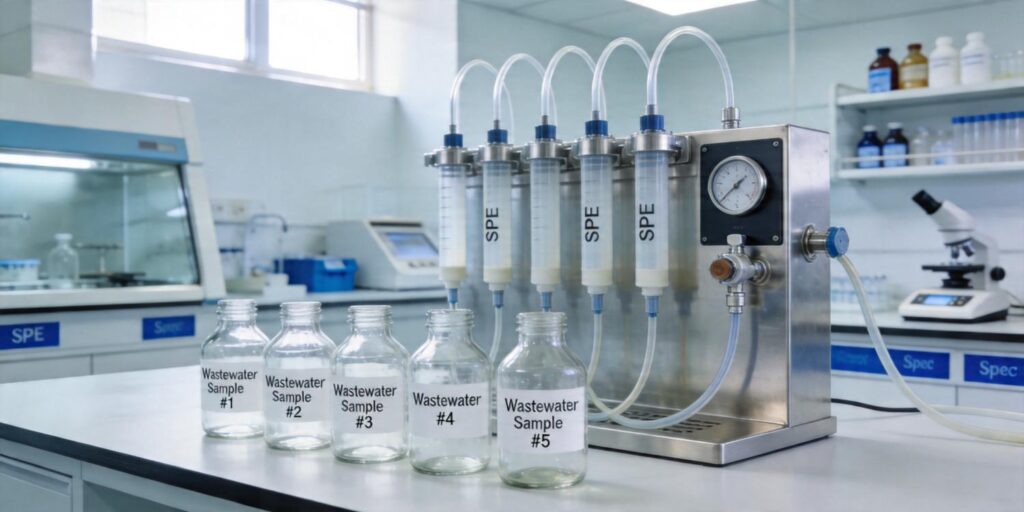
Solid-phase extraction remains the gold standard for concentrating pharmaceutical residues from large-volume wastewater samples (typically 100-1000 mL). The choice of SPE sorbent depends on the target analytes’ physicochemical properties:
- HLB (Hydrophilic-Lipophilic Balanced): Ideal for broad-spectrum extraction of pharmaceuticals with diverse polarities, including acidic, basic, and neutral compounds. The N-vinylpyrrolidone-divinylbenzene copolymer provides both hydrophilic and lipophilic interactions.
- MCX (Mixed-mode Cation Exchange): Specifically designed for basic pharmaceuticals (pKa > 7) such as antidepressants and beta-blockers. The sulfonic acid groups provide strong cation exchange interactions at low pH.
- MAX (Mixed-mode Anion Exchange): Optimal for acidic pharmaceuticals (pKa < 7) including non-steroidal anti-inflammatory drugs and some antibiotics. The quaternary amine groups facilitate anion exchange interactions.
- WAX (Weak Anion Exchange): Suitable for very polar acidic compounds, utilizing primary/secondary amine functionalities for weaker anion exchange interactions.
- WCX (Weak Cation Exchange): Designed for polar basic compounds, employing carboxylic acid groups for weak cation exchange interactions.
Optimized SPE Protocol
The fundamental SPE workflow for pharmaceutical analysis involves five critical steps:
- Conditioning: 5-10 mL methanol followed by 5-10 mL acidified water (pH 2-3)
- Loading: Sample application at controlled flow rates (3-10 mL/min) to ensure optimal analyte retention
- Washing: 5-10 mL acidified water or water-methanol mixtures (5-10% methanol) to remove interferences
- Drying: Vacuum or nitrogen drying for 5-30 minutes to remove residual water
- Elution: 5-10 mL of appropriate solvent (typically methanol, acetonitrile, or mixtures with acid/base modifiers)
As noted by Hennion (1999), on-line SPE-LC systems offer advantages for high-throughput monitoring, but off-line SPE provides greater flexibility for method development and sample storage.
Enrichment Factors and Detection Limits
By processing 500-1000 mL samples and eluting in 1-2 mL, enrichment factors of 250-1000× can be achieved, enabling detection at ng/L levels. Method detection limits (MDLs) typically range from 0.1-10 ng/L for most pharmaceuticals using LC-MS/MS, well below environmental effect concentrations.
LC-MS/MS Quantification of Common Pharmaceuticals
Chromatographic Separation
Reversed-phase chromatography using C18 or C8 columns (50-150 mm × 2.1 mm, 1.7-3.5 μm particle size) provides optimal separation for most pharmaceutical classes. Mobile phases typically consist of water and acetonitrile or methanol, with 0.1% formic acid or ammonium acetate buffers to enhance ionization. Gradient elution programs (5-95% organic over 10-20 minutes) effectively separate complex mixtures of pharmaceuticals with varying polarities.
Mass Spectrometric Detection
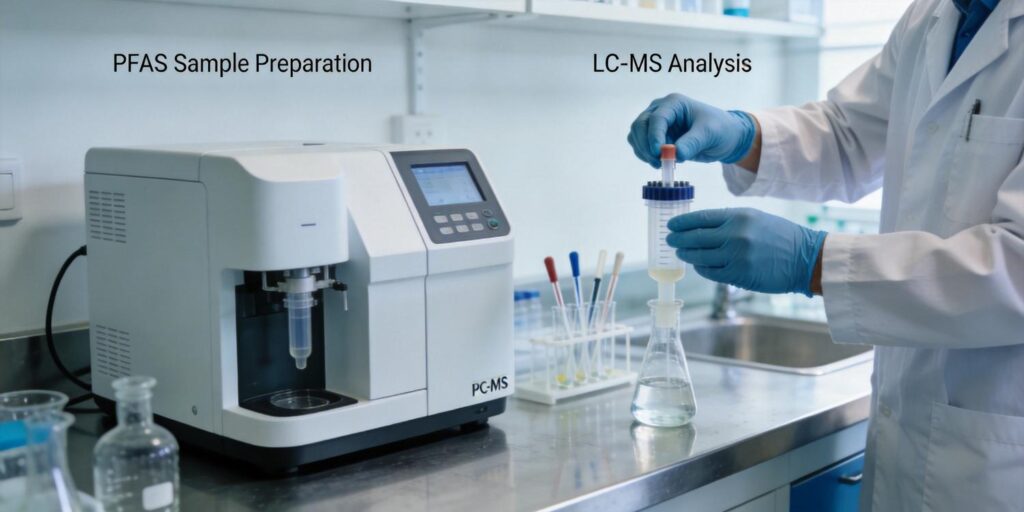
Triple quadrupole mass spectrometers operating in multiple reaction monitoring (MRM) mode offer the sensitivity and selectivity required for trace-level pharmaceutical analysis. Electrospray ionization (ESI) in both positive and negative modes covers the majority of pharmaceutical compounds. Key parameters include:
- Ion source temperature: 300-500°C
- Collision energies: Compound-specific optimization (typically 10-40 eV)
- Dwell times: 20-100 ms per transition
- Resolution: Unit resolution for both Q1 and Q3
Quality Assurance/Quality Control
Comprehensive QA/QC protocols include:
- Method blanks (ultrapure water processed identically to samples)
- Matrix spikes (known concentrations added to sample matrix)
- Surrogate standards (deuterated or 13C-labeled analogs of target analytes)
- Internal standards (added post-extraction to correct for instrument variability)
- Continuing calibration verification (CCV) every 10-20 samples
Recovery rates for most pharmaceuticals should fall within 70-120%, with relative standard deviations <20% for replicate analyses.
Interpretation of Monitoring Data in Environmental Studies
Data Normalization and Reporting
Pharmaceutical concentrations in wastewater effluents should be reported in ng/L, with accompanying information on sampling methodology, detection limits, and quality control measures. Normalization to population equivalents or flow rates facilitates comparison between different treatment plants and temporal trends.
Risk Assessment Frameworks
Environmental risk assessment typically involves comparing measured environmental concentrations (MECs) with predicted no-effect concentrations (PNECs). Risk quotients (RQs = MEC/PNEC) >1 indicate potential ecological risk. For human health risk assessment, the acceptable daily intake (ADI) approach considers exposure through drinking water and food chain accumulation.
Trend Analysis and Source Apportionment
Multivariate statistical techniques, including principal component analysis and cluster analysis, help identify patterns in pharmaceutical occurrence and potential sources. Seasonal variations, demographic factors, and prescribing patterns can all influence pharmaceutical loads in wastewater.
Regulatory Implications
Monitoring data inform regulatory decisions regarding:
- Efficient limit values for specific pharmaceuticals
- Prioritization of compounds for further study
- Design requirements for advanced treatment technologies
- Source control measures (e.g., take-back programs, green pharmacy initiatives)
As Simpson (2000) noted in his concluding thoughts on SPE, the technique’s future lies in its continued adaptation to emerging analytical challenges. For pharmaceutical monitoring in wastewater, SPE provides the necessary sensitivity and selectivity to address one of today’s most pressing environmental concerns. The integration of automated SPE systems with advanced analytical instrumentation represents the current state-of-the-art, enabling comprehensive monitoring programs that protect both environmental and human health.
For laboratories implementing these workflows, Poseidon Scientific offers a comprehensive range of SPE products specifically designed for environmental pharmaceutical analysis, including HLB cartridges for broad-spectrum extraction, MCX cartridges for basic pharmaceuticals, and 96-well SPE plates for high-throughput applications.