Chemical Characteristics of Acidic Herbicides
Acidic herbicides such as 2,4-D (2,4-dichlorophenoxyacetic acid) and dicamba (3,6-dichloro-2-methoxybenzoic acid) represent a critical class of agricultural chemicals characterized by their carboxylic acid functional groups. These compounds typically exhibit pKa values below 5, making them strong acids that exist predominantly in their anionic forms at environmental pH levels. The presence of aromatic rings and halogen substituents contributes to their environmental persistence while the carboxylic acid groups ensure water solubility and mobility in soil matrices.
Research by Ngan and Ikesaki (1991) demonstrated that these acidic herbicides require specialized extraction approaches due to their ionic nature and tendency to form complexes with soil organic matter. The structural characteristics of these compounds make them ideal candidates for weak anion exchange (WAX) solid-phase extraction, as their anionic forms can interact effectively with positively charged functional groups on WAX sorbents.
Soil Extraction Methods Prior to SPE Cleanup
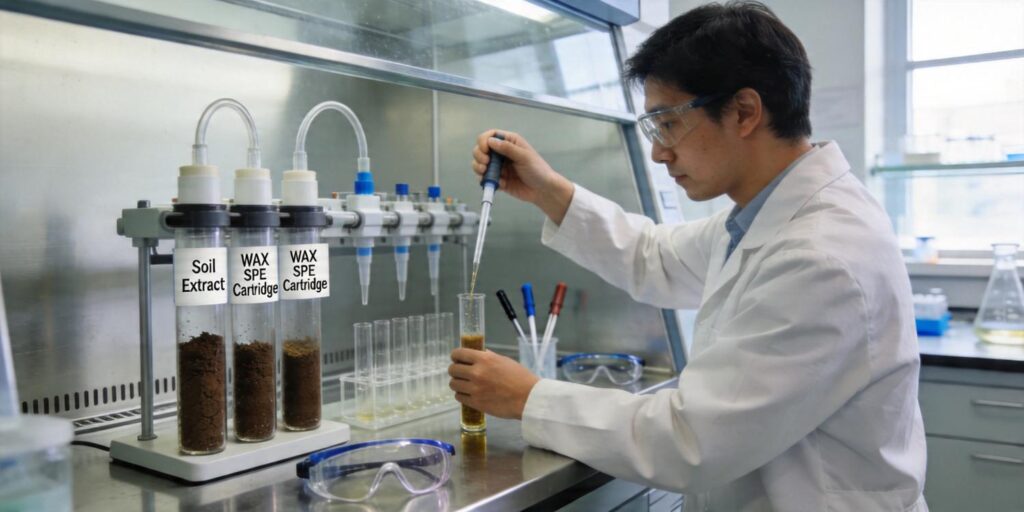
Effective soil extraction represents the critical first step in acidic herbicide analysis. Traditional methods include solvent extraction using acetone, dichloromethane, or aqueous acetone mixtures, often followed by partitioning steps to separate analytes from soil matrices. The Luke procedure, as described in Simpson and Wynne’s comprehensive work, involves blending soil samples with acetone and partitioning between dichloromethane and aqueous acetone phases.
More recent approaches have evolved toward more efficient extraction techniques. Redondo et al. (1993) demonstrated the use of solid-phase extraction disks for pesticide determination in soil samples, while modern methods often incorporate accelerated solvent extraction (ASE) or microwave-assisted extraction (MAE) for improved recovery and reduced solvent consumption. The extracted soil solutions typically contain significant amounts of dissolved organic matter (DOM), humic substances, and other matrix components that can interfere with subsequent analysis, necessitating effective cleanup procedures.
Weak Anion Exchange Mechanism of WAX Sorbents
Weak anion exchange (WAX) sorbents operate through a mixed-mode retention mechanism combining both ion-exchange and reversed-phase interactions. As documented in Waters’ technical literature, Oasis WAX sorbent was specifically developed to provide superior sample preparation for strong acidic compounds. The sorbent features a tightly controlled ion-exchange capacity of 0.6 meq/g, ensuring reproducible SPE protocols for acidic compound extraction.
The retention mechanism involves positively charged functional groups (typically primary or secondary amines) that interact with anionic analytes through ionic attraction. This mixed-mode approach provides enhanced selectivity compared to traditional reversed-phase sorbents, particularly for strongly acidic compounds with pKa values below 1.0. The water-wettable polymeric structure of modern WAX sorbents maintains stability across the entire pH range (0-14), facilitating method development and ensuring consistent performance.
Conditioning Steps for Optimal Ionic Interaction
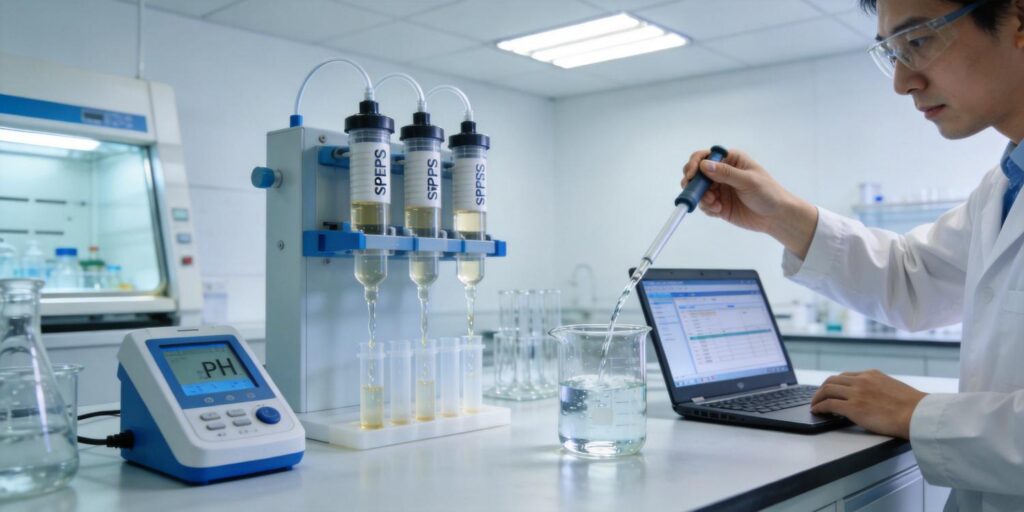
Proper conditioning of WAX SPE cartridges is essential for establishing optimal ionic interactions between the sorbent and acidic herbicides. The conditioning protocol typically involves sequential washing with methanol followed by water or buffer solution. For WAX sorbents, conditioning with a basic solution (such as 5% ammonium hydroxide) helps ensure the ion-exchange sites are in their free-base form, ready to interact with anionic analytes.
Waters’ documentation recommends specific conditioning protocols for WAX cartridges, including methanol activation followed by aqueous buffer conditioning. The conditioning step serves multiple purposes: it removes any residual manufacturing impurities, activates the sorbent surface, establishes the appropriate ionic environment for analyte retention, and ensures consistent flow characteristics throughout the extraction process.
Sample Loading with pH-Controlled Extracts
Sample loading represents the most critical phase of WAX SPE for acidic herbicide extraction. Soil extracts must be adjusted to an appropriate pH (typically above the pKa of the target herbicides) to ensure the analytes exist predominantly in their anionic forms. For most acidic herbicides, this means adjusting to pH 7-9 using ammonium hydroxide or other suitable bases.
The loading process should maintain a controlled flow rate (1-5 mL/min) to ensure sufficient contact time between analytes and sorbent. Research by Wells and Michael (1987b) demonstrated that recovery of 2,4-D from aqueous samples by reversed-phase solid-phase extraction could be optimized through careful pH control during loading. For soil extracts containing significant DOM, the loading pH becomes even more critical, as humic substances can compete with target analytes for binding sites on the WAX sorbent.
Washing Steps Removing Neutral Soil Components
Washing protocols for WAX SPE cartridges must effectively remove neutral and weakly acidic soil components while retaining target acidic herbicides. Typical washing solutions include water or aqueous buffers containing 2-5% methanol or acetonitrile. Waters’ documentation suggests washing protocols involving 2% formic acid followed by 100% methanol for certain applications.
The washing step serves to remove matrix interferences such as neutral organic compounds, humic acids, and other soil components that may have been co-extracted. For soil samples, additional washing with organic solvents may be necessary to remove lipid components and other non-polar interferences. The key challenge lies in selecting washing conditions that maximize interference removal while minimizing analyte loss.
Elution with Acidic Methanol Solutions
Elution of acidic herbicides from WAX sorbents requires disruption of the ionic interactions between the anionic analytes and positively charged sorbent sites. This is typically achieved using acidic methanol solutions containing 2-5% formic acid or acetic acid. The acidic conditions protonate the carboxylic acid groups of the herbicides, converting them to their neutral forms and releasing them from the ion-exchange sites.
Waters’ recommended elution protocols for WAX cartridges include elution with 5% ammonium hydroxide in methanol followed by 2% formic acid in methanol for certain applications. For acidic herbicides, elution with methanol containing 2-5% formic acid generally provides excellent recovery. The elution volume should be sufficient to completely displace all retained analytes, typically 2-5 mL depending on cartridge size and analyte loading.
GC-MS or LC-MS Analytical Validation
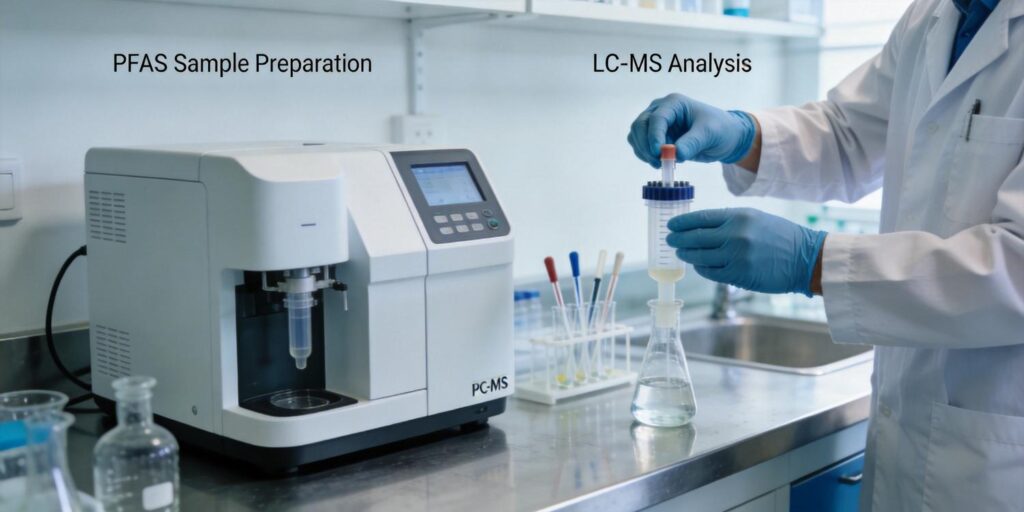
Final analytical validation of extracted acidic herbicides typically employs either gas chromatography-mass spectrometry (GC-MS) or liquid chromatography-mass spectrometry (LC-MS). GC-MS analysis often requires derivatization of the acidic herbicides to their methyl esters using diazomethane or other methylating agents, as demonstrated by Ngan and Ikesaki (1991) for nine acidic herbicides in water and soil.
LC-MS methods, particularly using electrospray ionization in negative mode, provide direct analysis of acidic herbicides without derivatization. Modern UPLC-MS/MS systems offer superior sensitivity and selectivity for trace-level herbicide analysis in complex soil matrices. Method validation should include assessment of recovery, precision, linearity, limit of detection, and limit of quantification, with particular attention to matrix effects that may influence ionization efficiency in MS detection.
The comprehensive approach outlined here—from soil extraction through WAX SPE cleanup to final MS analysis—provides laboratories with a robust methodology for monitoring acidic herbicide residues in environmental samples. This methodology aligns with regulatory requirements while offering the sensitivity and specificity needed for modern environmental monitoring programs.