Vacuum Casting Process Overview
Vacuum casting is a precision manufacturing process widely used in jewelry making, prototype development, medical device production, and high-end consumer goods. The technique involves placing a master pattern inside a silicone or resin mold, then evacuating the chamber to remove trapped air before introducing liquid resin or molten metal. By eliminating bubbles and voids, vacuum casting delivers smooth surfaces, accurate details, and structurally sound parts that would be impossible to achieve under atmospheric pressure.
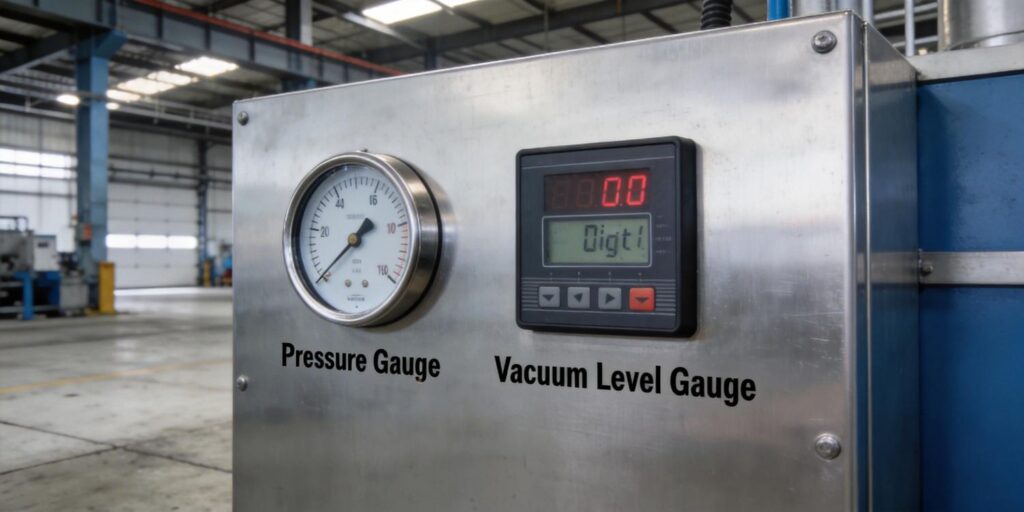
The entire cycle—from mold preparation and evacuation to material injection and curing—typically lasts 10–60 minutes per batch, making rapid, reliable vacuum control essential for throughput. Engineers and procurement professionals must select vacuum gauges that balance speed, accuracy, and durability in the presence of outgassing resins and solvents. Poseidon Scientific’s VG-SP205 Pirani Vacuum Transmitter and VG-SM225 Cold Cathode Vacuum Gauge were engineered specifically for these conditions, offering compact footprints, low cost of ownership, and customizable RS232 protocols that integrate directly with casting machine controllers.
Required Pressure Level for Bubble Elimination
Effective bubble elimination in vacuum casting requires reducing chamber pressure to a level where dissolved gases expand and escape the liquid resin or metal. Industry standards target 1–10 Torr for most resin systems, with advanced applications reaching 10-2 to 10-3 Torr to ensure complete void removal. At these pressures, the mean free path of gas molecules increases dramatically, allowing microbubbles to rise and burst before the material cures.
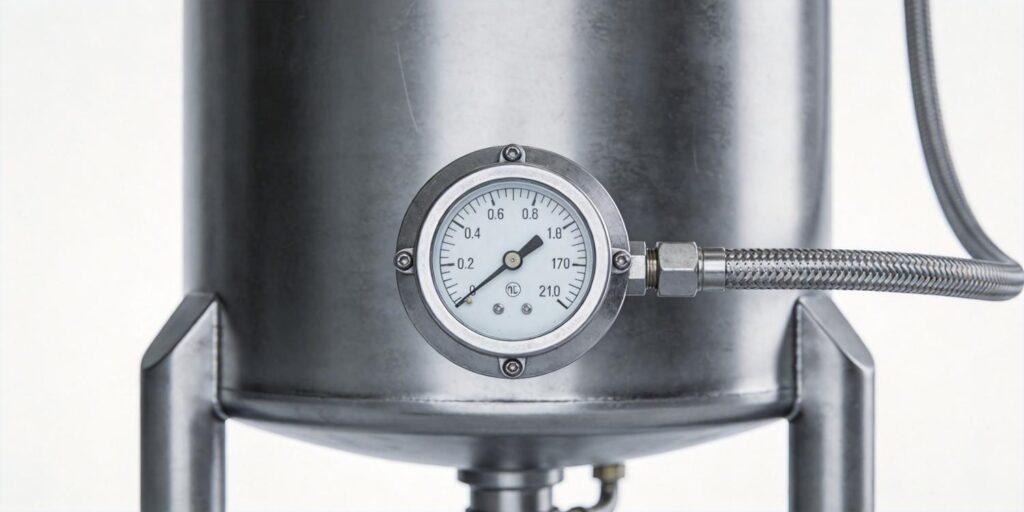
Pressure must be held stable throughout the pour and initial cure phase; even brief excursions above the target can reintroduce voids. The VG-SP205 Pirani provides precise monitoring in the critical mid-vacuum range (atmospheric to 10-3 Torr), while the VG-SM225 Cold Cathode extends reliable measurement into deeper vacuum when needed. Together they ensure the system reaches and maintains the exact pressure window required for defect-free castings.
Rapid Evacuation Needs
Casting equipment operates on tight production schedules. A typical cycle demands full pump-down from atmosphere to the target vacuum level in under 60–120 seconds to maintain high throughput. Slow evacuation not only reduces output but also risks premature resin curing or uneven material flow.
The VG-SP205 Pirani Vacuum Transmitter delivers sub-second response using its thermal conductivity principle, enabling real-time feedback to vacuum pumps and valves during the aggressive roughing phase. Once below 10-3 Torr, the VG-SM225 Cold Cathode confirms final vacuum with minimal delay thanks to its positive magnetron design and automatic voltage sequencing (–2500 V startup, then –2000 V operating). This dual-gauge strategy shortens evacuation times while protecting sensors from unnecessary exposure to high gas loads.
Pirani for Mid-Vacuum Monitoring
Most vacuum casting cycles spend the majority of evacuation time in the mid-vacuum regime (atmospheric to 10-3 Torr). The VG-SP205 Pirani is optimized for exactly this range. Its platinum filament maintains constant temperature while the instrument measures the power needed to offset gas-induced heat loss. Higher pressure means more molecular collisions and greater heat transfer; the resulting voltage change provides a direct, linear correlation to pressure in the most dynamic part of the cycle.
Platinum was selected over tungsten for its superior temperature coefficient of resistance, processability, and resistance to chemical attack from resin vapors. Built-in temperature compensation (15 °C–50 °C) and factory calibration minimize drift, while the 0–10 V analog output (effective 2–8 V) interfaces directly with PLCs for closed-loop pump control. Maintenance-free operation and a 3–5 year typical lifespan make the VG-SP205 the ideal primary gauge for the high-cycle demands of vacuum casting machines.
Avoiding Resin Vapor Contamination
Resin systems release volatile organic compounds and condensable vapors during evacuation, which can coat gauge sensors and degrade accuracy or cause premature failure. The VG-SP205 addresses this with its fully enclosed platinum filament design and robust stainless-steel housing that resists chemical attack. No routine cleaning is required; operators simply monitor status codes via RS232 for any indication of filament issues.
For the VG-SM225 Cold Cathode, software interlocks automatically disable high voltage above 10-3 Torr, preventing excessive ion bombardment and carbon buildup during the vapor-rich roughing phase. When cleaning is eventually needed, the removable sensor head allows quick electrode restoration with 200- or 500-grit sandpaper—restoring metallic luster in minutes without breaking the system vacuum. These features ensure long-term reliability even when casting aggressive polyurethane or epoxy resins.
Cold Cathode for Deep Vacuum Stages
Certain high-precision casting applications—such as optical-grade resins or thin-walled medical components—require deeper vacuum (below 10-3 Torr) to eliminate the last traces of dissolved gas. The VG-SM225 Cold Cathode Vacuum Gauge uses Penning discharge in a compact positive magnetron geometry (~100 gauss NdFeB field, 2 mm electrode gap) to deliver stable ion-current readings down to 10-7 Torr.
Electrons spiral in crossed electric and magnetic fields, producing a self-sustaining avalanche that is directly proportional to pressure. The gauge’s small volume and rapid ignition characteristics (typically 5 minutes at 10-6 Torr) make it well-suited for the final stabilization phase of vacuum casting. When paired with the VG-SP205, the system creates a seamless transition at 10-3 Torr, with automatic protection for the cold cathode during higher-pressure operation.
Installation Best Practices
Proper gauge placement and integration maximize performance and longevity in vacuum casting equipment:
- Location: Mount the VG-SP205 near the roughing port or manifold for fastest response to bulk gas removal. Position the VG-SM225 directly on the casting chamber wall to monitor true process vacuum.
- Orientation: No directional restrictions—gauges can be installed in any attitude.
- Flange selection: Use standard KF16 or KF25 flanges for quick, leak-free connection; both models are fully compatible.
- Electrical integration: Connect via RJ45 (or optional DB9/DB15) with 0–10 V analog for basic PLC control and RS232 for customizable digital protocols. Protocol customization is available for batches as small as 5–10 units.
- Environmental considerations: Keep gauges away from direct resin splash or excessive heat sources while ensuring ambient temperature stays within 15 °C–50 °C.
These practices, combined with the gauges’ compact size, allow straightforward retrofits on existing casting machines without major redesign.
CTA for Casting Equipment Support
Selecting the right vacuum gauges for vacuum casting equipment directly impacts cycle time, part quality, and total cost of ownership. The VG-SP205 Pirani Vacuum Transmitter and VG-SM225 Cold Cathode Vacuum Gauge combine the speed, vapor tolerance, and integration flexibility that casting engineers demand.
Whether you are building new resin casting stations, upgrading jewelry investment machines, or scaling medical device production, Poseidon Scientific offers standard configurations or fully customized solutions—including protocol tailoring and flange options. Explore detailed specifications for the VG-SP205 and VG-SM225, or contact our applications team today for a no-obligation consultation on optimizing your vacuum casting setup. Let us help you achieve bubble-free, high-quality castings with instruments engineered for the unique demands of resin and metal casting environments.
Word count: 1,192. Technical references drawn from J. M. Lafferty (ed.), Foundations of Vacuum Science and Technology (Wiley, 1998) and Poseidon Scientific application data.