Monitoring Veterinary Drugs in Aquaculture Products
Aquaculture has become a vital source of protein worldwide, but with intensive farming practices comes the increased use of veterinary drugs to prevent and treat diseases. Antibiotics, antiparasitics, and other pharmaceuticals are routinely administered in fish farming operations, creating potential risks for drug residues persisting in edible tissues. Regulatory agencies worldwide, including the FDA, EFSA, and Codex Alimentarius, have established maximum residue limits (MRLs) for veterinary drugs in fish and seafood products to ensure consumer safety.
The monitoring of these residues is particularly challenging due to the complex nature of fish tissue matrices and the diverse chemical properties of veterinary drugs. Traditional liquid-liquid extraction methods often struggle with the high lipid and protein content of fish samples, leading to emulsion formation and poor analyte recovery. This is where solid-phase extraction (SPE) has emerged as a critical tool for reliable residue analysis.
According to research documented in “Solid Phase Extraction: Principles, Techniques and Applications” (Simpson, 2000), SPE provides distinct advantages over traditional extraction methods for veterinary drug analysis. The technology allows for more flexible use of chromatographic instruments and offers new methods to enhance analyte recovery while reducing matrix background interference.
Matrix Challenges in Fish Tissue Extracts
Fish tissue presents one of the most challenging matrices for analytical chemists. The high lipid content (particularly in fatty fish species), complex protein structures, and varying moisture levels create significant obstacles for clean extraction. As noted in veterinary drug abuse applications, tissue samples like liver and brain are particularly difficult to work with using conventional methods because homogenized tissue samples cannot be applied directly onto SPE cartridges without causing clogging.
Research by Horie et al. (1991) demonstrated successful extraction of antibacterial drugs from fish tissue by homogenizing the tissue in a slurrying buffer of metaphosphoric acid/methanol (3:2 v/v) to deproteinize the sample. After filtration and roto-evaporation, the resulting liquid could be applied to standard SPE cartridges. This approach highlights the importance of proper sample pretreatment before SPE application.
The high protein and lipid content of fish samples often makes them prone to emulsification during liquid-liquid extraction (LLE). SPE offers a valuable alternative, as demonstrated by Ono et al. (1997) who extracted organo-tin compounds from fish following hydrolysis with ethanolic potassium hydroxide solution. The hydrolysate was extracted with petroleum ether, concentrated, and then processed through a hydrophobic divinylbenzene methacrylate copolymer SPE cartridge before GC/MS analysis.
SPE Sorbent Selection for Antibiotic Classes
Mixed-Mode Sorbents for Comprehensive Extraction
For veterinary drug screening in fish tissue, mixed-mode sorbents combining hydrophobic and ion-exchange interactions have proven particularly effective. These sorbents can simultaneously extract compounds with diverse chemical properties, which is essential when monitoring multiple drug classes. The Certify® mixed-mode cartridges (combining non-polar and strong cation exchange phases) have demonstrated excellent recovery of basic drugs including β-blockers, β-agonists, opiates, narcotic analgesics, and alkaloidal drugs from biological matrices.
Sorbent Selection by Drug Class
Basic Antibiotics: Quinolones (e.g., enrofloxacin, ciprofloxacin) and aminoglycosides require strong cation exchange (SCX) or mixed-mode sorbents. These compounds are retained through ionic interactions at appropriate pH conditions.
Acidic Antibiotics: Sulfonamides and tetracyclines work well with mixed-mode sorbents containing anion exchange properties. Research by Walker and Barker (1994) demonstrated successful extraction of sulfadimethoxine from channel catfish muscle using matrix solid-phase dispersion followed by SPE cleanup.
Neutral/Lipophilic Compounds: Macrolides and lincosamides typically require reversed-phase sorbents like C18 or HLB (hydrophilic-lipophilic balanced). These sorbents effectively retain compounds based on hydrophobic interactions while allowing removal of polar interferences.
Zwitterionic Compounds: Tetracyclines, which contain both acidic and basic functional groups, present particular challenges. Mixed-mode sorbents with both cation and anion exchange capabilities often provide the best recovery for these compounds.
Example Extraction and Cleanup Workflow
Sample Preparation
1. Homogenization: Weigh 2.0 g of fish tissue and homogenize with 10 mL of extraction solvent (typically acetonitrile/water or methanol with acidification).
2. Protein Precipitation: Add appropriate precipitating agents (e.g., trichloroacetic acid, metaphosphoric acid) to denature proteins.
3. Defatting: For fatty fish species, include a hexane wash or cold temperature precipitation step to remove lipids.
4. pH Adjustment: Adjust sample pH according to target analytes’ pKa values to ensure optimal SPE retention.
SPE Procedure
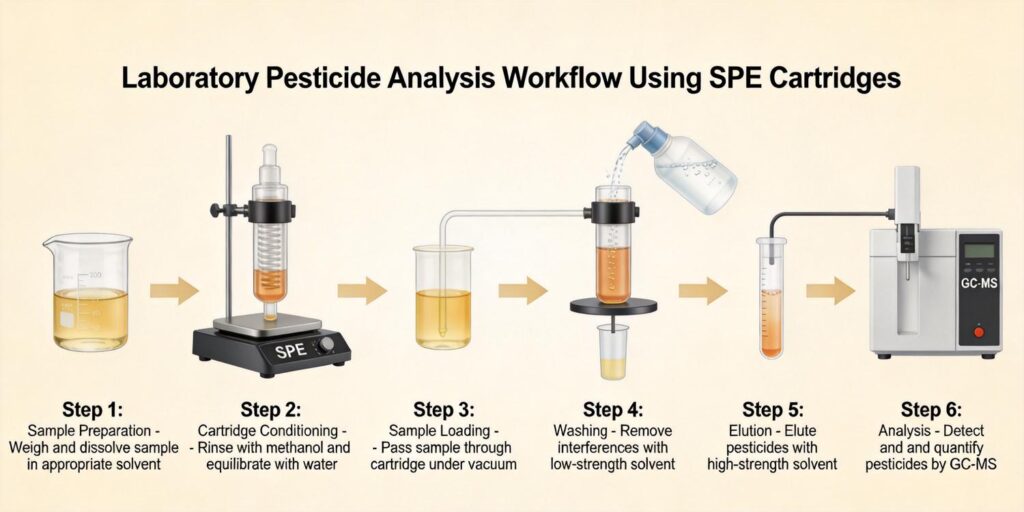
1. Cartridge Conditioning: Condition mixed-mode SPE cartridge (e.g., MCX for basic drugs, MAX for acidic drugs, or HLB for broad-spectrum extraction) with methanol followed by water or appropriate buffer.
2. Sample Loading: Apply prepared sample extract at controlled flow rate (typically 1-2 mL/min).
3. Washing: Remove interferences with appropriate wash solvents:
– Water or buffer to remove salts and polar compounds
– Methanol/water mixtures to remove moderately polar interferences
– Organic solvents (e.g., hexane, ethyl acetate) to remove non-polar lipids
4. Drying: Apply vacuum or positive pressure to remove residual water from sorbent bed.
5. Elution: Elute target analytes with appropriate solvent mixture:
– Basic drugs: methanol with 2-5% ammonia
– Acidic drugs: methanol with 2-5% formic acid
– Neutral drugs: acetonitrile or methanol
Post-SPE Treatment
1. Evaporation: Concentrate eluate under gentle nitrogen stream at appropriate temperature.
2. Reconstitution: Reconstitute in mobile phase compatible with LC-MS/MS analysis.
3. Filtration: Pass through 0.22 μm syringe filter before injection.
LC-MS/MS Detection Methods
Modern veterinary drug residue analysis in fish tissue relies heavily on liquid chromatography coupled with tandem mass spectrometry (LC-MS/MS). This technique provides the sensitivity, selectivity, and multi-residue capability required for monitoring programs. Key considerations include:
Chromatographic Conditions
Column Selection: Reversed-phase columns (C18, C8, or phenyl-hexyl) with sub-2μm or core-shell particles provide excellent separation efficiency. For polar antibiotics, hydrophilic interaction liquid chromatography (HILIC) columns may be preferable.
Mobile Phase: Typically employs water and organic modifiers (acetonitrile or methanol) with volatile additives:
– Acidic conditions: 0.1% formic acid for positive ion mode
– Basic conditions: ammonium hydroxide or ammonium acetate for negative ion mode
– Buffer systems: Ammonium formate or acetate buffers for improved reproducibility
Mass Spectrometry Parameters
Ionization: Electrospray ionization (ESI) is most common, operating in both positive and negative modes to cover diverse compound classes.
Multiple Reaction Monitoring (MRM): Two transitions per compound (quantifier and qualifier) provide both quantification and confirmation. Optimized collision energies and cone voltages are critical for sensitivity.
Dynamic MRM: For large compound panels, scheduled MRM based on retention time windows improves sensitivity and number of detectable compounds.
Validation Parameters
Method validation should include:
– Linearity over relevant concentration range
– Limit of detection (LOD) and quantification (LOQ)
– Recovery studies at multiple fortification levels
– Precision (repeatability and reproducibility)
– Matrix effects evaluation
– Specificity/selectivity confirmation
Food Safety Monitoring and Regulatory Compliance
The implementation of robust SPE-LC-MS/MS methods for veterinary drug residues in fish tissue is essential for ensuring food safety and regulatory compliance. Monitoring programs must address several critical aspects:
Multi-Residue Methods
Modern laboratories increasingly adopt multi-residue methods capable of detecting 100+ veterinary drugs in a single analysis. These methods require careful optimization of SPE conditions to ensure adequate recovery across diverse chemical classes. The trend toward broader screening panels reflects the reality of multiple drug use in aquaculture and the need for comprehensive surveillance.
Quality Control Measures
Effective monitoring programs incorporate:
– Use of isotopically labeled internal standards for each analyte class
– Regular participation in proficiency testing schemes
– Implementation of quality control samples with each batch
– Adherence to ISO 17025 accreditation requirements
– Documentation of measurement uncertainty
Emerging Challenges
The veterinary drug landscape continues to evolve with new compounds and formulations entering the market. Additionally, the issue of antimicrobial resistance (AMR) has heightened scrutiny of antibiotic use in food animals. SPE methods must be adaptable to address these emerging concerns, potentially requiring:
– Expansion to include new drug classes
– Lower detection limits for certain compounds
– Improved throughput to handle increasing sample volumes
– Compatibility with new analytical technologies
Global Harmonization
International trade in seafood products necessitates harmonization of testing methods and regulatory limits. Organizations like Codex Alimentarius work toward establishing internationally recognized standards. Laboratories must stay current with evolving regulations in key markets including the EU, United States, Japan, and China.
The combination of optimized SPE sample preparation with sensitive LC-MS/MS detection provides a powerful tool for ensuring the safety of aquaculture products. By addressing matrix challenges through appropriate sorbent selection and method development, analytical chemists can deliver reliable data to support food safety decisions and protect consumer health. As aquaculture continues to grow in importance as a protein source, these analytical methods will play an increasingly vital role in global food safety systems.