
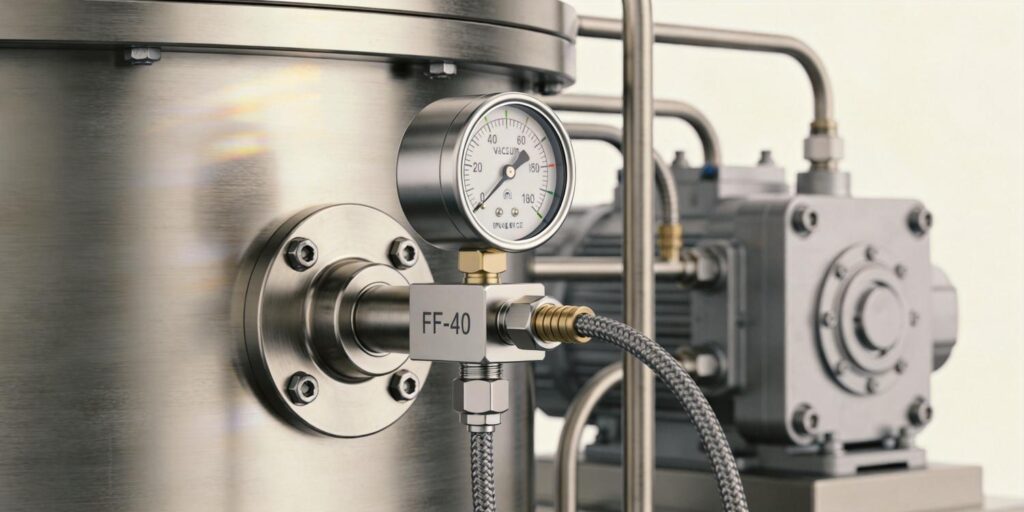
Plasma Discharge Behavior at High Pressure
Cold cathode gauges rely on the Penning (magnetron) discharge to ionize gas molecules. A high negative voltage (–2000 V operating, –2500 V for startup) combined with a ~100 gauss magnetic field traps electrons in long spiral paths, creating an avalanche of ions whose current is proportional to pressure. This mechanism works beautifully from 10⁻³ Torr down to 10⁻⁷ Torr. Above that threshold—specifically above ~1 mbar (≈0.75 Torr)—the physics changes dramatically.
At higher pressures the mean free path of electrons becomes extremely short. Instead of gaining sufficient energy between collisions to sustain ionization, electrons undergo frequent, low-energy scatters. The discharge current no longer rises monotonically with pressure; it reaches a peak and then falls. In extreme cases the plasma becomes unstable, transitioning toward a glow discharge that can draw excessive current or even arc. Ion bombardment of the cathode and anode surfaces intensifies, rapidly depositing carbon or oxide layers. The net result: the gauge may output erratic or falsely low readings, and repeated exposure without protection accelerates electrode contamination.
Poseidon Scientific’s VG-SM225 Cold Cathode Vacuum Gauge is explicitly rated for 10⁻³ to 10⁻⁷ Torr. Exposure above 1 mbar is outside specification, yet the gauge’s built-in safeguards (detailed below) ensure that such excursions cause no permanent harm when proper system design is followed.
Internal Stress Risks
Without protection, sustained operation above 1 mbar imposes several mechanical and electrical stresses. First, the high gas density multiplies ion flux to the cathode, accelerating sputtering and material removal. Second, localized heating from increased current can stress the stainless-steel electrodes and PEEK insulators. Third, in the worst case an arc can form across the ~2 mm electrode gap, potentially pitting surfaces or damaging the high-voltage feedthrough.
Field data from early prototypes and competitor units confirm that repeated unprotected exposure above 1 mbar can shift calibration by more than one decade and shorten electrode life from 3–5 years to under 12 months. The “工”字形 magnetron geometry of the VG-SM225, however, was optimized with generous gas-flow slots and robust stainless-steel construction precisely to survive brief transients—provided the high voltage is removed before stress accumulates.
Automatic Protection Logic
The VG-SM225 incorporates both hardware and firmware safeguards that make overpressure exposure a non-event in correctly designed systems. The embedded microcontroller continuously monitors discharge current. Whenever pressure exceeds 10⁻³ Torr (detected by a rapid rise in ion current beyond the normal operating envelope), the firmware commands an immediate shutdown of the –2500 V startup rail and drops the operating voltage to zero. A bright LED on the transmitter housing flashes to signal “HV disabled—safe to vent.”
Hardware backup includes a dedicated over-current trip circuit and a crowbar diode across the HV supply. These layers operate independently of the microcontroller, ensuring protection even if software were somehow compromised. Once roughing brings pressure back below 10⁻³ Torr, the gauge automatically re-enables HV and restarts the discharge—typically within 5–30 seconds depending on exact pressure. No manual reset or recalibration is required.
This logic has been validated across hundreds of mass-spectrometer and vacuum-furnace installations. Engineers report zero electrode damage after more than 500 vent-to-atmosphere cycles when the protection is active.
Recommended Roughing Interlock
For maximum safety and simplicity, pair the VG-SM225 with a Poseidon VG-SP205 Pirani Vacuum Transmitter on the same chamber or foreline. The Pirani’s 0–10 V analog output (or customizable RS232 status byte) provides a reliable “pressure >10⁻³ Torr” flag long before the cold cathode sees any stress. Route this signal to the PLC or directly to the cold-cathode enable input via a simple relay or digital interlock.
Typical wiring: VG-SP205 analog output → PLC analog input; when value > threshold (corresponding to ~5×10⁻⁴ Torr for safety margin), force VG-SM225 HV off. This interlock adds negligible cost yet delivers redundant protection and allows the PLC to log every vent event for compliance records. In systems without a PLC, a low-cost pressure switch wired in series with the HV supply achieves the same result.
Because both Poseidon gauges share identical RJ45 connectors and 24 VDC power requirements, mechanical and electrical integration takes minutes. The combination also gives continuous full-range monitoring (atmosphere to 10⁻⁷ Torr) with analytical redundancy at the 10⁻³ Torr crossover.
Damage vs Temporary Instability
With the automatic protection engaged, exposure above 1 mbar produces only temporary instability—no permanent damage. The gauge simply disables HV, the output drops to zero (or a defined “HV-off” value), and the LED flashes. Once pressure falls, normal operation resumes within seconds. Calibration remains unchanged, and electrode surfaces show no measurable wear.
Only when protection is deliberately bypassed (e.g., external HV kept on during venting) does cumulative contamination occur. In that rare scenario, operators observe two classic symptoms after the next pump-down: (1) extended startup time (>5 min at 10⁻⁶ Torr or >30 min at 10⁻⁷ Torr) or (2) readings biased low by one full decade. Both are reversible: the sensor head is fully removable, electrodes are lightly polished with 200- or 500-grit sandpaper until metallic luster returns, and the gauge is back online in under 10 minutes with no vacuum break on the chamber side.
This cleanable design sets the VG-SM225 apart from sealed cold-cathode tubes that must be replaced after contamination. Lifespan in clean environments remains 3–5 years; even after multiple cleanings the electrodes continue to perform within specification.
Field Troubleshooting Example
A semiconductor PVD tool operator reported that the cold cathode gauge suddenly read 10⁻⁶ Torr when the chamber was actually at 5×10⁻⁵ Torr (confirmed by a reference capacitance manometer). The LED was steady green, but startup after every vent took >15 minutes. Review of the PLC log showed the Pirani interlock had been inadvertently disabled during a software update two weeks earlier.
Diagnosis: brief unprotected exposure during several vent cycles had deposited a thin carbon layer. Solution: isolate the gauge, remove the sensor head (two screws), polish both cathode and anode surfaces until shiny, reinstall, and re-enable the interlock. Total downtime: 18 minutes. The gauge immediately returned to accurate readings and has operated without further cleaning for 14 months since.
This case illustrates two key lessons: (1) the automatic protection works only when enabled, and (2) contamination is detectable early via startup-time monitoring and is fully reversible. Most field issues resolve with cleaning rather than replacement—another reason the VG-SM225 total cost of ownership stays far below imported alternatives.
Protect Your Process with Confident Overpressure Design
Exposure above 1 mbar need never compromise your cold cathode gauge when proper protection logic and a simple Pirani interlock are in place. Poseidon Scientific’s VG-SM225 delivers the high-vacuum performance engineers demand—compact size, cleanable electrodes, customizable RS232 protocol, and 0–10 V analog output—while its built-in safeguards turn potential overpressure events into non-issues.
Whether you are retrofitting an existing tool or designing a new coating chamber, vacuum furnace, or mass-spectrometer system, the combination of VG-SM225 Cold Cathode and VG-SP205 Pirani provides full-range monitoring, automatic protection, and years of maintenance-free operation at a fraction of legacy imported pricing.
Explore the products trusted by OEMs worldwide:
- VG-SM225 Cold Cathode Vacuum Gauge – precision high-vacuum monitoring with automatic overpressure protection
- VG-SP205 Pirani Vacuum Transmitter – roughing and interlock signal for complete system safety
Our engineering team is ready to review your chamber schematic, pump-down curve, or PLC logic and recommend the exact interlock configuration and protocol settings for your process. Send us your details today and receive a complete protection strategy—including sample PLC code and wiring diagram—within 48 hours. Let Poseidon Scientific help you eliminate overpressure risk once and for all.


