Trace Analysis Challenges in Environmental Monitoring
Environmental contaminants often exist at ultratrace levels—typically in the part-per-billion (ppb) to part-per-trillion (ppt) range—posing significant analytical challenges. Unlike clinical samples where drug concentrations might be in the ppm or ppb range, environmental matrices require handling large sample volumes to obtain detectable analyte quantities. According to research from Tennessee Technological University, environmental chemists routinely deal with liters of samples compared to the milliliters used in clinical settings.
The fundamental challenge lies in the concentration disparity: trace pollutants at ppt levels require concentrating factors of 1000-fold or more to reach instrument detection capabilities. This concentration process inevitably co-extracts matrix interferences, creating complex analytical challenges. Environmental samples present additional difficulties including non-homogeneous matrices containing particulates, dissolved organic matter, and a wide range of analytes spanning hydrophilic to hydrophobic extremes.
Key Analytical Hurdles
- Ultra-low concentrations: Target analytes often below 1 ng/L
- Matrix complexity: Natural organic matter, particulates, and competing ions
- Volume requirements: Large sample volumes needed for adequate detection
- Interference management: Co-extracted compounds masking target analytes
Large Volume Sample Loading Strategies
Processing large environmental samples requires specialized approaches that differ fundamentally from clinical sample preparation. Environmental chemists typically work with drinking water, surface water, groundwater, wastewater, and seawater samples ranging from hundreds of milliliters to multiple liters. The strategy centers on converting these large volumes into analyzable concentrations through efficient extraction mechanisms.
Volume Considerations and Practical Implications
The sample volume determination follows a simple principle: larger volumes are needed when analyte concentrations are lower. For solid environmental matrices like soil and plant tissues, an effective strategy involves converting them into “water” samples before processing. Soil samples extracted with water-miscible organic/buffer mixtures yield several milliliters of extract, which are then diluted with water to reduce eluotropic strength before SPE processing.
Breakthrough volume becomes a critical parameter when handling large samples. This represents the maximum sample volume that can be processed before analytes begin to elute from the sorbent bed. Understanding and calculating breakthrough volumes ensures complete analyte retention during large volume loading.
SPE vs. Liquid-Liquid Extraction for Large Volumes
Solid-phase extraction offers distinct advantages over traditional liquid-liquid extraction (LLE) for large volume environmental samples:
- Non-equilibrium advantage: SPE operates as a non-equilibrium process, unlike LLE which depends on equilibrium distribution coefficients
- Reduced solvent consumption: Significantly lower organic solvent usage and waste generation
- Elimination of emulsions: No emulsion formation common in LLE of complex matrices
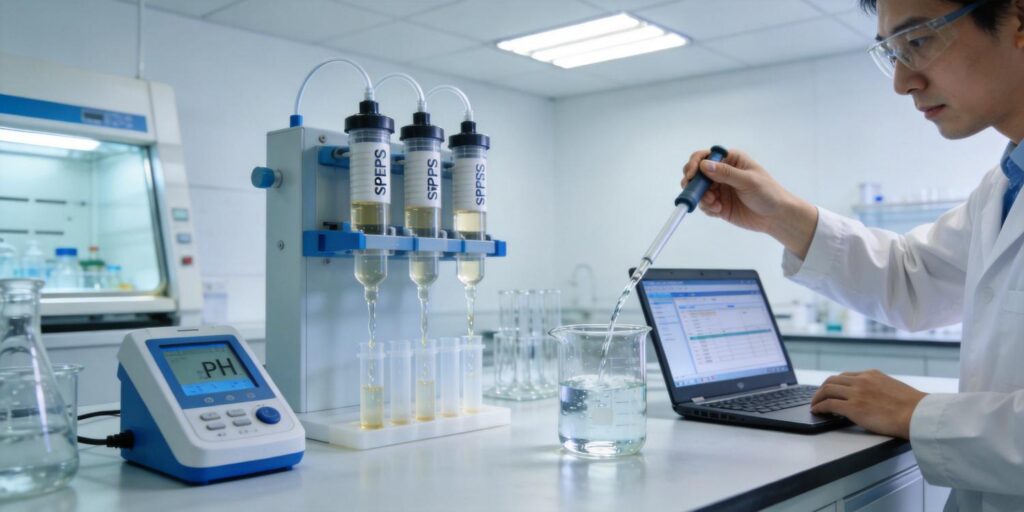
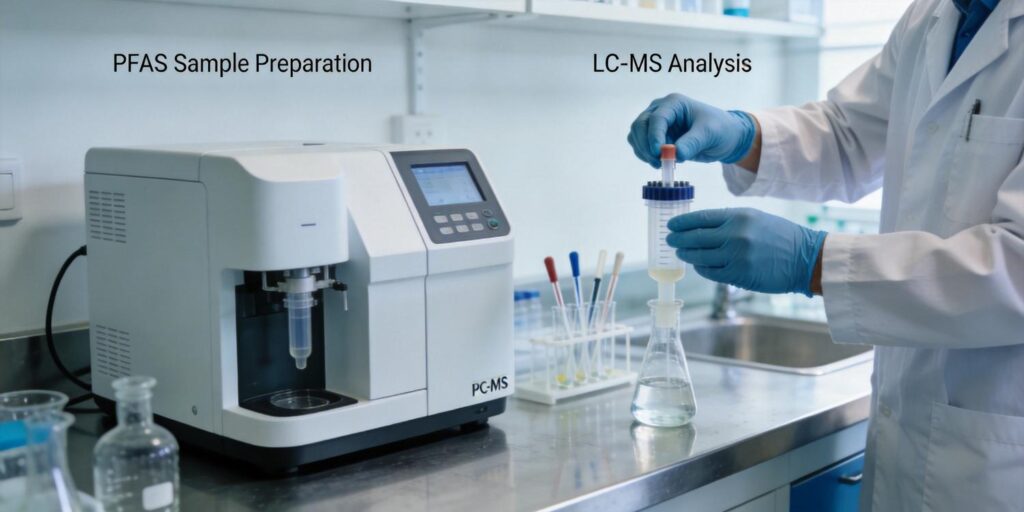
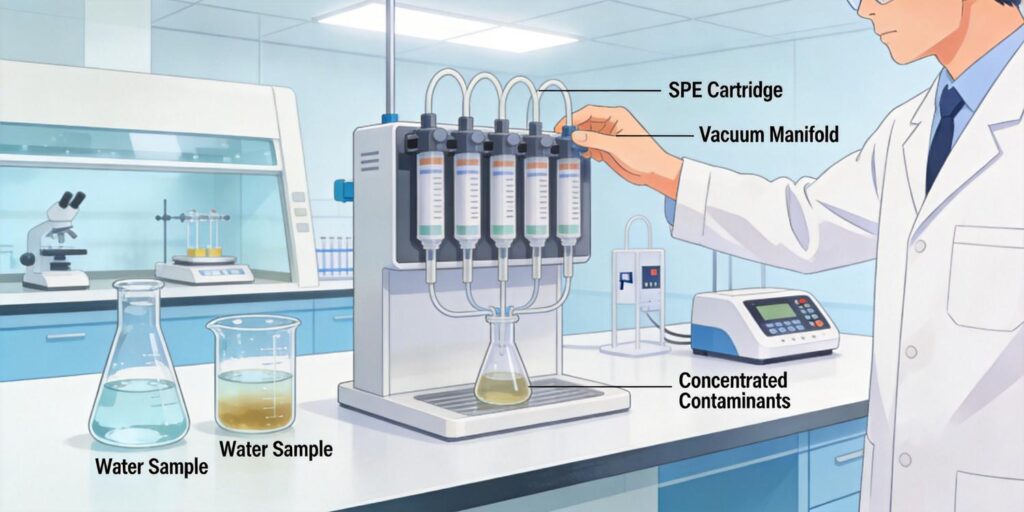
- Parallel processing capability: Multiple simultaneous extractions possible with manifold systems
- Higher reproducibility: More consistent recoveries compared to LLE
As noted in environmental SPE literature, “the primary advantage that SPE has over other separation and preconcentration procedures for large volume samples is the fundamental, theoretical difference inherent in the SPE approach—SPE is a non-equilibrium procedure.” This characteristic ensures more complete extraction compared to equilibrium-based methods like LLE.
Preconcentration Using SPE: Mechanisms and Optimization
Solid-phase extraction serves as an ideal preconcentration technique for trace environmental contaminants through three primary mechanisms:
- Large volume processing: Passing substantial sample volumes through optimized sorbent beds
- Minimal elution volumes: Releasing analytes in the smallest possible solvent volumes
- Volatile solvent compatibility: Using solvents amenable to further concentration
SPE Concentration Fundamentals
The concentration factor achieved through SPE depends on the ratio of breakthrough volume (V_b) to elution volume (V_e). Optimizing this ratio involves careful selection of sorbent chemistry, sample loading conditions, and elution parameters. For environmental applications, achieving concentration factors of several hundred-fold is common when sample size isn’t limiting.
Sorbent Selection for Trace Enrichment
Different sorbent chemistries offer varying advantages for environmental preconcentration:
- HLB (Hydrophilic-Lipophilic Balanced): Ideal for broad-spectrum extraction of contaminants spanning wide polarity ranges
- MAX (Mixed-mode Anion Exchange): Excellent for acidic compounds and anionic contaminants
- MCX (Mixed-mode Cation Exchange): Optimal for basic compounds and cationic species
- WAX (Weak Anion Exchange): Suitable for strong acids and anionic compounds
- WCX (Weak Cation Exchange): Effective for strong bases and cationic analytes
Method Development Considerations
Successful preconcentration requires addressing several critical parameters:
- Breakthrough volume determination: Ensuring complete analyte retention during loading
- Flow rate optimization: Balancing extraction efficiency with processing time
- pH adjustment: Maximizing analyte retention through proper ionization control
- Ionic strength management: Addressing matrix effects on extraction efficiency
- Elution solvent selection: Choosing solvents that provide complete recovery while allowing further concentration
Research demonstrates that environmental applications benefit particularly from SPE’s trace enrichment capabilities, especially for clean samples like drinking water or groundwater. More challenging matrices like river water or wastewater require additional considerations for handling particulates and dissolved organic matter.
Detection Limits Improvement Through SPE Preconcentration
The primary goal of SPE preconcentration in environmental analysis is improving method detection limits (MDLs) to meet regulatory requirements and enable accurate monitoring of trace contaminants. SPE achieves this through several mechanisms that collectively enhance analytical sensitivity.
Concentration Factor Contributions
SPE improves detection limits through:
- Analyte enrichment: Concentrating analytes from large volumes into small elution volumes
- Matrix simplification: Removing interfering compounds that contribute to baseline noise
- Solvent exchange: Converting samples into solvents compatible with analytical instruments
- Analyte preservation: Protecting labile compounds during storage and processing
Quantitative Improvements in Sensitivity
Studies demonstrate that SPE preconcentration can improve detection limits by factors of 100-1000× compared to direct injection methods. For example, research on pesticide analysis shows SPE enabling detection of triazine herbicides at sub-ppt levels that would be undetectable without preconcentration. Similar improvements have been documented for pharmaceuticals, endocrine disruptors, and industrial contaminants in water matrices.
Case Studies in Detection Limit Improvement
Environmental monitoring applications showcase SPE’s impact on analytical sensitivity:
- Pesticide analysis: Determination of atrazine in water at low and sub-parts per trillion levels using SPE preconcentration
- Pharmaceutical residues: Trace enrichment enabling detection of drug metabolites in surface waters
- Industrial contaminants: SPE-based concentration of PCBs and dioxins to meet stringent regulatory limits
- Heavy metal speciation: Complexation-SPE approaches for ultratrace metal analysis
Method Validation Considerations
When implementing SPE for detection limit improvement, several validation parameters require attention:
- Recovery studies: Ensuring consistent and quantitative analyte recovery
- Precision assessment: Evaluating method reproducibility at trace levels
- Matrix effect evaluation: Quantifying suppression or enhancement in different water types
- Carryover assessment: Verifying complete elution between samples
- Stability testing: Confirming analyte integrity during extraction and storage
Practical Implementation and Best Practices
Equipment Selection for Environmental SPE
Environmental laboratories have several format options for large volume SPE:
- Cartridge formats: Traditional columns ranging from 1mL to 6mL bed volumes
- Disk technologies: Membrane-based extraction for high flow rate applications
- 96-well plates: High-throughput processing for large sample batches
- Mega-columns: Several-gram sorbent beds for very large sample volumes
Automation and Throughput Considerations
Modern environmental laboratories increasingly adopt automated SPE systems to:
- Improve reproducibility across large sample batches
- Increase laboratory throughput and productivity
- Reduce analyst exposure to solvents and samples
- Enable 24/7 operation for monitoring programs
- Integrate with analytical instruments for online analysis
Quality Control Measures
Essential QC practices for environmental SPE include:
- Method blanks to monitor contamination
- Matrix spikes to verify recovery in different water types
- Duplicate analyses to assess precision
- Continuing calibration verification
- Surrogate standards to monitor extraction efficiency
Future Directions in Environmental SPE
The evolution of SPE technology continues to address emerging environmental monitoring challenges:
- Miniaturization: Development of micro-SPE devices for field sampling
- New sorbent chemistries: Materials with enhanced selectivity for emerging contaminants
- Online integration: Direct coupling with analytical instruments for real-time monitoring
- Green chemistry approaches: Reduced solvent consumption and waste generation
- High-throughput platforms: Parallel processing for large-scale monitoring programs
As environmental regulations become more stringent and new contaminants are identified, SPE preconcentration will remain essential for achieving the detection limits required for effective environmental protection and public health monitoring.
For laboratories seeking to implement or optimize SPE methods for trace environmental analysis, Poseidon Scientific offers a comprehensive range of HLB SPE cartridges, MAX SPE cartridges, MCX SPE cartridges, WAX SPE cartridges, WCX SPE cartridges, and 96-well SPE plates designed specifically for environmental applications.