Regulatory Limits for Antibiotic Residues in Dairy Products
Antibiotic residues in milk and dairy products are strictly regulated worldwide to ensure consumer safety and prevent antimicrobial resistance. Regulatory agencies including the FDA, EU Commission, and Codex Alimentarius establish Maximum Residue Limits (MRLs) for various antibiotic classes. These limits typically range from 4-100 μg/kg depending on the specific compound and its toxicological profile.
For β-lactams like penicillin, MRLs are often set at 4-10 μg/kg due to potential allergic reactions. Tetracyclines generally have higher limits (100-200 μg/kg) as they bind to calcium in milk. Sulfonamides are regulated at 100 μg/kg, while macrolides and aminoglycosides have varying limits based on their toxicity profiles. These regulations drive the need for sensitive analytical methods capable of detecting residues at or below these thresholds.
Challenges of Milk Matrix: Fat, Proteins, and Complex Composition
Milk presents one of the most challenging matrices for analytical chemistry due to its complex composition. Whole milk contains approximately 3.5-4% fat, 3.3% protein (primarily casein and whey proteins), 4.8% lactose, and 0.7% minerals. This complexity creates multiple interferences during analysis:
Fat Content Issues
The lipid fraction can trap lipophilic antibiotics, reducing extraction efficiency and causing matrix effects in LC-MS/MS. Fat globules can also clog SPE cartridges if not properly removed during sample preparation.
Protein Binding Challenges
Many antibiotics, particularly β-lactams and tetracyclines, bind strongly to milk proteins. Casein micelles can encapsulate drug residues, requiring effective protein denaturation strategies to release bound analytes.
Emulsion Formation
The natural emulsion of milk can lead to phase separation issues during extraction, potentially causing analyte loss and poor reproducibility.
SPE Sorbent Options for Different Antibiotic Classes
Selecting the appropriate SPE sorbent is critical for successful antibiotic residue analysis in milk. Different antibiotic classes require specific sorbent chemistries based on their physicochemical properties:
Reversed-Phase Sorbents (C18, C8, HLB)
Hydrophilic-Lipophilic Balanced (HLB) polymers like those in Poseidon Scientific HLB cartridges are ideal for broad-spectrum antibiotic extraction. These sorbents retain both polar and non-polar compounds, making them suitable for multi-class antibiotic screening. HLB sorbents work well for sulfonamides, tetracyclines, and macrolides.
Mixed-Mode Sorbents (MCX, MAX, WCX)
For basic antibiotics like aminoglycosides and fluoroquinolones, Mixed-Mode Cation Exchange (MCX) sorbents provide superior cleanup. These sorbents combine reversed-phase retention with ion-exchange mechanisms, allowing selective retention of basic compounds while removing acidic and neutral interferences.
For acidic antibiotics such as penicillins and cephalosporins, Mixed-Mode Anion Exchange (MAX) or Weak Cation Exchange (WCX) sorbents offer optimal performance. The Poseidon Scientific MCX cartridges and WCX cartridges are specifically designed for these applications.
Specialized Sorbents for Specific Classes
For tetracyclines, which form complexes with metal ions, sorbents with chelating properties or those combined with EDTA treatment yield better recoveries. Sulfonamides often benefit from SCX (Strong Cation Exchange) sorbents due to their amphoteric nature.
Protein Precipitation Combined with SPE Cleanup
Effective protein removal is essential before SPE cleanup. Several precipitation methods are commonly employed:
Acetonitrile Precipitation
Adding 2-4 volumes of acetonitrile to milk effectively precipitates proteins while maintaining antibiotic stability. This method works well for most antibiotic classes except for highly polar compounds that may co-precipitate.
Trichloroacetic Acid (TCA) or Perchloric Acid
These strong acids provide excellent protein precipitation but may degrade acid-labile antibiotics like β-lactams. Typically, 5-10% TCA is used, followed by neutralization before SPE.
Organic Acid/Acetate Buffer Systems
For tetracyclines, EDTA-McIlvaine buffer (pH 4.0) effectively releases protein-bound analytes while preventing metal complexation.
After precipitation, centrifugation at 4000-10000 × g for 10-15 minutes separates the supernatant, which is then diluted with water or buffer to reduce organic solvent content before SPE loading.
Example Workflow for LC-MS/MS Analysis
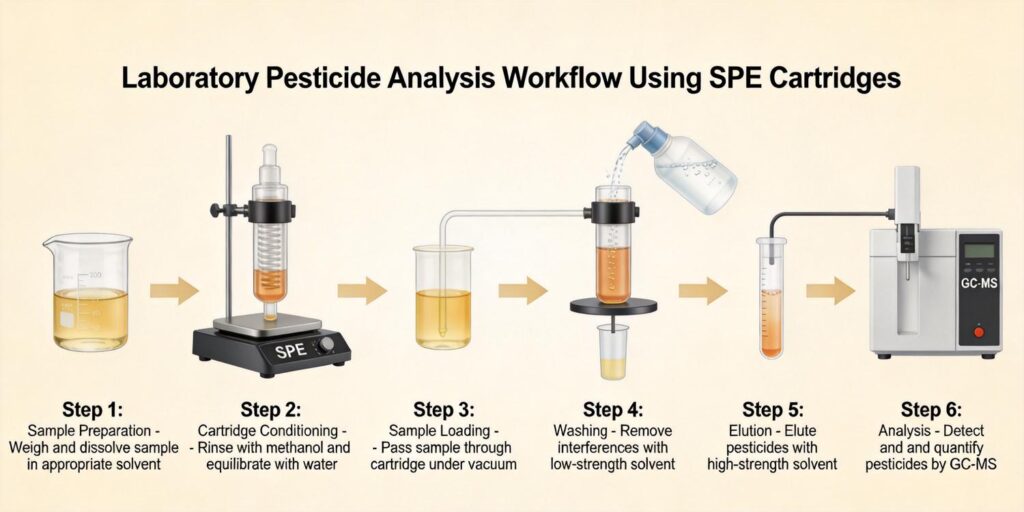
Here’s a comprehensive workflow for multi-class antibiotic residue analysis in milk using SPE and LC-MS/MS:
Step 1: Sample Preparation
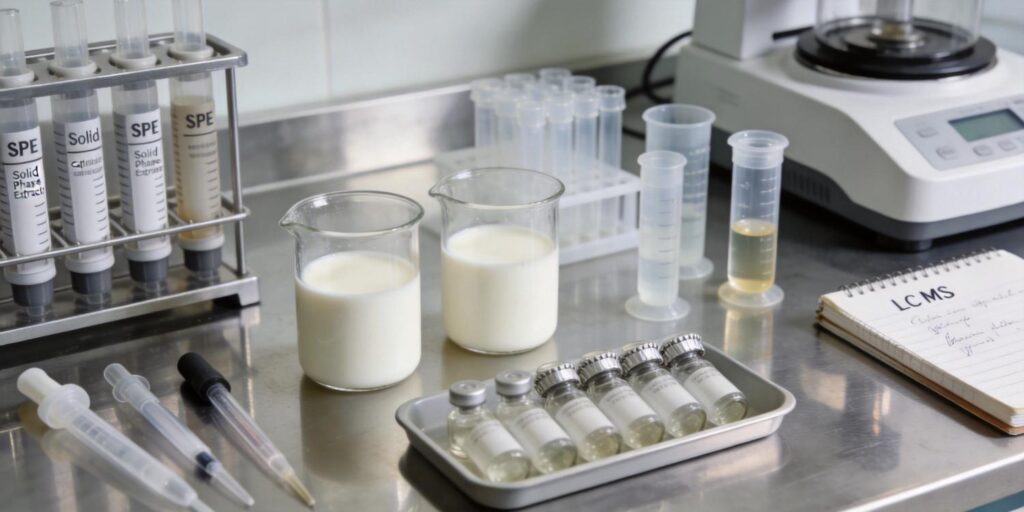
1. Weigh 5 g of milk sample into a 50 mL centrifuge tube
2. Add 10 mL of 0.1 M EDTA-McIlvaine buffer (pH 4.0)
3. Vortex for 1 minute, then sonicate in ice bath for 10 minutes
4. Add 20 mL acetonitrile, vortex vigorously for 2 minutes
5. Centrifuge at 4000 × g for 10 minutes at 4°C
6. Transfer supernatant to a clean tube
Step 2: SPE Cleanup Using HLB Cartridges
1. Condition HLB cartridge (500 mg/6 mL) with 5 mL methanol followed by 5 mL water
2. Load 10 mL of diluted supernatant (1:1 with water) at 1-2 mL/min
3. Wash with 5 mL 5% methanol in water
4. Dry cartridge under vacuum for 5 minutes
5. Elute with 8 mL methanol containing 2% formic acid
6. Evaporate eluate to dryness under nitrogen at 40°C
7. Reconstitute in 1 mL mobile phase initial conditions
Step 3: LC-MS/MS Analysis
1. Column: C18, 100 × 2.1 mm, 1.7 μm
2. Mobile phase: A) 0.1% formic acid in water, B) 0.1% formic acid in acetonitrile
3. Gradient: 5% B to 95% B over 10 minutes
4. Flow rate: 0.3 mL/min
5. MS/MS: ESI positive/negative switching, MRM mode
6. Injection volume: 10 μL
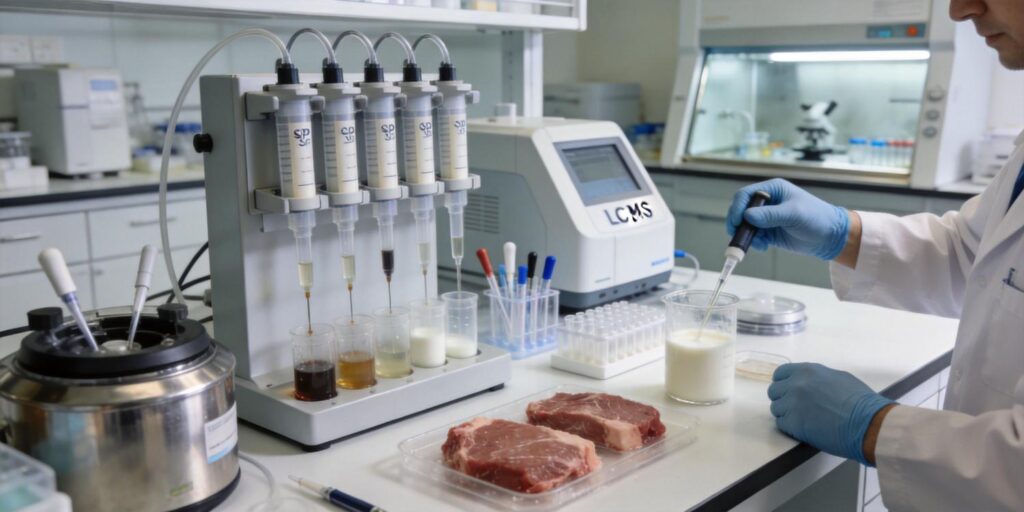
For high-throughput applications, consider using 96-well SPE plates which allow parallel processing of multiple samples.
Recovery and Validation Considerations
Method validation for antibiotic residue analysis must comply with guidelines from regulatory agencies like FDA, EU 2002/657/EC, and Codex Alimentarius.
Recovery Requirements
Acceptable recovery ranges are typically 70-120% with RSD < 20% at the MRL. For screening methods, recoveries of 50-120% may be acceptable. Matrix-matched calibration is essential to compensate for matrix effects in LC-MS/MS.
Validation Parameters
1. Specificity: No interference at analyte retention times in blank matrix
2. Linearity: R² > 0.99 over calibration range (0.5-2× MRL)
3. Accuracy: Recovery within acceptable limits at multiple concentration levels
4. Precision: Intra-day and inter-day RSD < 15%
5. Limit of Detection (LOD): Typically 1/3 to 1/2 of MRL
6. Limit of Quantification (LOQ): At or below MRL
7. Matrix Effects: Evaluate signal suppression/enhancement using post-column infusion
Quality Control Measures
Include procedural blanks, fortified samples at MRL, and certified reference materials in each batch. For multi-class methods, monitor at least one representative compound from each antibiotic class as a quality control marker.
Method Performance Comparison
Studies show that optimized SPE methods using mixed-mode sorbents can achieve recoveries of 85-110% for most antibiotic classes in milk. For example, tetracyclines typically show 80-95% recovery using HLB or MAX sorbents, while β-lactams achieve 70-90% recovery with proper pH control during extraction.
The choice between different SPE sorbents—whether MAX for acidic compounds, MCX for basic compounds, or WAX for strong acids—depends on the specific antibiotic classes being targeted. For comprehensive multi-residue methods, HLB sorbents often provide the best balance of recovery and cleanup efficiency.
Proper method validation ensures reliable detection of antibiotic residues at regulatory limits, protecting consumer health while maintaining the integrity of the dairy supply chain.