Introduction: The Challenge of Fatty Food Matrices in LC-MS Analysis
Liquid chromatography-mass spectrometry (LC-MS) has become the gold standard for food safety testing, contaminant monitoring, and nutritional analysis. However, when analyzing fatty food matrices like edible oils, meat extracts, dairy products, and processed foods, laboratories face significant challenges that can compromise analytical accuracy and instrument performance. High-fat content introduces complex interferences that require specialized sample preparation strategies.
Problems Caused by High-Fat Matrices in LC-MS
Fatty food matrices present multiple analytical challenges that directly impact LC-MS performance:
Ion Suppression Effects
Co-extracted lipids, particularly phospholipids and triglycerides, compete with analytes during the ionization process in atmospheric pressure ionization-MS systems. This competition leads to signal suppression, resulting in false negatives and inaccurate quantification. Research has shown that endogenous interferences from biofluids and fatty matrices can suppress ionization by up to 90% in extreme cases, necessitating selective SPE extraction applications to avoid these false negatives.
Instrument Contamination and Downtime
High molecular weight lipids and proteins can foul LC-MS interfaces, particularly electrospray, thermospray, and particle beam instruments. These components deposit in transfer capillaries and interfaces, leading to rapid signal decline and degraded spectral quality. Regular source cleaning becomes necessary, increasing instrument downtime and maintenance costs. Studies demonstrate that SPE significantly increases gas and liquid chromatography column life while reducing downtime on expensive equipment like GC-MS and LC-MS systems for source cleaning.
Matrix Effects and Reduced Sensitivity
Fatty matrices introduce complex background interferences that mask target analytes, reduce method sensitivity, and compromise detection limits. The high lipid load can overload analytical columns, causing peak broadening, retention time shifts, and reduced chromatographic resolution.
Lipid Removal Strategies Using SPE
Solid-phase extraction offers targeted approaches for lipid removal from fatty food matrices:
Matrix Adsorption vs. Analyte Adsorption
Two primary SPE modes are employed for fatty matrix cleanup. In matrix adsorption, lipids are retained on the sorbent while analytes pass through unretained (k ~ 0). This approach provides no preconcentration advantage but can yield cleaner extracts. In analyte adsorption, target compounds are retained (k >> 1) while matrix components are washed away, offering both cleanup and concentration benefits.
Class Fractionation Techniques
Advanced SPE methods enable lipid class fractionation, separating neutral lipids, free fatty acids, phospholipids, cholesterol esters, triglycerides, cholesterol, diglycerides, and monoglycerides with high efficiency and purity. The classic work by Kaluzny et al. (1985) demonstrated that a single sorbent type with complex elution patterns could separate chloroform extracts of lipid tissue into seven principle fractions, providing a foundation for modern lipid cleanup methods.
Sorbent Comparison: C18, Zirconia-Based Materials, and Polymeric Sorbents
C18 Sorbents for Lipid Removal
C18 (octadecylsilane) sorbents remain the most widely used for fatty matrix cleanup, accounting for nearly 90% of SPE applications according to industry surveys. Their strong hydrophobic interactions effectively retain non-polar lipids while allowing more polar analytes to pass through or be selectively eluted. However, C18 sorbents vary significantly in performance characteristics:
- Hydrophobicity Index: Indicates concentration of organic ligands bonded to silica
- Silanophilicity Index: Measures accessible silanol groups that can cause irreversible sorption of hydrogen-bonding bases
- Capacity: Typically 0-50 mg per gram of sorbent for small analytes
Studies comparing C18 sorbents from different manufacturers show recovery variations from 56.3% to 97.8% for basic compounds, highlighting the importance of sorbent selection and method optimization.
Zirconia-Based Sorbents
Zirconia-based materials offer unique advantages for fatty matrix cleanup:
- Enhanced Chemical Stability: Resistant to extreme pH conditions (pH 1-14) compared to silica-based sorbents
- Lewis Acid-Base Interactions: Zirconia surfaces provide additional retention mechanisms for compounds with electron-donating groups
- Phospholipid Removal: Particularly effective for removing phospholipids that cause ion suppression in LC-MS
- High Temperature Tolerance: Suitable for applications requiring elevated temperatures
Polymeric Sorbents
Polymeric sorbents, particularly styrene-divinylbenzene (SDVB) copolymers and polymethacrylates, have gained popularity for fatty food analysis:
- High Surface Area: Typically 400-800 m²/g compared to 50-500 m²/g for silica-based sorbents
- pH Stability: Operate effectively across the entire pH range (0-14)
- Reduced Secondary Interactions: Minimize irreversible binding of polar compounds
- Enhanced Capacity: Higher loading capacity for complex matrices
Modern polymeric sorbents like Oasis HLB combine lipophilic divinylbenzene with hydrophilic N-vinylpyrrolidone, creating a balanced hydrophilic-lipophilic copolymer that effectively handles both polar and non-polar interferences.
Specialized Sorbents for Specific Applications
Aminopropyl (NH2) Sorbents
NH2 sorbents provide both polar and weak anion exchange properties, making them ideal for separating lipid classes. They’ve been successfully applied to dairy products, olive oil, salami, and cheese samples for diglyceride separation, though some isomerization of esters has been reported.
Silver-Ion Modified Sorbents
By conditioning strong cation exchangers (SCX) with silver ions, researchers have created sorbents that discriminate between fatty acids with differing numbers of double bonds. This argentation technique allows separation of saturated, mono-ene, di-ene, tri-ene, and up to octa-ene species by varying elution solvent polarity.
Porous Graphitic Carbon (PGC)
PGC sorbents contain residual acidic and basic functional groups that enable binding of both polar and non-polar compounds. They’re particularly valuable for highly polar compounds with low binding capacity to conventional sorbents.
Step-by-Step Workflow for Edible Oil and Meat Extracts
Edible Oil Analysis Workflow
Sample Preparation
- Dilution: Dilute 0.5 g of oil sample with 10 mL of hexane or appropriate non-polar solvent
- Filtration: Pass through 0.45 μm membrane filter to remove particulates
- Conditioning: Condition C18 or polymeric cartridge with 3 mL methanol followed by 3 mL hexane
SPE Procedure
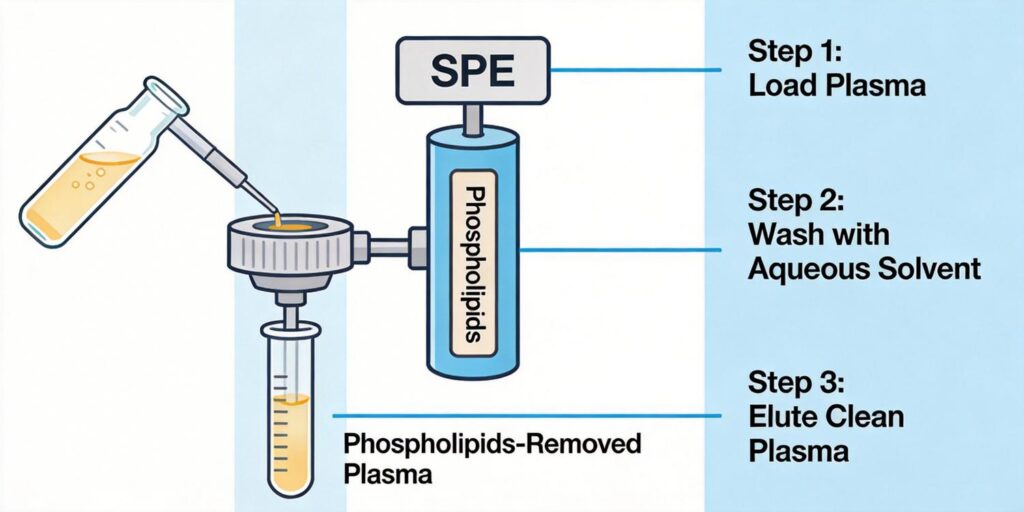
- Loading: Apply diluted sample at 1-2 mL/min flow rate
- Washing: Wash with 3 mL hexane to remove non-polar lipids
- Elution: Elute target analytes with appropriate solvent (typically methanol, acetonitrile, or mixtures with water)
- Concentration: Evaporate eluate under gentle nitrogen stream and reconstitute in mobile phase compatible solvent
Meat Extract Analysis Workflow
Sample Preparation
- Homogenization: Homogenize 5 g sample with 20 mL acetonitrile or methanol:water mixture
- Extraction: Sonicate or vortex for 15 minutes
- Centrifugation: Centrifuge at 4000 rpm for 10 minutes
- Defatting: Optional hexane partition for additional lipid removal
SPE Procedure
- Conditioning: Condition polymeric or C18 cartridge with 3 mL methanol followed by 3 mL water or buffer
- Loading: Apply supernatant after appropriate dilution (typically 1:1 with water)
- Washing: Wash with 3 mL 5-10% methanol in water
- Drying: Apply vacuum or positive pressure to dry cartridge (30-60 seconds)
- Elution: Elute with 3-5 mL appropriate organic solvent (methanol, acetonitrile, or mixtures)
Effects on Instrument Contamination and Ion Suppression
Reduced Instrument Contamination
Proper SPE cleanup significantly extends instrument uptime and reduces maintenance costs:
- Extended Column Life: Removal of lipids and proteins prevents column fouling and degradation
- Reduced Source Cleaning: Cleaner extracts minimize deposition on MS ion sources and interfaces
- Improved System Performance: Consistent backpressure and retention times
Studies show that SPE can increase GC and LC column life while reducing downtime on equipment like GC-MS and LC-MS for source cleaning by up to 50%.
Minimized Ion Suppression
Effective lipid removal addresses the primary cause of ion suppression in LC-MS analysis:
- Phospholipid Removal: Modern SPE sorbents can remove >95% of phospholipids, the main contributors to ion suppression
- Improved Signal Response: Cleaner extracts yield more consistent and intense analyte signals
- Enhanced Method Sensitivity: Lower detection limits and better quantification accuracy
Research demonstrates that co-extracted endogenous interferences from fatty matrices can be reduced by 90-99% with optimized SPE methods, dramatically improving method robustness.
Validation Tips for Food Laboratories
Method Validation Parameters
Recovery Studies
SPE recoveries should exceed 90% absolute recovery for most applications. If recoveries are lower, parameters such as solubility, pH, and solvent strength need adjustment. Conduct recovery studies at multiple concentration levels across the calibration range.
Matrix Effects Evaluation
- Post-extraction Addition: Compare responses of standards in neat solvent vs. post-extracted blank matrix
- Matrix-matched Calibration: Prepare calibration standards in processed blank matrix
- Ion Suppression Monitoring: Use constant infusion of analyte during LC-MS runs to identify suppression regions
Carryover Assessment
Test for carryover by running blank samples after high-concentration samples. Implement appropriate wash steps between samples, considering solvent compatibility and analyte solubility.
Quality Control Measures
Blank Matrix Preparation
Source representative blank matrices for method development and validation. For difficult-to-find blanks, consider:
- Purchasing certified blank matrices
- Using alternative matrices with similar properties
- Developing in-house blank preparation methods
System Suitability Testing
Implement daily system suitability tests including:
- Extraction efficiency of control samples
- Chromatographic performance metrics
- MS sensitivity and stability checks
Contamination Control
Regularly check for contamination from:
- Reagents and solvents (use HPLC/MS grade)
- Laboratory glassware and plasticware
- SPE device components (frits, barrels, filters)
- Instrument components and mobile phases
Method Transfer Considerations
Documentation Requirements
Comprehensive documentation should include:
- Detailed SOPs with troubleshooting guidance
- Batch records for SPE cartridge lots
- Instrument performance logs
- Validation data and acceptance criteria
Training Protocols
Develop standardized training for:
- Sample preparation techniques
- SPE cartridge handling and storage
- Instrument operation and maintenance
- Data review and interpretation
Conclusion: Optimizing SPE for Fatty Food Matrices
Effective SPE cleanup for fatty food matrices before LC-MS analysis requires careful consideration of sorbent selection, method optimization, and validation strategies. By understanding the specific challenges posed by high-fat matrices and implementing appropriate SPE techniques, laboratories can achieve:
- Improved analytical accuracy and precision
- Reduced instrument downtime and maintenance costs
- Enhanced method sensitivity and detection limits
- Increased laboratory productivity and throughput
The evolution of SPE sorbent technology, particularly the development of advanced polymeric materials and specialized phases, continues to provide food laboratories with powerful tools for tackling even the most challenging fatty matrices. By staying current with these developments and implementing robust validation protocols, analysts can ensure reliable, accurate results for food safety testing, quality control, and regulatory compliance.
For laboratories seeking to optimize their fatty matrix cleanup methods, Poseidon Scientific offers a comprehensive range of SPE products including HLB SPE cartridges, MAX SPE cartridges, MCX SPE cartridges, and 96-well SPE plates designed specifically for challenging food matrix applications.