Sensitivity Limitations in Direct Injection LC-MS Screening
Direct injection liquid chromatography-mass spectrometry (LC-MS) screening for drugs in biological matrices like urine faces significant sensitivity challenges that can compromise analytical accuracy. The primary limitation stems from matrix effects – the suppression or enhancement of analyte ionization by co-eluting compounds. In urine toxicology screening, endogenous compounds such as urea, salts, phospholipids, and metabolites create substantial ionization suppression, particularly in electrospray ionization (ESI) sources.
Research demonstrates that matrix effects can reduce analyte signals by 50-90% in direct injection methods, severely impacting detection limits. The complexity of urine matrices, containing thousands of endogenous compounds at varying concentrations, creates unpredictable ionization conditions. This variability leads to poor reproducibility and necessitates frequent calibration, increasing analytical costs and reducing throughput.
Additionally, direct injection methods suffer from limited concentration capabilities. Many drugs of abuse and their metabolites exist at trace levels (ng/mL to pg/mL) in urine, requiring sensitive detection that direct injection often cannot provide without extensive dilution. The high salt content in urine can also lead to source contamination and instrument downtime, further reducing analytical efficiency.
Benefits of SPE Concentration and Cleanup
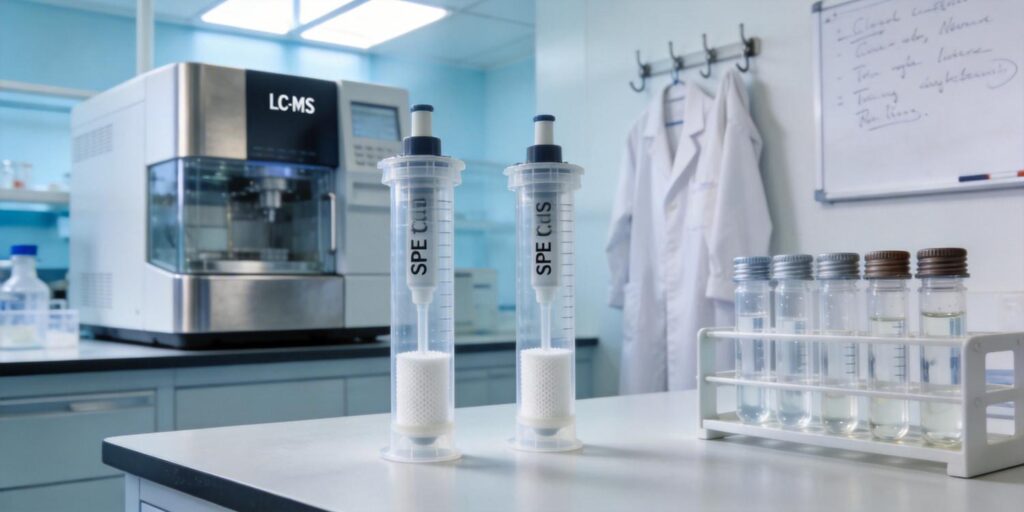
Solid-phase extraction (SPE) addresses these limitations through two primary mechanisms: concentration and cleanup. SPE enables scientists to reduce chromatographic complexity, increase signal-to-noise ratios, improve detection limits, and minimize risks associated with matrix effects. By concentrating analytes of interest while removing interfering compounds, SPE transforms challenging samples into clean extracts suitable for sensitive LC-MS analysis.
The concentration aspect of SPE allows for significant analyte enrichment. By processing larger sample volumes (typically 1-5 mL of urine) and eluting in smaller volumes (50-200 μL), SPE can achieve 10-100× concentration factors. This enrichment directly translates to lower detection limits, enabling the identification of trace-level drugs that would otherwise go undetected.
Cleanup benefits are equally important. SPE selectively removes phospholipids, proteins, salts, and other matrix components that cause ionization suppression. Studies show that proper SPE cleanup can reduce matrix effects by 95% or more, leading to more consistent ionization and improved quantitative accuracy. This cleanup also protects analytical columns from fouling, extending column lifetime and reducing system downtime.
Selecting Sorbents for Broad Drug Panels
Choosing the appropriate SPE sorbent is critical for successful broad-spectrum drug screening. The ideal sorbent must retain a wide range of compounds with varying chemical properties while providing effective cleanup. Modern SPE technology offers several options tailored to different analytical needs.
Hydrophilic-Lipophilic Balanced (HLB) Sorbents
Oasis HLB represents the gold standard in polymeric SPE sorbents for broad drug screening. Constructed with a water-wettable copolymer stable from pH 0-14, HLB provides high capacity for acids, bases, and neutrals without requiring conditioning and equilibration steps. Its unique structure combines hydrophilic retention of polar compounds with lipophilic reversed-phase retention, making it ideal for comprehensive drug panels.
Mixed-Mode Sorbents for Enhanced Selectivity
For applications requiring higher analyte specificity and sensitivity, mixed-mode sorbents offer dual retention mechanisms combining reversed-phase and ion-exchange functionality:
- Oasis MCX: Mixed-mode cation exchange for basic compounds (pKa ~6)
- Oasis MAX: Mixed-mode anion exchange for acidic compounds (pKa 2-8)
- Oasis WCX: Mixed-mode weak cation exchange for strong bases and quaternary amines (pKa >10)
- Oasis WAX: Mixed-mode weak anion exchange for strong acids (pKa <1)
The Oasis 2×4 strategy simplifies method development by offering only two protocols and four sorbents to analyze all types of compounds: acids, bases, and neutrals. This systematic approach ensures optimal recovery across diverse drug classes.
Specialized Sorbents for Specific Applications
For routine analysis requiring ultra-clean extracts, Oasis PRiME HLB provides simplified protocols that remove 95% of common matrix interferences with minimal steps. This sorbent is particularly valuable in high-throughput laboratories where speed and consistency are paramount.
Example SPE Protocol for Urine Toxicology Screening
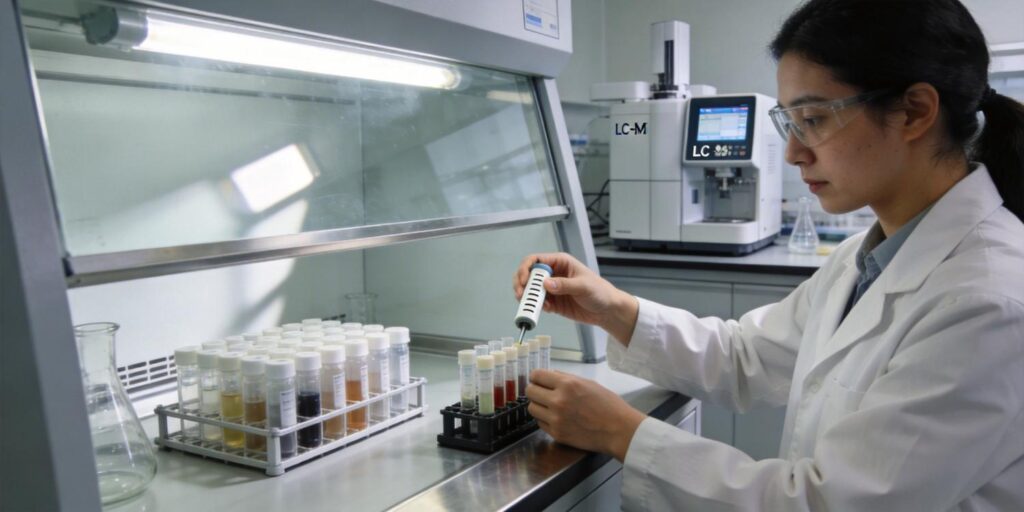
A robust SPE protocol for urine toxicology screening using mixed-mode sorbents typically follows these steps:
Sample Preparation
- Collect 2-5 mL of urine sample in appropriate container
- Add internal standards (deuterated analogs of target analytes)
- Adjust pH according to target drug classes (typically pH 4-6 for basic drugs, pH 8-9 for acidic drugs)
- Centrifuge if necessary to remove particulates
SPE Procedure for Basic Drugs (Oasis MCX)
- Conditioning: Load 3 mL methanol followed by 3 mL water or buffer
- Sample Loading: Apply prepared urine sample at 1-2 mL/min flow rate
- Washing: Wash with 3 mL 2% formic acid in water, then 3 mL methanol
- Drying: Apply vacuum for 5 minutes to dry sorbent bed
- Elution: Elute with 3 mL 5% ammonium hydroxide in methanol
- Evaporation: Evaporate eluent to dryness under nitrogen at 40°C
- Reconstitution: Reconstitute in 100 μL mobile phase for LC-MS analysis
SPE Procedure for Acidic Drugs (Oasis MAX)
- Conditioning: Load 3 mL methanol followed by 3 mL water or buffer
- Sample Loading: Apply prepared urine sample at 1-2 mL/min flow rate
- Washing: Wash with 3 mL 5% ammonium hydroxide in water, then 3 mL methanol
- Drying: Apply vacuum for 5 minutes to dry sorbent bed
- Elution: Elute with 3 mL 2% formic acid in methanol
- Evaporation: Evaporate eluent to dryness under nitrogen at 40°C
- Reconstitution: Reconstitute in 100 μL mobile phase for LC-MS analysis
This protocol has been validated for numerous drug classes including opioids, benzodiazepines, stimulants, and their metabolites, typically achieving recoveries >85% with excellent reproducibility.
Impact on Detection Limits and Chromatographic Peak Quality
The implementation of SPE in LC-MS drug screening workflows produces measurable improvements in both detection limits and chromatographic performance. Studies comparing direct injection versus SPE-prepared samples consistently demonstrate 5-10× lower limits of detection (LOD) and 10-50× lower limits of quantification (LOQ) with SPE.
Detection Limit Improvements
For common drugs of abuse in urine, SPE typically achieves:
- Amphetamines: LOD 0.1-0.5 ng/mL vs 1-5 ng/mL with direct injection
- Opioids: LOD 0.5-1 ng/mL vs 5-10 ng/mL with direct injection
- Benzodiazepines: LOD 0.1-0.2 ng/mL vs 1-2 ng/mL with direct injection
- Cannabinoids: LOD 0.5-1 ng/mL vs 5-10 ng/mL with direct injection
These improvements are particularly critical for detecting low-concentration metabolites and for applications requiring high sensitivity, such as workplace drug testing or forensic investigations.
Chromatographic Benefits
SPE cleanup significantly enhances chromatographic performance:
- Peak Shape: Reduced matrix effects lead to sharper, more symmetrical peaks
- Retention Time Stability: Consistent ionization improves retention time reproducibility
- Signal-to-Noise Ratio: Typical improvements of 10-100× compared to direct injection
- Column Protection: Reduced fouling extends column lifetime by 3-5×
The cleaner extracts also reduce source contamination, leading to longer intervals between instrument maintenance and more stable calibration curves over extended analytical runs.
Troubleshooting Low Recovery Drugs in Screening Workflows
Despite optimized protocols, certain drug classes may exhibit lower than expected recovery in SPE workflows. Understanding and addressing these challenges is essential for comprehensive screening.
Common Causes of Low Recovery
- pH Mismatch: Incorrect sample pH prevents proper ionization for retention
- Inadequate Conditioning: Improper sorbent activation leads to poor retention
- Excessive Wash Stringency: Too strong wash solvents elute target analytes
- Incomplete Elution: Weak elution solvents fail to displace strongly retained compounds
- Analyte Degradation: Chemical instability during sample processing
Specific Drug Class Considerations
Highly Polar Compounds: Drugs like gabapentin and gamma-hydroxybutyric acid (GHB) require specialized approaches. For GHB, SPE serves primarily as a filtration step to remove urea and other interferences, followed by additional cleanup if needed.
Zwitterionic Compounds: Compounds like timolol with both acidic and basic functional groups may require pH optimization or alternative sorbent selection.
Quaternary Ammonium Compounds: Strong bases like glycopyrrolate benefit from Oasis WCX sorbent, which provides mixed-mode retention combining weak cation exchange with reversed-phase mechanisms.
Optimization Strategies
- pH Optimization: Adjust sample pH to ensure target analytes are in their ionized form for optimal retention
- Sorbent Selection: Consider alternative sorbents or mixed-mode approaches for challenging compounds
- Wash Optimization: Use weaker wash solvents or include additional wash steps with varying solvent strengths
- Elution Optimization: Test different elution solvents or include multiple elution steps with increasing strength
- Internal Standard Correction: Use appropriate deuterated internal standards to correct for recovery variations
Quality Control Measures
Implement comprehensive quality control including:
- Process blanks to monitor contamination
- Matrix-matched calibration standards
- Quality control samples at multiple concentrations
- Internal standard monitoring for each sample
- Recovery assessments for all target analytes
By systematically addressing these factors, laboratories can achieve consistent, high recovery across diverse drug panels, ensuring reliable detection in urine toxicology screening applications.
The strategic implementation of SPE in LC-MS drug screening represents a critical advancement in analytical toxicology. By overcoming the limitations of direct injection methods through effective concentration and cleanup, SPE enables laboratories to achieve the sensitivity, specificity, and reliability required for modern drug testing applications. As SPE technology continues to evolve with new sorbent chemistries and simplified protocols, its role in improving analytical sensitivity will only become more significant in clinical, forensic, and research settings.