Overview of Common Mycotoxins in Grain
Mycotoxin contamination in grain represents one of the most significant food safety challenges facing the agricultural and food processing industries. Among the hundreds of mycotoxins identified, three classes dominate grain contamination profiles: aflatoxins, deoxynivalenol (DON), and zearalenone (ZEA).
Aflatoxins: The Carcinogenic Threat
Aflatoxins, particularly B1, B2, G1, and G2, are produced primarily by Aspergillus flavus and A. parasiticus. These compounds are classified as Group 1 human carcinogens by the International Agency for Research on Cancer (IARC), with aflatoxin B1 being the most potent natural carcinogen known. European Union regulations mandate maximum limits of 5 μg/kg for aflatoxin B1 and 10 μg/kg for total aflatoxins in maize products, while Brazil establishes a limit of 20 μg/kg for total aflatoxins in corn.
Deoxynivalenol (DON): The Vomitoxin
Produced by Fusarium graminearum and related species, DON (vomitoxin) primarily affects wheat, barley, and corn. While less carcinogenic than aflatoxins, DON causes acute gastrointestinal distress and has immunosuppressive effects. Regulatory limits for DON vary by region but typically range from 0.5-2 mg/kg in finished grain products.
Zearalenone (ZEA): The Estrogenic Mycotoxin
Also produced by Fusarium species, ZEA exhibits potent estrogenic activity, disrupting reproductive systems in animals and potentially affecting humans. Its structural similarity to natural estrogens allows it to bind to estrogen receptors, making it particularly concerning for livestock feed and human consumption.
Matrix Interferences in Grain Extracts
Grain matrices present complex analytical challenges due to their diverse chemical composition. Cornmeal, for instance, contains proteins (6-10%), lipids (1-5%), carbohydrates (primarily starch at 68-90%), soluble sugars (2-5%), and ash (0.2-1.4%). Research by Massarolo et al. (2018) demonstrated that proteins and sugars significantly interfere with aflatoxin recovery, with correlation coefficients of -0.99 for aflatoxin G2 and G1 respectively.
Key Interfering Components
- Proteins: Hydrophobic proteins like zein in corn can compete with mycotoxins for binding sites on reversed-phase sorbents
- Sugars: Polar carbohydrates can interfere with extraction efficiency, particularly for more polar mycotoxins
- Lipids: Fatty compounds can cause matrix effects in LC-MS analysis and reduce sorbent capacity
- Pigments: Natural colorants in grains can co-extract and interfere with detection
Particle Size Effects
Granulometric profile significantly impacts extraction efficiency. Studies show that coarse cornmeal (70% particles between 0.50-0.355 mm) yields recoveries of 60.6-93.7%, while fine cornmeal (54% particles between 0.355-0.25 mm) shows reduced recoveries of 40.0-88.5%. This highlights the importance of considering particle size in method development.
SPE Sorbent Options for Mycotoxin Cleanup
Hydrophilic-Lipophilic Balanced (HLB) Sorbents
HLB sorbents, such as those offered by Poseidon Scientific, represent a versatile solution for mycotoxin analysis. These water-wettable copolymers provide stable performance across pH 0-14 without requiring pre-conditioning steps. Their balanced hydrophilic-lipophilic character makes them ideal for simultaneous extraction of mycotoxins with varying polarities.
Immunoaffinity Columns (IACs)
IACs offer exceptional selectivity through antibody-antigen interactions. As described in forensic applications, immunoaffinity SPE provides highly selective extraction by using immobilized antibodies to capture specific analytes. For aflatoxin analysis, IACs typically achieve recoveries of 76.5-99.7% with LODs of 0.01-0.04 ng/g. However, they suffer from higher costs, limited capacity, and specificity that may exclude multi-mycotoxin analysis.
Polymeric Sorbents vs. Traditional Options
Polymeric sorbents like HLB offer several advantages over traditional silica-based C18:
- pH Stability: Unlike silica-based sorbents that degrade outside pH 2-8, HLB polymers maintain integrity across the entire pH range
- Water Wettability: Direct loading of aqueous samples without pre-conditioning
- Higher Capacity: Greater surface area and loading capacity for complex matrices
- Reduced Secondary Interactions: Minimal silanol interactions that can cause irreversible binding
Mixed-Mode Sorbents
For laboratories requiring enhanced selectivity, mixed-mode sorbents combining reversed-phase and ion-exchange functionality provide orthogonal separation mechanisms. These are particularly valuable for basic mycotoxins or when analyzing complex matrices with ionic interferences.
Example Extraction and SPE Purification Workflow
Vortex-Assisted Matrix Solid-Phase Dispersion (MSPD)
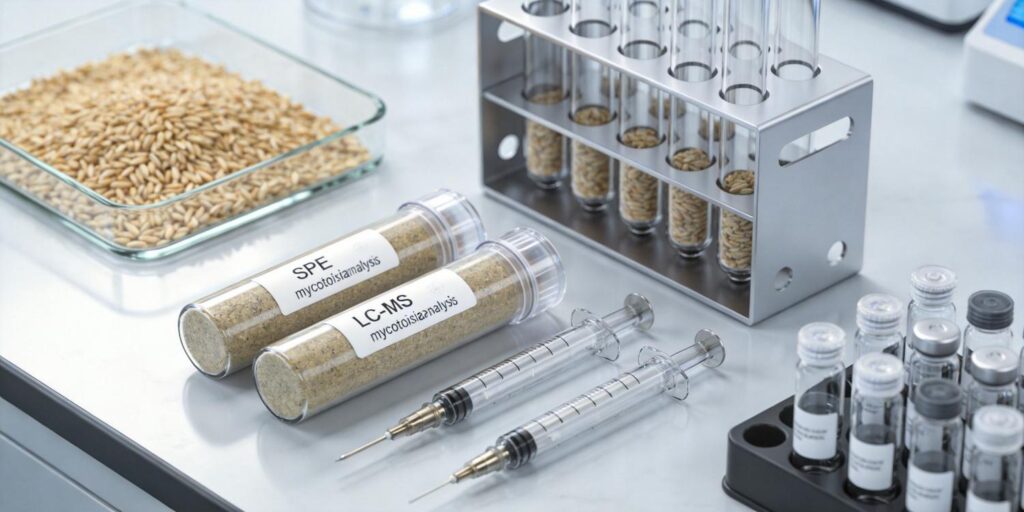
Recent research demonstrates the effectiveness of vortex-assisted MSPD for aflatoxin extraction from cornmeal. The optimized protocol includes:
- Sample Preparation: 1 g cornmeal mixed with 25 mg C18 solid support
- Dispersion: Thorough mixing using vortex agitation
- Elution: 10 mL methanol/acetonitrile (50:50, v/v)
- Cleanup: Filtration or additional SPE cleanup if required
- Analysis: HPLC with fluorescence detection or LC-MS/MS
Performance Metrics
This MSPD method achieves impressive performance characteristics:
- Recoveries: 85.7-114.8% for aflatoxins G2, G1, B2, B1
- LODs: 0.01-0.04 ng/g
- LOQs: 0.02-0.10 ng/g
- RSD: <20% for repeatability
- Matrix Effects: 11-20%, within SANTE/11945/2015 guidelines
Comparative Analysis
When compared to immunoaffinity column cleanup, MSPD shows comparable recoveries (98.4% vs. 95.2% for aflatoxin G2) while using significantly less sample (1g vs. 10-25g) and solvent (10mL vs. 70-150mL). This makes MSPD particularly attractive for high-throughput laboratories and those prioritizing green chemistry principles.
Improving LC-MS Sensitivity Through SPE Fractionation
Strategic Elution Protocols
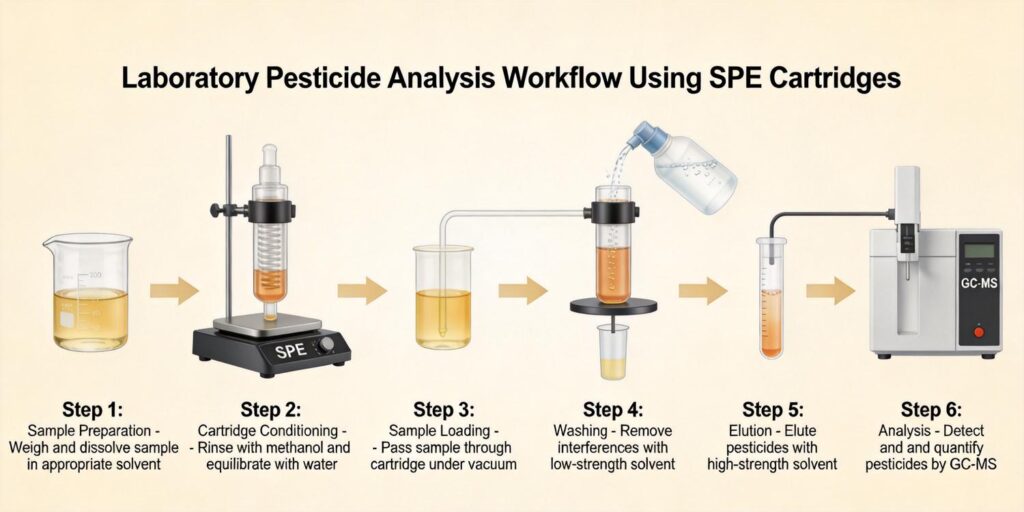
Fractionated elution from SPE cartridges can dramatically improve LC-MS sensitivity by separating mycotoxins from matrix interferences. A typical protocol might include:
- Weak Wash: 5-10% organic solvent to remove polar interferences
- Primary Elution: 40-60% organic for target mycotoxins
- Strong Elution: 80-100% organic for strongly retained compounds
Minimizing Matrix Effects
Matrix effects (ME) in LC-MS represent a major challenge in mycotoxin analysis. Studies show ME values of 11-20% for aflatoxins in cornmeal, which SANTE/11945/2015 considers acceptable for trace analysis. To minimize ME:
- Use selective washing steps to remove phospholipids and fats
- Implement stable isotope-labeled internal standards
- Optimize SPE conditions to balance recovery and cleanliness
- Consider 96-well SPE plates for consistent high-throughput processing
Enhanced Detection Limits
Proper SPE optimization can achieve LODs comparable to or better than those achieved by HPLC-tandem MS alone. The MSPD method described earlier achieves LODs of 0.01-0.04 ng/g for aflatoxins, sufficient for monitoring regulatory limits that typically range from 5-20 μg/kg.
Validation Considerations for Regulatory Testing Labs
Compliance with International Guidelines
Regulatory laboratories must validate SPE methods according to established guidelines. The European Commission (2006) establishes specific criteria for mycotoxin methods:
- Recovery Ranges: 50-120% for concentrations <1 μg/kg; 70-110% for 1-10 μg/kg
- Precision: RSD <20% for repeatability at trace levels
- Linearity: Typically r² >0.99 across the working range
- Specificity: Demonstrated through blank matrix analysis and interference testing
Method Performance Verification
Key validation parameters for SPE-based mycotoxin methods include:
- Selectivity: Assessment of interference from matrix components
- Linearity and Range: Typically 0.1-10x the regulatory limit
- Accuracy: Through recovery studies at multiple concentration levels
- Precision: Both within-day and between-day variability
- Limit of Detection/Quantification: Based on signal-to-noise ratios of 3:1 and 10:1 respectively
- Robustness: Testing method stability against minor variations in parameters
Quality Control Measures
Implementing robust QC protocols is essential for regulatory compliance:
- Process Blanks: To monitor contamination during extraction
- Matrix-Matched Standards: To account for matrix effects
- Control Samples: Certified reference materials when available
- System Suitability: Regular testing of SPE cartridge performance
- Documentation: Complete records of lot numbers, expiration dates, and performance verification
Choosing the Right SPE Format
For high-throughput regulatory labs, 96-well SPE plates offer significant advantages in consistency and throughput. For method development or lower volume applications, traditional cartridges in various sizes (1mL, 3mL, 6mL) provide flexibility in sample loading and elution optimization.
Future Directions
The trend in mycotoxin analysis continues toward multi-mycotoxin methods capable of detecting numerous compounds in a single analysis. Modern SPE sorbents, particularly HLB and mixed-mode polymers, support this trend by providing broad-spectrum retention while maintaining the cleanliness required for sensitive detection. As regulatory limits become increasingly stringent and the list of monitored mycotoxins expands, optimized SPE protocols will remain essential tools for ensuring food safety and regulatory compliance.
By understanding the complex interactions between mycotoxins, matrix components, and SPE sorbents, laboratories can develop robust, reliable methods that meet both analytical and regulatory requirements. The choice between immunoaffinity, polymeric, or mixed-mode SPE should be guided by the specific analytes of interest, matrix complexity, required sensitivity, and throughput considerations.