
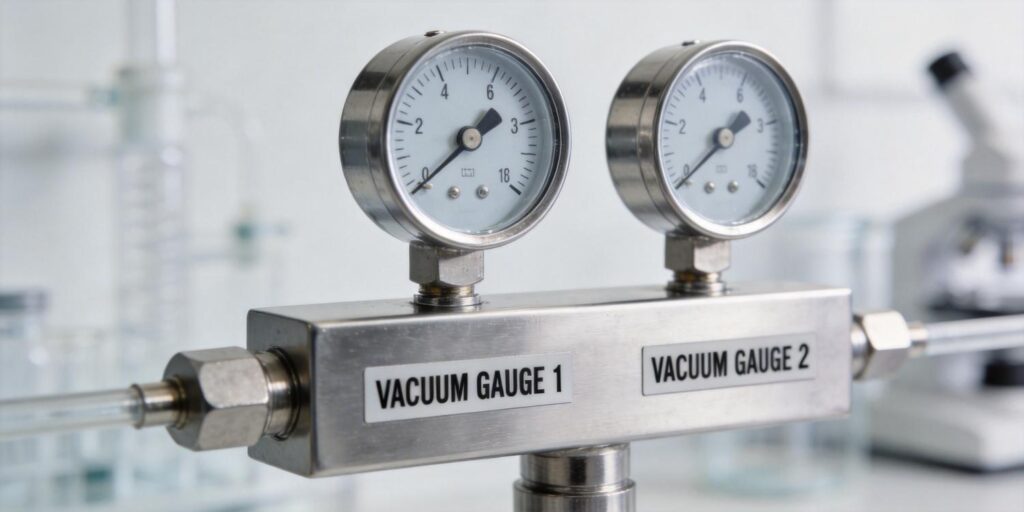
Why a Single Gauge Is Insufficient for 10-3 to 10-7 mbar Monitoring
In semiconductor etch, PVD thin-film deposition, mass spectrometry, and vacuum heat-treatment systems, the working pressure envelope routinely spans 10-3 to 10-7 mbar. A single vacuum gauge cannot deliver accurate, repeatable readings across this entire range without compromising either resolution, reliability, or service life.
Pirani gauges rely on thermal conductivity and excel from atmosphere down to approximately 10-3 mbar, where gas-molecule density is high enough for measurable heat transfer. Below this threshold, thermal conductivity drops sharply, producing non-linear response and errors that can exceed ±50 % near the low end. Cold-cathode ionization gauges, by contrast, use a Penning discharge sustained by crossed electric and magnetic fields and provide linear, high-resolution data from 10-3 down to 10-7 mbar. Above 10-3 mbar, however, excessive molecular collisions destabilize the discharge, accelerate electrode contamination, and risk arcing—conditions that force automatic high-voltage shutdown to protect the sensor.
Attempting to use either gauge alone therefore creates blind spots. A Pirani alone loses precision exactly where process-critical base-pressure and plasma-stabilization steps occur. A cold-cathode gauge alone cannot safely monitor load-lock roughing or high-gas-load phases without rapid fouling. Industry literature, including comparative studies of hot- and cold-cathode ionization gauges, confirms that no single technology maintains both the dynamic range and robustness required for continuous wide-range monitoring in production environments. The practical solution is a dual-gauge strategy that pairs the complementary strengths of thermal-conductivity and cold-cathode technologies.
Combining the VG-SP205 Pirani and VG-SM225 Cold Cathode for Seamless Coverage
The Poseidon Scientific VG-SP205 Pirani Vacuum Transmitter and VG-SM225 Cold Cathode Vacuum Gauge were engineered as a matched pair precisely for this wide-range challenge. The VG-SP205 covers atmosphere to 10-3 mbar with best linearity (±10 %) between 10 and 10-2 mbar, making it ideal for load-lock cycling, roughing-pump monitoring, and initial chamber pump-down. Its platinum filament offers superior chemical stability and a maintenance-free design for 3–5 years in typical service.
The VG-SM225 takes over at 10-3 mbar and extends reliable measurement to 10-7 mbar using a positive-magnetron Penning discharge (–2000 V operating voltage, ~100 gauss neodymium field). The sensor head is field-removable and cleanable, restoring performance after hydrocarbon or process-by-product deposition without factory return. Its drop-in compatibility with Pfeiffer PTR225N flanges simplifies retrofits.
Together, the two gauges provide continuous, overlap-protected coverage from atmosphere to 10-7 mbar. Installation is straightforward: the Pirani mounts on the load-lock or roughing line; the cold cathode monitors the main process chamber. Both share identical 0–10 V analog outputs (usable 2–8 V linear range) and customizable RS232 digital interfaces, enabling unified PLC or SCADA integration without additional signal converters in most cases.
Overlap Calibration Technique
The critical transition zone around 10-3 mbar is where both gauges operate within their linear regions, allowing cross-calibration and continuous validation. In practice, engineers establish a factory-matched overlap curve by recording simultaneous readings from both sensors during a controlled pump-down in a test chamber. The resulting data set is stored in the PLC as a lookup table or simple linear-correction function.
During normal operation the system continuously compares the two readings in the 5 × 10⁻⁴ to 5 × 10⁻³ mbar window. Any deviation beyond ±10 % triggers an immediate “gauge health” alarm, alerting maintenance before process drift occurs. This overlap technique also serves as an in-situ verification method: after cleaning the VG-SM225 or replacing a Pirani, a single pump-down cycle confirms that both sensors once again agree within specification. The approach eliminates reliance on periodic factory recalibration for the overlap region and provides a built-in redundancy that single-gauge systems cannot offer.
PLC Logic Switching Thresholds
Modern PLCs handle dual-gauge logic with minimal code. A typical implementation uses the following pressure-dependent switching rules:
- P > 5 × 10⁻³ mbar: Use VG-SP205 Pirani output exclusively (cold-cathode high-voltage remains disabled).
- 5 × 10⁻⁴ < P < 5 × 10⁻³ mbar: Blend or average the two signals after applying the overlap correction table; continue monitoring both for health checks.
- P < 5 × 10⁻⁴ mbar: Switch to VG-SM225 cold-cathode output; Pirani reading is retained only for trending and alarm backup.
Hysteresis (typically 20 % of the threshold) prevents rapid toggling during transients. The logic can be implemented in ladder logic, structured text, or function-block diagrams on virtually any industrial PLC. Poseidon supplies sample code snippets upon request to accelerate integration. Because both gauges output the same 0–10 V scale, the PLC simply selects the appropriate analog input channel—no scaling or offset adjustments are required after initial calibration.
Alarm Setpoint Programming
Dual-gauge architecture allows layered, context-aware alarms that single-gauge systems cannot replicate. Typical setpoints include:
- Load-lock roughing alarm (Pirani): > 50 mbar after 5 minutes → abort cycle.
- Base-pressure interlock (cold cathode): > 5 × 10⁻⁶ mbar before plasma ignition → hold recipe.
- Process-pressure deviation (either gauge in active range): ±15 % from recipe target → immediate pause and operator alert.
- Gauge-health alarm (overlap zone): > ±10 % disagreement between sensors → schedule maintenance without stopping the tool.
RS232 status bytes from both transmitters provide additional diagnostic flags (filament health, high-voltage status, error codes) that feed directly into the PLC’s alarm matrix. This multi-layered approach improves both safety and uptime compared with single-gauge reliance on a single analog channel.
Cost vs Accuracy Analysis
A dual Poseidon strategy delivers superior value. The combined installed cost of one VG-SP205 and one VG-SM225 is typically 40–60 % lower than a single high-end wide-range gauge or a legacy OEM dual package. Accuracy in each native range matches or exceeds competitive offerings: Pirani linearity ±10 % in the 10–10-2 mbar process window; cold-cathode linearity with sensitivity comparable to PTR225N equivalents. The field-cleanable VG-SM225 further reduces total cost of ownership by eliminating frequent factory returns.
Quantitative comparison (typical 2026 pricing for 10-unit volumes):
| Configuration | Approx. Unit Cost (USD) | Annual Maintenance Cost | Effective Accuracy (full range) | MTBF (hours) |
|---|---|---|---|---|
| Single wide-range OEM gauge | 9,500–12,000 | 1,200–2,500 | ±15–30 % (compromised at extremes) | 12,000–18,000 |
| Dual Poseidon VG-SP205 + VG-SM225 | 5,800–7,200 (pair) | 400–800 | ±10 % (native ranges) | 25,000+ |
The dual approach also reduces spare-parts inventory (two low-cost modules versus one expensive assembly) and simplifies training—technicians already familiar with Pirani and cold-cathode maintenance handle both devices.
Real Installation Wiring Example
A typical dual-gauge installation on a cluster-tool main chamber and load lock uses the following wiring:
- Both gauges connect via industry-standard RJ45 to a common PLC cabinet (or DB9/DB15 adapters for legacy tools).
- Analog 0–10 V signals route to two dedicated PLC analog inputs (e.g., channels AI0 for Pirani, AI1 for cold cathode). Cable shield grounded at one end only to minimize noise.
- RS232 lines (TX/RX/GND) connect to a single PLC serial port or Ethernet gateway for digital health monitoring and protocol customization.
- 24 VDC power is supplied from the PLC’s auxiliary output; both transmitters draw <100 mA each.
- Optional digital output from the VG-SM225 high-voltage status LED routes to a discrete input for visual confirmation of safe operation.
Physical layout: Pirani on KF25 load-lock port; cold cathode on CF or KF16 main-chamber side port with 100 mm extension tube to reduce direct contamination flux. Total wiring time for an experienced technician is under two hours, including overlap calibration pump-down.
Conclusion and Integration Support
A dual-gauge strategy using the VG-SP205 Pirani and VG-SM225 Cold Cathode eliminates the range, accuracy, and reliability compromises inherent in single-gauge installations. Seamless overlap calibration, straightforward PLC logic, layered alarms, and attractive cost-of-ownership metrics make the combination the preferred choice for engineers specifying new tools or retrofitting legacy systems.
Whether you are integrating these gauges into a new etch or deposition platform, upgrading an existing fleet, or simply need help tuning switching thresholds and alarm logic, Poseidon Scientific stands ready to assist. Our product managers can provide customized PLC code samples, overlap calibration procedures, and on-site support within 48 hours of request.
Request integration support today—download the full technical package, including wiring diagrams, sample PLC logic, and overlap calibration worksheet. Our team will review your chamber layout and communication requirements and return a detailed configuration recommendation at no charge.
VG-SP205 Pirani Vacuum Transmitter
VG-SM225 Cold Cathode Vacuum Gauge (PTR225N compatible)
At Poseidon Scientific, we measure success by the vacuum systems that deliver uninterrupted, wide-range performance—day after day, wafer after wafer.


