Challenges of Pesticide Residue Extraction from Leafy Matrices
Leafy vegetables present unique analytical challenges for pesticide residue analysis due to their complex matrix composition. The primary interfering compounds include chlorophyll, plant waxes, pigments (carotenoids, anthocyanins), organic acids, sugars, and various other plant metabolites. These components can significantly interfere with chromatographic analysis and mass spectrometric detection, leading to matrix suppression effects and reduced method sensitivity.
According to research from Waters Corporation, leafy matrices require specialized cleanup approaches due to their high pigment content. The company’s DisQuE product line specifically addresses these challenges with formulations containing graphitized carbon black (GCB) for pigment removal. Studies show that without proper cleanup, chlorophyll and other pigments can cause severe matrix effects in LC-MS/MS analysis, with signal suppression reaching 50-80% in some cases.
The presence of waxes in leafy vegetables like spinach and lettuce creates additional complications. As noted in Simpson and Wynne’s comprehensive work on solid-phase extraction, waxes are typically insoluble in methanol and can precipitate during sample preparation, potentially trapping analytes or causing column fouling during chromatographic analysis.
Comparison of QuEChERS vs SPE Cleanup Workflows
Two primary approaches dominate pesticide residue analysis in food matrices: QuEChERS (Quick, Easy, Cheap, Effective, Rugged, and Safe) and traditional solid-phase extraction (SPE). Each method offers distinct advantages depending on the analytical requirements and matrix complexity.
QuEChERS Advantages
QuEChERS methods, as described in Waters documentation, offer simplified protocols with decreased sample preparation time. The DisQuE system provides pre-weighed sorbents and buffers in convenient formats, with typical processing times of 30-40 minutes for 6-12 samples. Cost efficiency is notable, with material costs of approximately $1-3 per sample and minimal waste generation (<12 mL per sample). Recovery rates typically range between 90-110% with RSDs <5%, making this approach suitable for high-throughput laboratories.
Traditional SPE Advantages
Traditional SPE provides superior cleanup capabilities for complex matrices like leafy vegetables. As outlined in Agilent’s technical documentation, SPE allows for more selective removal of specific matrix components through careful sorbent selection and method optimization. The approach offers better control over cleanup specificity, particularly for challenging analytes or when dealing with high pigment content.
Research indicates that for leafy vegetables with high chlorophyll content, traditional SPE often provides better pigment removal than standard QuEChERS protocols, though modified QuEChERS approaches incorporating specialized sorbents can bridge this gap.
Selection of Sorbents for Pigment Removal
The choice of sorbent material is critical for effective cleanup of leafy vegetable extracts. Three primary sorbents dominate this application space:
Primary Secondary Amine (PSA)
PSA sorbents effectively remove polar organic acids, certain sugars, and some pigments. Waters documentation indicates that PSA provides alternative selectivity compared to aminopropyl silica, making it particularly useful for Japanese Ministry of Health, Labour and Welfare (JPMHLW) official methods for pesticides in food. PSA’s dual functionality allows it to interact with both acidic and basic compounds through hydrogen bonding and ionic interactions.
C18 (Octadecyl Silica)
C18 sorbents, particularly trifunctionally-bonded varieties, provide excellent hydrolytic stability and strong hydrophobic interactions. According to Waters product specifications, these sorbents effectively adsorb analytes of even weak hydrophobicity from aqueous solutions. For leafy vegetables, C18 helps remove non-polar interferences including some waxes and lipids that might co-extract with pesticides.
Graphitized Carbon Black (GCB)
GCB represents the most effective sorbent for pigment removal from leafy vegetable extracts. Waters’ technical data shows that GCB-containing formulations specifically target chlorophyll and carotenoid removal. However, caution is necessary as GCB can also retain planar pesticides, potentially leading to analyte loss. The company recommends specific formulations containing 2.5-15 mg GCB for pigment-rich matrices, with careful consideration of pesticide structural characteristics.
Combination Approaches
For optimal cleanup, combination sorbents often provide the best results. Waters offers several specialized formulations:
- Carbon Black/Aminopropyl: Two-layer sorbent bed used for pesticide cleanup in food matrices prior to GC analysis
- Carbon Black/PSA: Alternative selectivity for JPMHLW official methods
- PSA/C18/GCB combinations: Comprehensive cleanup for matrices containing both pigments and lipids
Example SPE Protocol for Spinach and Lettuce Extracts
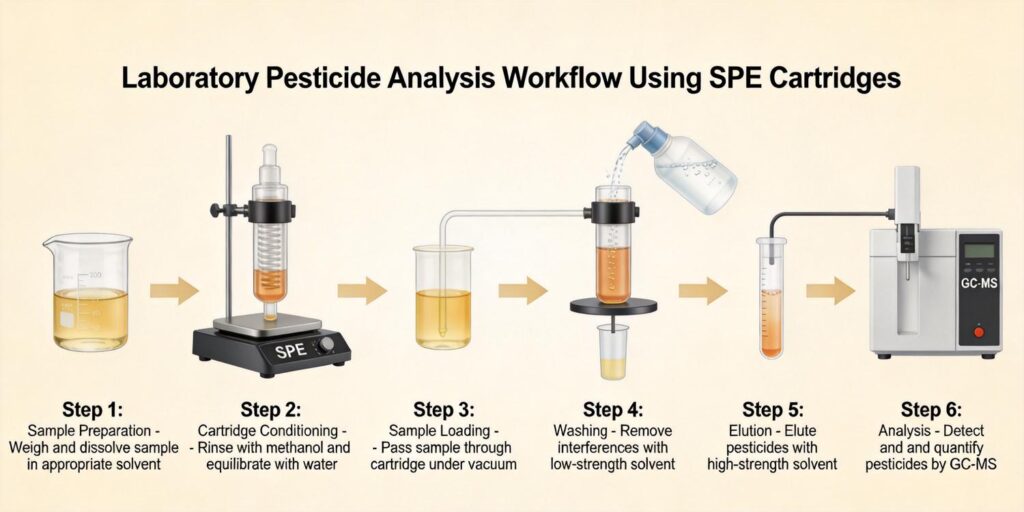
Based on established methodologies and product specifications, here’s a comprehensive SPE protocol for pesticide residue analysis in spinach and lettuce:
Sample Preparation
- Homogenize 15g of sample with 15mL acetonitrile containing 1% acetic acid
- Add extraction salts (4g MgSO4, 1g NaCl, 1g Na3Citrate·2H2O, 0.5g Na2HCitrate·1.5H2O)
- Shake vigorously for 1 minute and centrifuge at 4000 rpm for 5 minutes
SPE Cleanup Procedure
- Cartridge Selection: Use Waters Sep-Pak Carbon Black/PSA or equivalent combination cartridge (500mg each sorbent)
- Conditioning: Pass 5mL acetonitrile through cartridge at 1-2 mL/min
- Equilibration: Pass 5mL acetonitrile:water (1:9, v/v) through cartridge
- Sample Loading: Transfer 1mL of extract supernatant to cartridge, maintain flow rate at 1-2 mL/min
- Washing: Pass 5mL acetonitrile:water (1:9, v/v) to remove polar interferences
- Drying: Apply vacuum for 5 minutes to remove residual water
- Elution: Elute with 10mL acetonitrile containing 1% formic acid
- Concentration: Evaporate to dryness under gentle nitrogen stream at 40°C
- Reconstitution: Reconstitute in 1mL methanol:water (1:1, v/v) for LC-MS/MS analysis
Method Validation Parameters
This protocol typically achieves recovery rates of 70-120% for most pesticides, with RSDs 90% of chlorophyll and other pigments, significantly reducing matrix effects.
LC-MS/MS Performance Improvements After SPE Cleanup
Proper SPE cleanup dramatically improves LC-MS/MS performance for pesticide residue analysis in leafy vegetables. Documented improvements include:
Reduced Matrix Effects
Studies show that SPE cleanup can reduce matrix suppression/enhancement effects from 50-80% to <20% for most pesticides. Waters' data demonstrates that their specialized sorbents can achieve matrix effect reductions of 60-90% compared to untreated extracts.
Improved Sensitivity
Clean extracts allow for lower detection limits, with typical improvements of 5-10x in signal-to-noise ratios. This enables reliable quantification at regulatory limits (often 10-50 ng/g for leafy vegetables).
Enhanced Chromatographic Performance
Removal of pigments and other matrix components prevents column fouling, maintains retention time stability, and improves peak shape. Waters’ UPLC methods demonstrate excellent separation of 402 pesticide residues in 10-minute runs when combined with proper SPE cleanup.
Extended Instrument Lifetime
Reduced matrix loading decreases source contamination in mass spectrometers and extends column lifetime, resulting in lower maintenance costs and improved data quality over time.
Common Matrix Suppression Issues and Mitigation Strategies
Matrix suppression remains a significant challenge in pesticide residue analysis of leafy vegetables, even after SPE cleanup. Understanding and addressing these issues is crucial for reliable quantification.
Ion Suppression Mechanisms
Matrix components can interfere with analyte ionization through several mechanisms:
- Competitive ionization: Co-eluting compounds compete for available charges in the ESI source
- Solution phase effects: Changes in droplet surface tension and evaporation rates
- Gas phase reactions: Proton transfer reactions in the gas phase
Quantification Strategies
Matrix-Matched Calibration
Prepare calibration standards in blank matrix extract to compensate for remaining matrix effects. This approach provides the most accurate quantification but requires sufficient blank matrix.
Standard Addition
Spike known amounts of analytes into sample extracts to account for matrix effects. While accurate, this method is time-consuming for multi-residue analysis.
Isotope-Labeled Internal Standards
Use deuterated or 13C-labeled analogs of target pesticides as internal standards. These compounds experience similar matrix effects as native analytes, providing excellent compensation.
Post-Column Infusion
Monitor matrix effects throughout the chromatographic run by continuously infusing analyte standards post-column while injecting matrix extracts.
Additional Mitigation Approaches
Beyond SPE cleanup, several strategies can further reduce matrix effects:
- Dilution: Simple dilution of extracts can reduce matrix concentration while maintaining adequate sensitivity for many pesticides
- Enhanced Chromatographic Separation: Improved LC methods that separate analytes from matrix components
- Alternative Ionization Techniques: APCI or APPI may show different matrix effects compared to ESI
- Source Parameter Optimization: Careful optimization of source temperature, gas flows, and voltages
Quality Control Measures
Implement comprehensive QC protocols including:
- Regular analysis of procedural blanks
- Continual calibration verification
- Analysis of QC samples at multiple concentration levels
- Monitoring of internal standard responses
- Regular assessment of matrix effects using post-column infusion
By implementing these SPE cleanup strategies and matrix effect mitigation approaches, laboratories can achieve reliable, sensitive, and accurate pesticide residue analysis in challenging leafy vegetable matrices. The combination of appropriate sorbent selection, optimized protocols, and comprehensive quality control ensures compliance with regulatory requirements while maintaining analytical confidence.
For laboratories seeking standardized solutions, products like Waters’ DisQuE systems with specialized sorbent combinations offer validated approaches for leafy vegetable analysis. These systems provide consistent performance and simplify method implementation while maintaining the flexibility needed for different analytical requirements.