
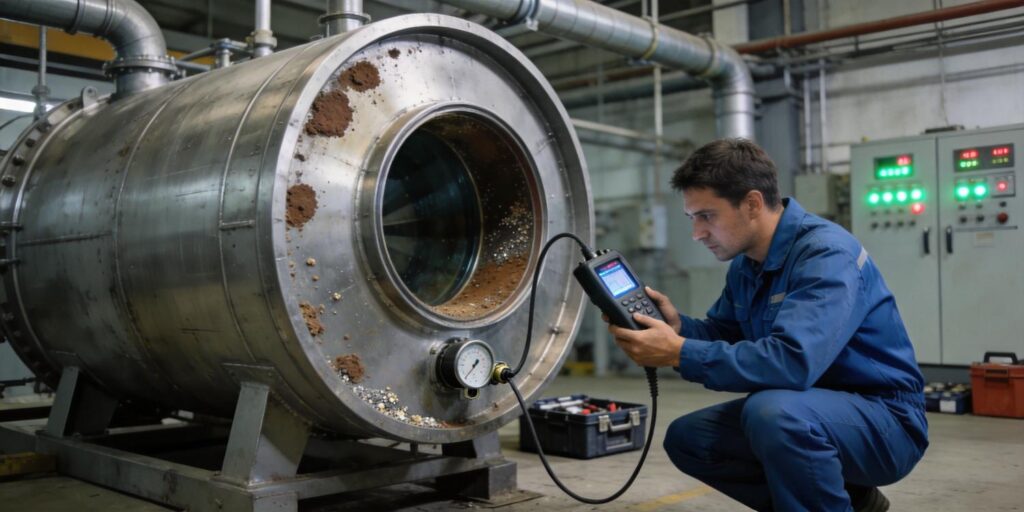
Understanding High Outgassing Systems and Vacuum Gauge Reliability
High-outgassing vacuum systems—common in semiconductor etch, PVD coating, vacuum heat treatment, and analytical instruments—release significant volumes of water vapor, hydrocarbons, and process by-products during pump-down and operation. These gases not only slow base-pressure recovery but also accelerate sensor contamination, leading to drift, false readings, or outright gauge failure. For engineers and procurement teams responsible for uptime, preventing vacuum gauge failure is a matter of process economics: a single unplanned downtime event in a 300 mm etch tool can cost tens of thousands of dollars in lost wafers.
At Poseidon Scientific, we designed the VG-SP205 Pirani Vacuum Transmitter and VG-SM225 Cold Cathode Vacuum Gauge with high-outgassing environments in mind. Their platinum filament, field-cleanable Penning cell, and robust temperature compensation address the very failure modes that plague legacy gauges. This guide details the root causes, early-warning indicators, and proven prevention strategies so your gauges deliver reliable data for the full 3–5 year service life.
Common Causes of Sensor Contamination
Sensor contamination in vacuum gauges stems from four primary sources in high-outgassing systems:
- Chamber and material outgassing: Polymers, elastomers, and residual moisture on chamber walls release water vapor and hydrocarbons during initial pump-down or after venting.
- Process by-products: Fluorine- or chlorine-based etch chemistries, photoresist fragments, and metal halides deposit conductive or insulating films on gauge electrodes and filaments.
- Pump backstreaming: Oil-sealed roughing pumps can introduce hydrocarbon vapor when base pressure is still marginal.
- Prolonged high-pressure exposure: Operating above 10-3 Torr for extended periods overwhelms the gauge’s designed operating envelope.
These mechanisms are well documented in vacuum metrology literature and manifest differently in thermal-conductivity versus cold-cathode technologies. Early detection through pump-down curve analysis can prevent 80 % of failures.
Hydrocarbon Deposition in Cold Cathode Gauges
Cold-cathode gauges like the VG-SM225 rely on a Penning discharge sustained by crossed electric and magnetic fields. In high-outgassing environments, hydrocarbon molecules are ionized and fragmented by electron impact. The resulting radicals polymerize on the cathode and anode surfaces, forming dark carbon layers or colored oxide films.
Visible symptoms include:
- Delayed ignition (startup time exceeds 5–30 minutes at 10-6–10-7 Torr)
- Persistent red LED indication (high-voltage disabled)
- Pressure readings shifted one full decade low (e.g., true 10-5 Torr displayed as 10-6 Torr)
The VG-SM225’s positive-magnetron geometry and removable sensor head were engineered to mitigate this. When contamination occurs, the head can be detached without breaking chamber vacuum, cleaned with 500-mesh or 200-mesh sandpaper until metallic luster returns, and reinstalled in under 10 minutes. This field-serviceable design contrasts sharply with sealed OEM units that require full replacement or factory return, dramatically reducing mean-time-to-repair in 24/7 fabs.
Proactive protection: the gauge’s software automatically disables high voltage above 10-3 Torr, preventing arcing and excessive deposition during roughing phases.
Filament Overload and Degradation in Pirani Gauges
Pirani gauges such as the VG-SP205 measure pressure via the power required to maintain a platinum filament at constant temperature. In high-outgassing systems, two failure modes dominate:
- Corrosive attack: Halogenated etch by-products chemically attack the filament surface, increasing resistance and shifting the power-pressure curve.
- Thermal overload: Prolonged exposure near atmospheric pressure (or repeated high-gas-load cycles) forces the control circuit to deliver excessive power, accelerating filament fatigue.
Platinum was chosen over tungsten precisely for its superior chemical stability and large temperature coefficient of resistance. Even so, lifetime is finite—typically 3–5 years in clean systems and 1–2 years in aggressive etch load locks. The definitive failure mode is filament burnout, which is irreversible and triggers an immediate “sensor error” status code.
Because the VG-SP205 is a sealed transmitter with no user-serviceable parts, the correct preventive strategy is scheduled replacement rather than cleaning. Its compact size and low cost make this economically attractive compared with imported alternatives.
Installation Best Practices to Minimize Contamination Exposure
Proper placement and orientation can reduce contamination flux by an order of magnitude. Follow these guidelines:
Strategic Mounting Location
Install gauges on side ports or via KF16/KF25 extension tubes rather than line-of-sight to the wafer chuck or plasma source. This geometry shields the sensor from direct sputtered material and radical bombardment.
Orientation and Gas Flow
Either gauge may be mounted in any orientation, but vertical (inlet down) aids particulate drainage in systems with heavy deposition. Avoid mounting directly above turbopumps to minimize backstreaming.
Sealing and Virtual Leaks
Use metal-sealed CF flanges where possible; Viton O-rings are acceptable for KF but should be baked at 150 °C prior to first use to reduce initial outgassing. Apply vacuum-grade thread sealant sparingly on any NPT adapters.
RF and Magnetic Isolation
Maintain >10 cm clearance from RF coils and other magnets. The VG-SM225’s localized 100-gauss field has negligible impact on typical ICP or CCP plasmas when side-mounted.
Pump-Down Curve Monitoring as an Early-Warning System
Continuous logging of pressure versus time reveals outgassing anomalies before they damage gauges:
- Normal curve: Smooth exponential decay from atmosphere to base pressure within manufacturer-specified times.
- Warning signatures: Plateau at 10-2–10-3 Torr (excessive water vapor), sudden pressure spikes (virtual leak), or slower-than-expected recovery after venting.
Both Poseidon transmitters output 0–10 V analog and customizable RS232, enabling direct PLC or SCADA trending. Set software alarms at 20 % deviation from baseline curves. In high-outgassing systems, trending the ratio of Pirani to cold-cathode readings during the 10-3 Torr crossover provides a sensitive indicator of contamination buildup long before hard failures appear.
Cleaning and Recalibration Strategy
A tiered approach maximizes gauge life:
Cold Cathode (VG-SM225)
Inspect monthly in aggressive chemistries. Clean when ignition exceeds 10 minutes or readings deviate >1 decade. Procedure:
- Power off and vent gauge port.
- Remove sensor head (tool-free).
- Gently abrade cathode and anode with 500-mesh sandpaper until metallic luster returns—no mirror finish required.
- Reinstall and run factory burn-in cycle (30 min at 10-4 Torr).
Post-cleaning recalibration is rarely needed; the linear current-pressure relationship is restored by geometry alone.
Pirani (VG-SP205)
Non-serviceable. Monitor filament current draw via RS232 status bytes. Replace at first sign of drift beyond ±10 % in the linear region or when error code indicates burnout.
Factory Recalibration
Return gauges annually for full multi-point calibration against NIST-traceable standards. Poseidon offers expedited service with 48-hour turnaround for critical tools.
Preventive Maintenance Checklist for High-Outgassing Systems
| Frequency | Action | VG-SP205 Pirani | VG-SM225 Cold Cathode |
|---|---|---|---|
| Daily | Verify 0–10 V output and status LEDs | Check linear region stability | Confirm HV enable below 10-3 Torr |
| Weekly | Review pump-down curve logs | Flag any plateau >15 min at 10-2 Torr | Monitor ignition time |
| Monthly | Visual inspection & data trending | Compare filament power draw to baseline | Check for carbon deposits via startup behavior |
| Quarterly | Sensor cleaning or replacement | N/A (monitor only) | Clean electrodes if indicated |
| Annually | Factory recalibration | Full curve verification | Full curve verification |
| As-needed | Post-maintenance burn-in | Replace if burnout error | 30-minute conditioning at 10-4 Torr |
Download this checklist as a printable PDF from the Poseidon resource center (link in CTA below) and integrate it into your CMMS system for automated reminders.
Conclusion: Reliability by Design
High-outgassing systems do not have to shorten vacuum gauge life. By understanding contamination physics, installing gauges strategically, monitoring pump-down curves, and leveraging field-cleanable designs, engineers can achieve 3–5 years of continuous service with minimal intervention. The VG-SP205 and VG-SM225 pair—maintenance-free Pirani for load locks and cleanable cold cathode for main chambers—were purpose-built for exactly these conditions, delivering OEM-equivalent performance at 40–60 % lower total cost of ownership.
Proactive maintenance is the difference between scheduled calibration and unscheduled downtime. Implement the strategies above and your gauges will remain the reliable sentinels your process demands.
Request your free Poseidon Scientific Preventive Maintenance Guide—a 12-page PDF containing expanded checklists, troubleshooting flowcharts, and sample pump-down curves for high-outgassing etch and PVD tools. Our product managers are also available for a no-obligation system audit tailored to your chamber chemistry and tool platform.
Learn more about VG-SP205 Pirani Vacuum Transmitter
Learn more about VG-SM225 Cold Cathode Vacuum Gauge
At Poseidon Scientific, we measure success by the vacuum systems that never go down.


