
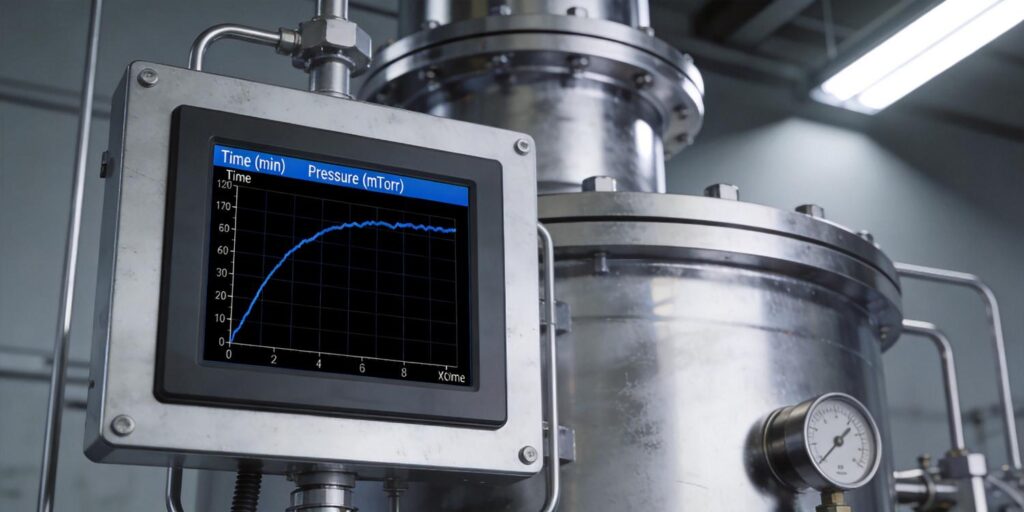
Analyze Full Pump-Down Curve (Atmosphere to High Vacuum)
Every vacuum system tells its story through the pump-down curve: pressure versus time from atmosphere (760 Torr) down to the ultimate base pressure. Plotting this curve—ideally with a data logger or PLC trend—is the first and most critical step in gauge sizing. A typical mechanical-pump + turbo-molecular-pump system shows three distinct regimes:
- Atmosphere to ~1 Torr: viscous flow, rapid pressure drop
- 1 Torr to 10⁻³ Torr: transition to molecular flow, Pirani-linear region
- Below 10⁻³ Torr: high-vacuum molecular regime where only ionization gauges deliver usable signal
Poseidon Scientific’s VG-SP205 Pirani Vacuum Transmitter covers the entire roughing phase (760 Torr to 10⁻³ Torr) with its thermal-conductivity principle. Its platinum filament and temperature-compensation circuit keep error below ±15 % in the linear band (10 Torr to 10⁻² Torr) and still provide usable (though non-linear) output up to atmosphere and down to 10⁻³ Torr. The VG-SM225 Cold Cathode Vacuum Gauge picks up exactly where the Pirani rolls off, delivering reliable ion-current output from 10⁻³ Torr to 10⁻⁷ Torr via Penning discharge in a compact traditional magnetron geometry.
Record at least three full pump-down cycles under normal process conditions. Mark the time to reach 10⁻³ Torr (the crossover point) and the ultimate pressure after 30–60 min. This map immediately reveals whether a single gauge can suffice or if a dual-gauge handoff is required. Industry references such as Lafferty’s Foundations of Vacuum Science and Technology confirm that no single technology spans atmosphere to 10⁻⁷ Torr with acceptable accuracy and overload tolerance.
Identify Steady-State Operating Window
Once the pump-down curve is in hand, overlay your process recipe. Most coating, heat-treatment, or analytical instruments spend 80–90 % of cycle time at a narrow steady-state pressure band—often called the “operating window.”
Typical windows include:
- PVD/ sputter coating: 10⁻³ to 10⁻² Torr (process gas flow)
- High-vacuum evaporation or ALD: 10⁻⁵ to 10⁻⁶ Torr
- Mass-spectrometer foreline: 10⁻⁴ to 10⁻⁶ Torr
- Vacuum annealing furnaces: 10⁻⁵ Torr setpoint
Locate this window on your curve. If it sits entirely above 10⁻³ Torr, a single VG-SP205 Pirani is often sufficient. If it lies below 10⁻⁴ Torr, the VG-SM225 Cold Cathode alone will suffice. Most real-world systems, however, cross the 10⁻³ Torr boundary during pump-down and again during venting, making the dual-gauge architecture the practical choice. The two Poseidon units overlap precisely at 10⁻³ Torr, allowing the PLC to blend signals smoothly and deliver continuous full-range monitoring without gaps.
Determine Required Measurement Resolution at Control Setpoint
Control loops are only as good as the sensor resolution at the exact operating pressure. The VG-SP205 outputs 0–10 V analog (effective linear range 2–8 V), corresponding to atmosphere to 10⁻³ Torr. At a 10⁻² Torr setpoint, a 0.1 V change equals roughly 10 % pressure shift—adequate for most PID loops. Below 10⁻³ Torr the Pirani signal flattens, losing resolution.
The VG-SM225 Cold Cathode, operating at –2000 V with ~100 gauss magnetic field, produces a near-logarithmic ion current that the internal electronics convert to a clean 0–10 V output. In the 10⁻⁵ Torr region, 0.1 V resolution easily distinguishes 5 % pressure changes—critical when process yield depends on maintaining ±10 % of target pressure. Both gauges transmit additional digital status (temperature, error codes, HV state) via customizable RS232, giving the PLC sub-0.1 % digital resolution when needed.
Rule of thumb: at your control setpoint, the gauge should deliver at least 50 digital counts or 0.2 V per decade of pressure change. If your process tolerates only ±2 % deviation (e.g., optical-coating uniformity), verify that the selected gauge meets this threshold in the overlap or operating band.
Evaluate Overload Tolerance During Venting
Venting is the most stressful event for any vacuum gauge. Rapid return to atmosphere can destroy hot-cathode filaments or contaminate cold-cathode electrodes. The VG-SP205 Pirani is inherently overload-proof: its platinum filament operates at low temperature and tolerates atmosphere indefinitely with no damage or recalibration drift. Lifetime remains 3–5 years even with daily venting.
The VG-SM225 Cold Cathode includes built-in protection: embedded firmware and hardware interlock automatically disable the –2500 V startup rail whenever pressure exceeds 10⁻³ Torr (detected via internal current monitoring). An LED flashes to indicate “HV off—safe to vent.” Once pressure drops below the threshold after roughing, the gauge restarts automatically. This design eliminates the need for external pressure switches or interlocks that legacy systems require. Field data from Poseidon’s mass-spectrometer customers confirm zero electrode damage after >500 vent cycles when the software protection is active.
During sizing, confirm that your venting protocol reaches >10⁻³ Torr within 30 s of the cold-cathode gauge; otherwise, add a simple Pirani interlock signal to the PLC for extra safety.
Select Single vs Dual-Gauge Architecture
With the curve, operating window, resolution, and overload data in hand, the architecture decision is straightforward:
| Operating Window | Recommended Architecture | Products | Reason |
|---|---|---|---|
| Entirely above 10⁻³ Torr | Single gauge | VG-SP205 Pirani only | Full range, zero maintenance, lowest cost |
| Entirely below 10⁻⁴ Torr | Single gauge | VG-SM225 Cold Cathode only | High resolution, cleanable electrodes |
| Crosses 10⁻³ Torr or full-range monitoring required | Dual-gauge with overlap | VG-SP205 + VG-SM225 | Continuous coverage, analytical redundancy, seamless PLC handoff |
The dual option adds <10 % to hardware cost yet reduces risk dramatically and simplifies compliance documentation. Both Poseidon gauges share the same RJ45 connector and 24 VDC supply footprint, so mechanical and electrical integration is plug-and-play.
Example Sizing Case (Coating Chamber)
Consider a 300 mm PVD sputter-coating chamber for optical thin films. Recorded pump-down curve: atmosphere to 10⁻³ Torr in 4 min (rotary + Roots), then turbo reaches 5×10⁻⁵ Torr in 12 min total. Steady-state recipe holds 8×10⁻⁵ Torr (±5 %) for 25 min with argon flow. Venting to atmosphere occurs every cycle.
Requirements:
- Full-range monitoring for interlocks
- ±5 % control at 8×10⁻⁵ Torr
- Daily venting tolerance
Sizing result: dual architecture. VG-SP205 Pirani covers roughing and provides the >10⁻³ Torr signal to safely disable the cold cathode during vent. VG-SM225 Cold Cathode delivers the high-resolution 0–10 V output in the 10⁻⁵ Torr band. At the 10⁻³ Torr crossover the PLC switches (or blends) signals using simple logic: if Pirani >5×10⁻⁴ Torr use Pirani; else use cold cathode. Total landed cost for the pair remains well under imported single-gauge equivalents, with built-in protocol customization for the customer’s existing Siemens PLC. After 18 months of 24/7 operation, only one electrode cleaning (10 min) was required on the cold cathode; the Pirani needed zero service.
Ready for Your Application Review?
Sizing a vacuum gauge is not guesswork—it is a data-driven engineering exercise that directly impacts yield, uptime, and cost of ownership. By mapping your real pump-down curve, locking onto the steady-state window, verifying resolution at setpoint, and confirming overload tolerance, you can select the exact Poseidon gauge (or pair) that delivers years of maintenance-free performance.
Our team has sized hundreds of systems for mass spectrometers, coating tools, vacuum furnaces, and research chambers. Send us your pump-down curve (even a simple Excel plot), setpoint, and venting frequency, and we will return a complete sizing recommendation—including PLC logic snippet, wiring diagram, and costed BOM—within 48 hours.
Explore the products used in thousands of successful installations:
- VG-SP205 Pirani Vacuum Transmitter – roughing and transition monitoring
- VG-SM225 Cold Cathode Vacuum Gauge – high-vacuum precision with cleanable electrodes
Contact us today for your no-obligation application review. Let Poseidon Scientific help you right-size every vacuum gauge in your facility—once and for all.


