Understanding Preservatives in Cosmetic Creams
Preservatives are essential in cosmetic creams to prevent microbial growth and extend shelf life. Common preservatives include parabens (methyl-, ethyl-, propyl-, butyl-, and isobutylparaben), phenoxyethanol, benzyl alcohol, sorbic acid, salicylic acid, and formaldehyde-releasing agents like DMDM hydantoin. Regulatory bodies such as the EU Cosmetics Regulation (EC No. 1223/2009) and the US FDA specify maximum allowed concentrations, making accurate determination critical for compliance.
Challenges of Lipid-Rich Cosmetic Matrices
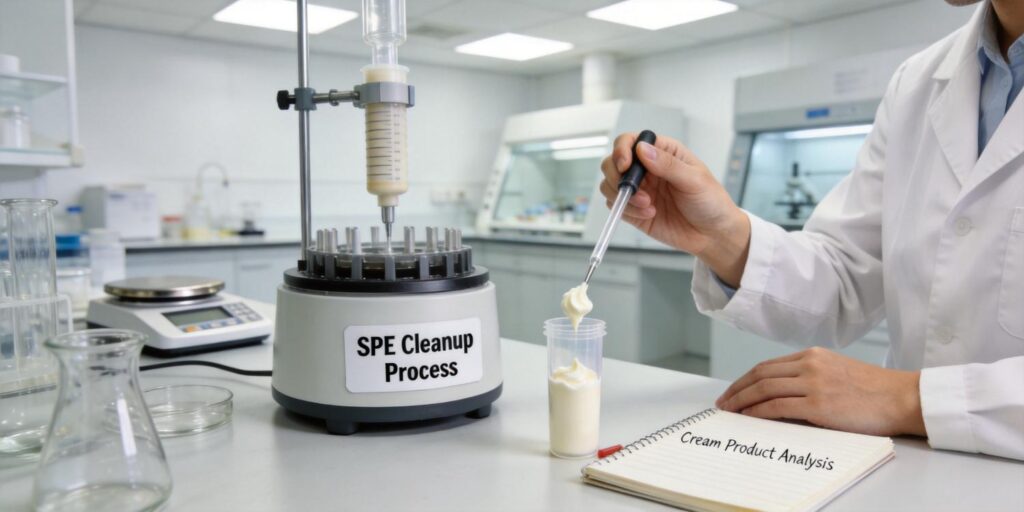
Cosmetic creams are complex emulsions containing oils, waxes, emulsifiers, humectants, and active ingredients. The high lipid content can interfere with chromatographic analysis by co-extracting and causing column fouling, matrix effects, and reduced sensitivity. Solid-phase extraction (SPE) is the preferred cleanup technique to isolate preservatives from these challenging matrices.
Sample Dilution and Extraction Protocols
Begin by weighing 1 g of cosmetic cream into a 15 mL centrifuge tube. Add 5 mL of methanol or acetonitrile and vortex for 2 minutes. For lipid-rich samples, a freeze-out step (−20°C for 30 minutes) helps precipitate fats. Centrifuge at 5000 × g for 10 minutes and collect the supernatant. Dilute the supernatant with water to reduce organic solvent content to below 10% before loading onto the SPE cartridge. This step is critical for proper retention of analytes on reversed-phase or mixed-mode sorbents.
SPE Cartridge Conditioning and Equilibration
For this application, HLB SPE cartridges (hydrophilic-lipophilic balance) are recommended due to their ability to retain both polar and nonpolar preservatives. Condition the cartridge with 3 mL of methanol, followed by 3 mL of water. Do not allow the bed to dry between conditioning and sample loading. Equilibration ensures consistent interactions between the sorbent and analytes.
Washing Steps Removing Oils and Emulsifiers
After loading the diluted sample (1–2 mL/min), wash the cartridge with 5 mL of 5% methanol in water containing 2% formic acid to remove acidic interferences. Then wash with 5 mL of 5% methanol in water to remove neutral lipids and emulsifiers. For more rigorous cleanup, a wash with 3 mL of hexane can be used – however, this may elute some nonpolar preservatives, so validation is necessary. MAX SPE cartridges (mixed-mode anion exchange) can provide additional selectivity for acidic preservatives like benzoic and sorbic acids.
Elution with Organic Solvent Mixtures
Elute the target preservatives with 5 mL of methanol or acetonitrile. For mixed-mode cartridges like MCX (cation exchange) or WAX (weak anion exchange), use acidified or basified organic solvents. For HLB, methanol alone is sufficient. Evaporate the eluate under nitrogen and reconstitute in 1 mL of mobile phase (e.g., water:methanol 50:50).
HPLC-UV or LC-MS Detection
Separate preservatives using a C18 column (150 × 4.6 mm, 5 µm) with a mobile phase of 0.1% formic acid in water (A) and methanol (B). Gradient: 40% B to 90% B over 20 minutes. UV detection at 254 nm for parabens and 280 nm for other preservatives. LC-MS/MS in negative ionization mode offers higher sensitivity and confirmation. Typical MRM transitions: methylparaben (151→92), propylparaben (179→136).
Cosmetic Regulatory Compliance Testing
This SPE workflow meets the requirements of ISO 12787:2011 for cosmetic analysis and EU regulation testing. Recoveries should be between 80–120% with RSD <15%. For high-throughput needs, 96-well SPE plates are available, allowing simultaneous processing of multiple samples. Always include matrix-matched calibration standards and isotope-labeled internal standards for quantitation. Validate the method using certified reference materials (CRMs) to ensure accuracy.
By following this SPE protocol, laboratories can achieve reliable, reproducible results for preservative determination in cosmetic creams, meeting both quality control and regulatory demands.