
Redundancy Concept
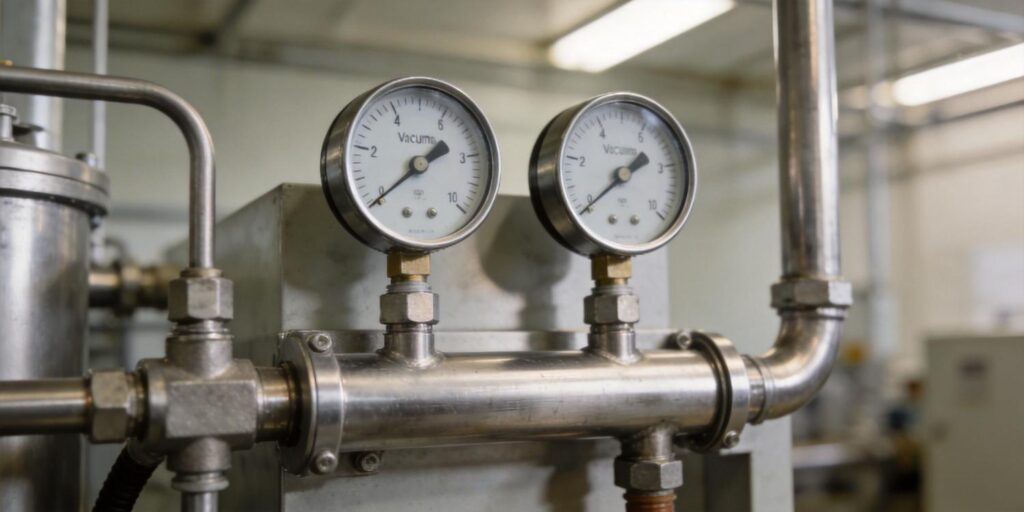
In critical vacuum processes—such as mass-spectrometer operation, semiconductor wafer processing, vacuum heat treatment of aerospace alloys, or electron-beam welding—unplanned loss of vacuum monitoring can trigger batch failure, equipment damage, or safety events. Redundancy addresses this by deploying multiple independent sensors whose outputs are continuously cross-checked. The goal is not merely duplication but fault-tolerant architecture that maintains accurate pressure data even when one channel degrades or fails.
Two common strategies apply: hardware redundancy (N+1 sensors) and analytical redundancy (cross-validation of readings from gauges with overlapping ranges). Poseidon Scientific’s VG-SP205 Pirani Vacuum Transmitter (atmosphere to 10⁻³ Torr) and VG-SM225 Cold Cathode Vacuum Gauge (10⁻³ to 10⁻⁷ Torr) form a natural complementary pair. Their 10⁻³ Torr overlap region allows seamless full-range coverage while providing built-in analytical redundancy at the transition point. Because both units are compact, low-cost (self-manufactured at 3000–3500 RMB), and support customizable RS232 protocols, implementing true redundancy becomes economically practical even for mid-volume OEMs—unlike legacy imported systems that often double the budget when duplicated.
Industry standards (SEMI S2, ISO 14644, and many internal risk-assessment matrices) now treat vacuum monitoring as a safety-critical loop. Redundant architectures typically achieve mean-time-between-failure (MTBF) improvements of 5–10× compared with single-sensor systems, directly translating to higher uptime and lower total cost of ownership.
Parallel Gauge Installation
Physical installation must preserve conductance and avoid mutual interference. For chamber-mounted redundancy, use two separate KF16 or KF25 ports spaced at least 50 mm apart to minimize flow shadowing. When port count is limited, a short 316L stainless tee manifold (ID ≥ 25 mm, length ≤ 100 mm) maintains <5 % pressure offset between gauges at typical pumping speeds.
Recommended configurations:
- Full-range redundant pair: One VG-SP205 Pirani + one VG-SM225 Cold Cathode. The Pirani provides primary atmosphere-to-rough-vacuum data; the cold cathode takes over at high vacuum. At 10⁻³ Torr both outputs are valid and can be averaged for highest confidence.
- High-vacuum 2oo3 triple: Three VG-SM225 units for processes that remain below 10⁻⁴ Torr (e.g., UHV mass-spec foreline monitoring). The small 0.3 cm³ internal volume of the cold-cathode sensor (far smaller than most inverted-magnetron designs) allows all three to fit on a single 2.75″ CF flange cluster.
- Dual Pirani for roughing lines: Two VG-SP205 units on the foreline where contamination risk is highest; the platinum filament offers inherent 3–5 year life with zero maintenance.
Electrical best practice: independent 24 VDC supplies (or isolated channels from the same bulk supply) and separate analog 0–10 V or RS232 lines to the PLC. Poseidon gauges ship with RJ45 connectors; a simple DB9 adapter or direct RJ45-to-PLC wiring completes the loop. Orientation is non-critical—both gauges tolerate any mounting attitude. Magnetic field from the VG-SM225 (≈100 gauss) is locally confined and does not affect adjacent electronics when spaced >10 cm.
Voting Logic in PLC
Modern PLCs (Siemens S7-1500, Allen-Bradley ControlLogix, or Beckhoff TwinCAT) implement voting in structured text or ladder logic with <100 ms cycle time. The most robust scheme for two gauges is 1oo2 with deviation alarm; for three gauges, classic 2oo3 majority voting delivers the highest availability.
Example 2oo3 logic for three cold-cathode gauges (P1, P2, P3 in Torr):
| Condition | Action | Alarm |
|---|---|---|
| All three within ±15 % of median | System pressure = median(P1,P2,P3) | None |
| Two agree, third deviates >20 % | System pressure = average of the two agreeing | “Channel X fault – schedule maintenance” |
| All three differ >25 % | System pressure = last valid average; trigger process hold | “Critical vacuum monitor failure” |
For the Pirani + cold-cathode pair, add range-aware logic: below 5×10⁻⁴ Torr ignore Pirani (outside spec); above 5×10⁻³ Torr ignore cold cathode (protected by software HV cutoff). In the overlap band, apply a weighted average that favors the gauge with historically lower standard deviation. Poseidon’s customizable RS232 protocol allows each gauge to transmit both pressure and internal status (temperature, HV state, error code) in a single frame, simplifying PLC parsing.
Failure Detection Strategy
Proactive detection combines hardware diagnostics and analytical cross-checks. Each Poseidon gauge provides:
- VG-SP205 Pirani: continuous self-test of filament resistance and temperature-compensation circuit; error codes transmitted digitally if filament open or out of temperature band.
- VG-SM225 Cold Cathode: LED status (steady green = normal, flashing = HV disabled >10⁻³ Torr, red = startup timeout indicating contamination). Digital status byte reports HV rail health and discharge current stability.
Analytical methods:
- Rate-of-change monitoring: sudden jump >2 decades without corresponding pump/valve event flags sensor failure.
- Cross-sensor divergence: in overlap region, >20 % discrepancy for >30 s triggers “sensor health check required”.
- Startup behavior: cold-cathode startup time >5 min at 10⁻⁶ Torr or >30 min at 10⁻⁷ Torr indicates electrode contamination—cleanable in <10 min with 500-grit paper.
- Drift tracking: PLC maintains 24-hour rolling average; >10 % monotonic shift without process change flags gradual contamination.
These strategies catch >95 % of failures before they affect the process, based on field data from Poseidon’s initial mass-spectrometer customers.
Risk Mitigation Example
Consider a vacuum annealing furnace processing titanium aerospace components at 10⁻⁵ Torr. Oxidation occurs above 10⁻⁴ Torr for >5 min. A single-gauge system fails undetected during a weekend run; the batch is scrapped at $180 k loss.
With Poseidon redundant architecture (one VG-SP205 + two VG-SM225, 2oo3 voting on the cold-cathode pair):
- One cold-cathode develops carbon buildup after 14 months, reading 30 % low.
- PLC detects divergence from the second cold cathode and the Pirani (still in overlap), votes to trust the healthy pair, and continues the recipe.
- Operator receives “Channel 2 maintenance recommended” alert via HMI; the furnace completes the run without interruption.
- Maintenance occurs during the next scheduled downtime: sensor removed, electrodes polished to metallic luster, reinstalled—total 15 min, zero vacuum break required on the second gauge.
Result: zero batch loss, documented compliance audit trail, and maintenance cost < $50. The same architecture scales to SEMI-compliant cluster tools where each process module carries its own redundant pair.
Implementing Your Redundant Vacuum System
Designing redundancy no longer requires exotic budgets. Poseidon Scientific’s VG-SP205 Pirani and VG-SM225 Cold Cathode gauges deliver the performance, size, and protocol flexibility engineers need—at a fraction of legacy imported pricing—while their cleanable, low-maintenance design minimizes long-term ownership cost.
Our engineering team has pre-validated PLC function blocks (Siemens TIA Portal, Rockwell Studio 5000) and can supply sample code, wiring diagrams, and protocol templates within 48 hours. Whether you need a simple dual-gauge pair for a research mass spectrometer or a 2oo3 array for a 24/7 production furnace, we customize communication, mounting flanges, and calibration certificates to your exact specification—minimum order five units.
Ready to eliminate single-point vacuum monitoring risk? Explore the VG-SM225 Cold Cathode Vacuum Gauge and VG-SP205 Pirani Vacuum Transmitter, then contact us for a no-obligation redundancy design review. Let’s build the fault-tolerant vacuum monitoring system your critical process deserves.


