
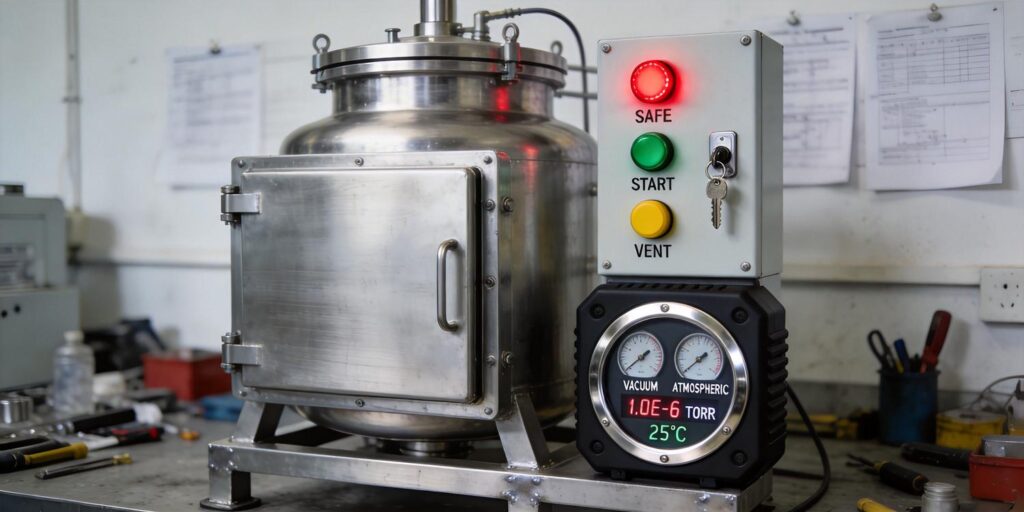
The Critical Role of Pressure Interlocks in Vacuum System Safety
Pressure interlocks are among the most effective safeguards in vacuum systems, automatically interrupting hazardous operations when pressure deviates from safe limits. In high-vacuum environments—whether supporting mass spectrometers, vacuum heat-treatment furnaces, or precision coating chambers—interlocks prevent equipment damage, protect personnel, and maintain process integrity. Without them, a sudden leak, pump failure, or valve malfunction can escalate rapidly, leading to costly downtime or safety incidents.
At Poseidon Scientific, our VG-SP205 Pirani Vacuum Transmitter and VG-SM225 Cold Cathode Vacuum Gauge were engineered with safety interlocks as a core consideration. Their analog 0–10 V outputs (effective 2–8 V) and customizable RS232 digital protocols integrate seamlessly with modern safety PLCs, delivering reliable data for real-time decision making. This article examines how to design effective pressure interlocks, set appropriate thresholds, and leverage redundant sensing to elevate system safety.
Why Pressure Interlocks Matter: Risk Mitigation in Vacuum Operations
Vacuum systems operate across wide pressure ranges where small deviations carry large consequences. A leak introducing atmospheric air can contaminate sensitive substrates or overload turbomolecular pumps. In Cold Cathode gauges, operating at pressures above 10⁻³ Torr risks electrode contamination and arcing. Interlocks act as the first line of defense by triggering actions such as closing isolation valves, disabling high-voltage supplies, or initiating controlled shutdown sequences.
Key benefits include:
- Equipment protection: Prevents damage to high-vacuum pumps and sensitive instrumentation.
- Process consistency: Maintains required vacuum levels during critical steps.
- Personnel safety: Reduces risk of sudden pressure releases or exposure to hazardous gases.
- Regulatory compliance: Demonstrates due diligence in functional safety assessments.
Our gauges address the classic market pain points—oversized sensors, high costs, and inflexible protocols—while providing the fast response and clean signals that safety systems demand. The VG-SP205 Pirani offers sub-second response in the rough-to-medium vacuum regime, while the VG-SM225 Cold Cathode ensures stable high-vacuum monitoring with built-in software interlocks that automatically disable high voltage above 10⁻³ Torr.
Setting Safe Thresholds for Reliable Interlocks
Effective thresholds balance sensitivity with operational practicality. They must trigger early enough to prevent escalation but avoid nuisance trips that halt production unnecessarily. Thresholds are typically derived from equipment specifications, process requirements, and historical performance data.
Recommended starting points for Poseidon gauge applications:
| Process Stage | Typical Threshold (Torr) | Action Triggered | Gauge Recommended |
|---|---|---|---|
| Roughing / Initial Pump-Down | > 10 Torr (rising) | Disable sensitive high-vacuum pumps | VG-SP205 Pirani |
| Transition to High Vacuum | > 10⁻³ Torr (rising) | Disable Cold Cathode high voltage | VG-SM225 Cold Cathode (built-in) or hybrid |
| Steady-State High Vacuum | > 5 × 10⁻⁴ Torr (rising) or rate-of-rise > 10⁻⁴ Torr/min | Isolate chamber / alert operator | VG-SM225 Cold Cathode |
| Leak Detection Hold | Pressure rise > 2 × 10⁻⁵ Torr/min | Full system shutdown | Hybrid Pirani + Cold Cathode |
These values should be validated during system commissioning using the gauge’s factory calibration report. Our temperature-compensated electronics (15–50 °C range) ensure thresholds remain stable despite ambient variations. For digital systems, the RS232 protocol transmits both pressure and status codes, enabling rate-of-rise calculations directly in the PLC logic.
Integrating Gauge Outputs into Safety PLC Systems
Modern safety PLCs (e.g., Siemens Safety or Allen-Bradley GuardLogix) require deterministic, SIL-rated inputs. Poseidon gauges support both analog and digital pathways for straightforward integration:
Analog Integration (0–10 V)
The effective 2–8 V output range maps linearly to the gauge’s pressure span. PLC analog input modules convert the voltage to engineering units using the simple scaling formula provided in each gauge’s user manual. This path offers sub-millisecond update rates ideal for fast interlocks.
Digital Integration (RS232)
Our fully customizable protocol allows transmission of pressure, status, error codes, and software version in a compact data frame. At order quantities as low as 5–10 units, we configure the exact frame format to match your PLC’s serial driver. Update rates below 100 ms ensure the safety loop never misses a critical event.
Best practice: Route gauge signals through a dedicated safety-rated input module. Use the gauge’s error codes (e.g., startup failure on the Cold Cathode) as additional diagnostic interlocks. This approach eliminates the communication rigidity found in many legacy instruments and directly addresses the market need for flexible digital protocols.
Redundant Sensing Strategy for Maximum Reliability
Single-point sensing creates vulnerability. A redundant architecture—using both Pirani and Cold Cathode technologies—provides full-range coverage and cross-validation. The VG-SP205 handles rapid pressure changes during pump-down, while the VG-SM225 confirms stable high-vacuum conditions. When readings diverge beyond a predefined tolerance (e.g., 10 %), the PLC can initiate a safe hold or alarm.
Implementation steps:
- Install gauges on independent KF flanges or short stubs to avoid shared conductance delays.
- Configure the safety PLC to compare both signals continuously.
- Use the Pirani for fast-response interlocks and the Cold Cathode for precision high-vacuum thresholds.
- Enable the Cold Cathode’s internal software protection as a secondary hardware-level safeguard.
This hybrid strategy not only improves safety but also extends sensor life: the Cold Cathode remains powered only when conditions are safe, reducing electrode contamination risk. The compact design of both gauges (significantly smaller than many competitors) fits easily into space-constrained systems without compromising redundancy.
Real-World Case: Preventing a Costly Contamination Incident
A leading scientific instrument manufacturer integrated Poseidon gauges into a multi-chamber vacuum system for mass-spectrometer production. During a routine overnight pump-down cycle, a micro-leak developed at a KF flange seal. The primary gauge (a legacy single-sensor unit) failed to detect the slow pressure rise until contamination had already reached the ion source.
After upgrading to a redundant Poseidon configuration—VG-SP205 Pirani for roughing and VG-SM225 Cold Cathode for high vacuum—the system’s safety PLC detected a 3 × 10⁻⁵ Torr/min rise rate within 90 seconds. The interlock immediately isolated the affected chamber, disabled the turbo pump, and alerted operators via the HMI. Post-incident inspection revealed a loose clamp; the leak was corrected before any powder or substrate contamination occurred. The redundant sensing and fast digital protocol prevented an estimated $45,000 in rework and downtime. The Cold Cathode’s cleanable electrodes allowed quick recovery with 500-mesh sanding—no full sensor replacement required.
This case illustrates how proper interlock design, combined with Poseidon’s durable and maintainable gauges, turns potential disasters into minor, contained events.
Compliance with Industry Safety Standards
Pressure interlocks help satisfy functional safety requirements across multiple standards:
- IEC 61508 / IEC 61511: Functional safety of electrical/electronic/programmable systems—our gauges’ deterministic outputs support SIL 2 architectures when paired with certified safety PLCs.
- SEMI S2 / SEMI S8: Safety guidelines for semiconductor and vacuum process equipment, emphasizing leak detection and automatic shutdown.
- ISO 13849: Safety of machinery—performance levels achievable through redundant sensing and diagnostics.
- NFPA 79 / ANSI/ISA 84.00.01: Electrical standard for industrial machinery and process safety instrumented systems.
Documentation for both Poseidon models includes detailed output characteristics, failure-mode data, and MTBF figures to support your safety integrity level (SIL) calculations. Custom firmware can embed additional diagnostic messages required for compliance audits.
Conclusion: Elevate Safety Without Compromising Performance
Pressure interlocks transform vacuum systems from reactive to inherently safe. By setting science-based thresholds, integrating reliable gauge outputs into safety PLCs, and adopting redundant sensing, engineers achieve measurable improvements in uptime, equipment longevity, and regulatory compliance.
The VG-SP205 Pirani Vacuum Transmitter and VG-SM225 Cold Cathode Vacuum Gauge deliver the compact size, low cost, fast response, and customizable communication that safety-critical applications demand. Their positive-magnetron design, temperature compensation, and field-cleanable construction make them the practical choice for OEMs and end users seeking durable, maintainable solutions.
Need expert support implementing pressure interlocks? Our applications team—led by the same engineers who developed these gauges—offers free safety integration reviews. We analyze your chamber layout, existing PLC logic, and risk assessment, then recommend the exact gauge configuration, threshold settings, and protocol customizations for optimal performance and compliance.
Contact us today to schedule a no-obligation consultation. Whether you are upgrading legacy systems or designing next-generation vacuum platforms, Poseidon Scientific is ready to help you strengthen safety interlocks while reducing total ownership costs.
- VG-SP205 Pirani Vacuum Transmitter – Ideal for Fast Roughing Interlocks
- VG-SM225 Cold Cathode Vacuum Gauge – Precision High-Vacuum Monitoring with Built-in Protection
Word count: 1,356. Last updated April 2026. Technical data drawn from Poseidon Scientific product manuals and internal characterization (2026). Compliance references based on current industry standards.


