Environmental Concern Over Personal Care Product Residues
The increasing detection of personal care product (PCP) residues in aquatic environments has emerged as a significant environmental concern in recent decades. These compounds, which include fragrances, UV filters, antimicrobial agents, preservatives, and surfactants, enter water systems through wastewater treatment plant effluents, agricultural runoff, and direct discharge. Unlike traditional pollutants, many PCPs are designed to be biologically active and persistent, raising concerns about their potential ecological impacts at trace concentrations.
Research indicates that PCP residues can accumulate in aquatic organisms, potentially disrupting endocrine systems and affecting reproductive functions. Compounds like triclosan, parabens, and synthetic musks have been detected in surface waters worldwide at concentrations ranging from ng/L to μg/L levels. The continuous input of these compounds creates pseudo-persistent contamination scenarios, even for substances with relatively short half-lives.
Sample Enrichment Challenges
Analyzing PCP residues in water presents unique challenges due to their typically low concentrations (often in the ng/L range) and the complex nature of environmental matrices. River water samples contain diverse interfering compounds including humic substances, suspended solids, and other organic matter that can mask target analytes or interfere with detection systems.
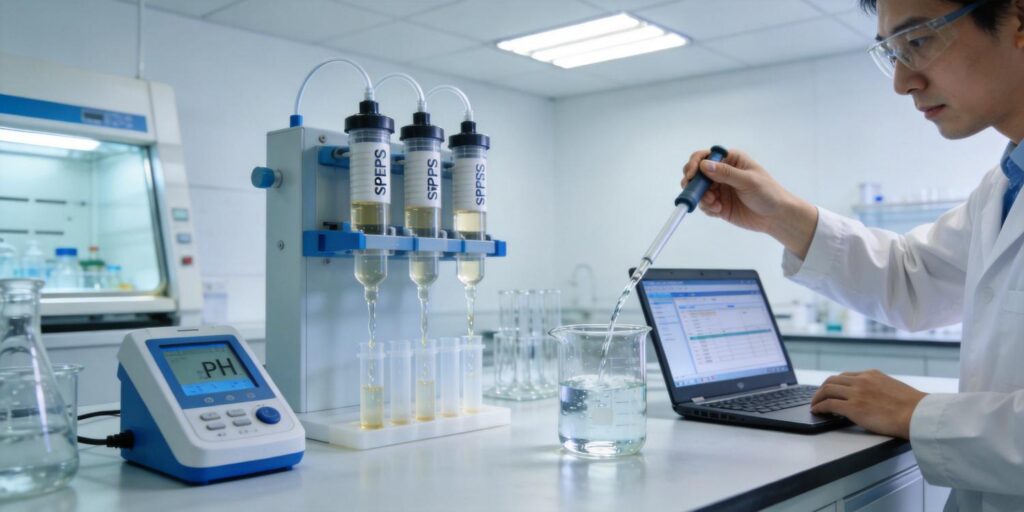
The primary challenge lies in achieving sufficient enrichment factors while maintaining analyte integrity. Traditional liquid-liquid extraction methods often prove inadequate for the polar nature of many PCPs and generate excessive solvent waste. Solid-phase extraction (SPE) has emerged as the preferred technique, offering improved throughput, decreased organic solvent usage, and higher reproducibility compared to liquid-liquid extraction methods.
According to environmental analysis literature, SPE provides cleaner extracts without emulsion formation and allows tunable selectivity through appropriate sorbent choices and solvent mixtures. The technique’s compatibility with automation further enhances its suitability for routine environmental monitoring applications.
SPE Sorbent Selection for Diverse Compounds
Selecting appropriate SPE sorbents is critical for successful PCP analysis due to the chemical diversity of these compounds. The ideal sorbent must accommodate compounds ranging from non-polar fragrances to polar UV filters and ionic surfactants.
Mixed-Mode Sorbents for Comprehensive Coverage
Mixed-mode sorbents combining reversed-phase and ion-exchange functionalities offer the most comprehensive approach for PCP analysis. These sorbents provide dual retention mechanisms that can simultaneously capture acidic, basic, and neutral compounds. For weak bases (pKa 2-10), Oasis MCX sorbents prove effective, while strong acids (pKa <1) are best captured using Oasis WAX materials. Weak acids (pKa 2-8) benefit from Oasis MAX sorbents, and strong bases (pKa >10) from Oasis WCX materials.
Hydrophilic-Lipophilic Balance (HLB) Sorbents
HLB sorbents represent another excellent choice for PCP analysis, particularly for their ability to retain both hydrophilic and hydrophobic compounds without requiring pH adjustment. These sorbents feature a balanced ratio of hydrophilic N-vinylpyrrolidone and lipophilic divinylbenzene monomers, providing exceptional capacity for polar compounds while maintaining compatibility with solvents across the entire pH range (0-14).
Specialized Sorbents for Specific Applications
For specific PCP classes, specialized sorbents may offer advantages. Graphitized carbon black effectively captures polar pesticides and their metabolites, while polymeric sorbents with high specific surface areas provide excellent recovery for compounds requiring on-line SPE-LC configurations. The choice between cartridge formats and 96-well plates depends on throughput requirements, with automated systems favoring plate formats for high-volume environmental monitoring programs.
Example Workflow for River Water Samples
A robust SPE workflow for PCP analysis in river water typically follows these optimized steps:
Sample Preparation and Preservation
Collect 500-1000 mL river water samples in amber glass containers, preserving with sodium azide (0.1% w/v) to inhibit microbial degradation. Filter through 0.45 μm glass fiber filters to remove suspended solids that could clog SPE cartridges. Adjust pH to 7.0 ± 0.5 unless specific compound classes require different conditions.
SPE Cartridge Conditioning
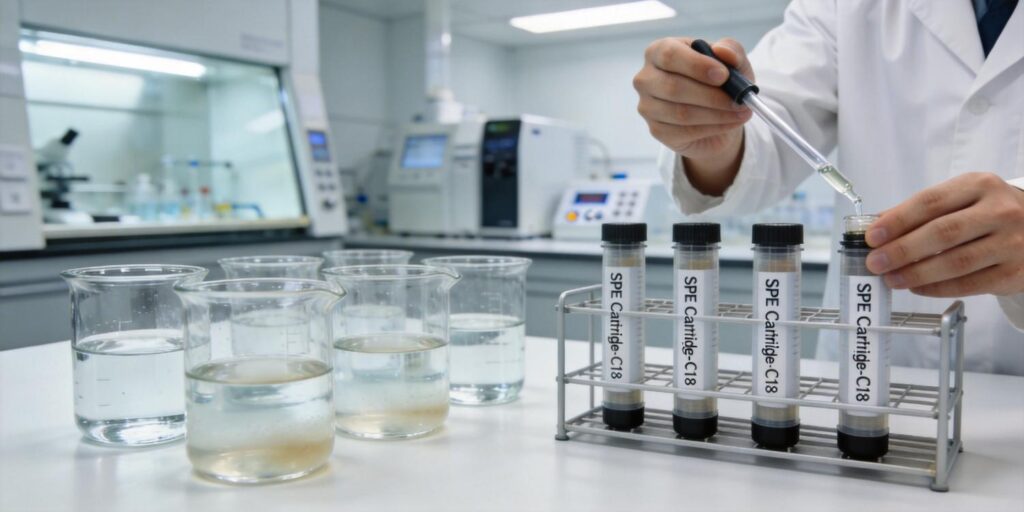
Condition Oasis HLB cartridges (200 mg, 6 cc) sequentially with 5 mL methanol followed by 5 mL deionized water at a flow rate of 1-2 mL/min. Maintain solvent contact with the sorbent bed to prevent channeling and ensure uniform activation.
Sample Loading and Interference Removal
Load filtered samples at 5-10 mL/min using vacuum or positive pressure systems. After loading, wash cartridges with 5 mL 5% methanol in water to remove weakly retained matrix components while retaining target PCPs. Dry cartridges under vacuum for 10-15 minutes to remove residual water.
Analyte Elution and Concentration
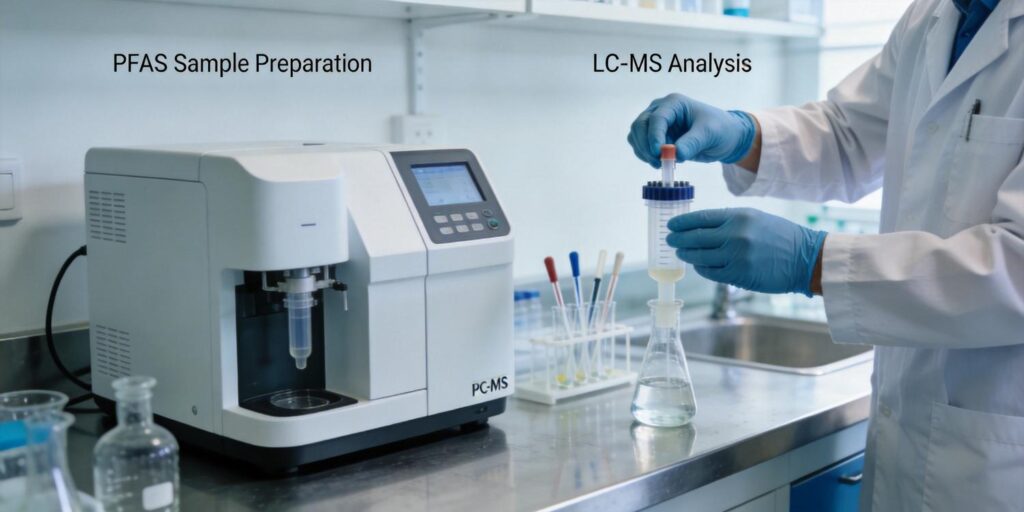
Elute analytes with 2 × 5 mL methanol, collecting eluates in calibrated tubes. Evaporate to near dryness under gentle nitrogen stream at 40°C, then reconstitute in 1 mL methanol:water (50:50, v/v) for LC-MS analysis. For GC-MS applications, alternative solvents like ethyl acetate or acetone may be preferred.
Quality Control Measures
Include procedural blanks, matrix spikes, and surrogate standards (such as deuterated analogs of target compounds) to monitor method performance. Recovery rates should typically fall between 70-120% for most PCPs, with relative standard deviations below 15% for replicate analyses.
LC-MS Detection Strategies
Liquid chromatography-mass spectrometry (LC-MS) has become the gold standard for PCP analysis due to its sensitivity, selectivity, and ability to handle polar compounds without derivatization.
Chromatographic Separation Optimization
Employ reversed-phase C18 columns (100 × 2.1 mm, 1.7-3.5 μm particle size) with gradient elution using water and methanol (both containing 0.1% formic acid). For comprehensive coverage, implement a 20-minute gradient from 10% to 100% methanol, followed by 5-minute re-equilibration. Column temperature should be maintained at 40°C to ensure consistent retention times.
Mass Spectrometric Detection Approaches
Electrospray ionization (ESI) in both positive and negative modes provides optimal coverage for diverse PCP classes. Use multiple reaction monitoring (MRM) for quantitative analysis, selecting two transitions per compound for confirmation. For screening applications, full-scan or data-dependent acquisition modes enable retrospective analysis and identification of non-target compounds.
Advanced MS Techniques
High-resolution mass spectrometry (HRMS) using time-of-flight (TOF) or Orbitrap instruments offers superior identification capabilities through accurate mass measurements. These techniques enable non-target screening and identification of transformation products that may form during water treatment processes.
Environmental Monitoring Applications
The developed SPE-LC-MS methods find extensive application in environmental monitoring programs aimed at understanding PCP fate, transport, and ecological impacts.
Wastewater Treatment Plant Assessment
Monitor influent and effluent samples to evaluate treatment efficiency for PCP removal. Studies consistently show that conventional treatment processes variably remove different PCP classes, with advanced oxidation processes and membrane filtration offering improved removal efficiencies.
Surface Water Quality Monitoring
Implement routine monitoring of rivers, lakes, and coastal waters to establish baseline concentrations and identify contamination hotspots. Spatial and temporal trend analysis helps identify sources and assess the effectiveness of regulatory measures.
Ecological Risk Assessment
Combine chemical analysis with biological effect monitoring to establish concentration-effect relationships. This integrated approach supports evidence-based environmental quality standards and helps prioritize compounds for regulatory attention based on their persistence, bioaccumulation potential, and toxicity.
Regulatory Compliance Monitoring
Support compliance with emerging regulations targeting specific PCPs in water bodies. Methods must demonstrate adequate sensitivity to measure concentrations below proposed environmental quality standards, typically in the low ng/L range.
The continuous evolution of SPE technologies, particularly in automation and sorbent chemistry, ensures that analytical methods remain capable of addressing the expanding list of PCPs entering aquatic environments. By combining robust sample preparation with sensitive detection techniques, environmental scientists can provide the data needed to protect water resources from emerging contaminants.