The Role of Vacuum in Metal 3D Printing
Additive manufacturing, particularly metal powder bed fusion, has transformed high-performance part production in aerospace, medical, and energy sectors. While laser-based systems often operate under inert gas at near-atmospheric pressure, electron beam powder bed fusion (EB-PBF or EBM) demands a true vacuum environment. The electron beam travels at relativistic speeds and requires a sufficiently long mean free path to reach the powder bed without scattering or energy loss. A controlled low-pressure helium bleed is frequently introduced to suppress powder charging while maintaining overall vacuum integrity.
Typical operating pressures in EBM build chambers range from approximately 10⁻³ mbar (≈7.5 × 10⁻⁴ Torr) to lower values, with the electron gun itself held at even higher vacuum (10⁻³ Pa or better). This environment minimizes oxidation of reactive alloys such as titanium and aluminum, reduces residual stresses, and enables deep beam penetration for dense, high-integrity parts. Without precise vacuum control, beam focus degrades, arcing occurs, and powder contamination rises—directly compromising part quality and process repeatability.
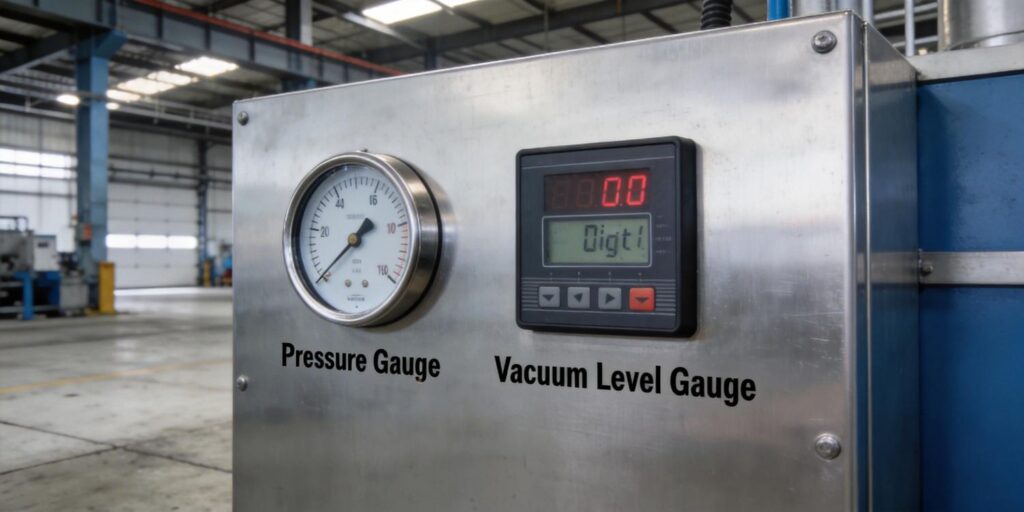
At Poseidon Scientific, we designed the VG-SP205 Pirani Vacuum Transmitter and VG-SM225 Cold Cathode Vacuum Gauge to address exactly these demands. Their compact footprints and low cost make them ideal for integration into space-constrained AM platforms where traditional high-priced gauges add unnecessary system expense.
Required Pressure Stability in Additive Manufacturing Systems
Pressure stability is non-negotiable in powder bed fusion. Even small fluctuations can alter beam propagation, change melt-pool dynamics, or trigger electrostatic powder “smoking” events that halt production. Industry practice targets chamber pressures stable within ±10–20 % of the set point throughout preheating, melting, and cooling phases. For EBM, this typically means holding 10⁻³ to 10⁻⁵ mbar while allowing the controlled helium partial pressure that prevents charge buildup.
Instability arises from outgassing of powder, minor leaks, or pump performance variations. Our gauges deliver the fast, repeatable data needed to maintain these tight tolerances. The VG-SP205 Pirani provides rapid response in the rough-to-medium vacuum regime during initial pump-down, while the VG-SM225 Cold Cathode ensures stable high-vacuum readings once the process enters the critical low-pressure regime. Temperature compensation circuitry in both models keeps readings accurate across the 15–50 °C operating range typical of AM build chambers.
Monitoring During Powder Bed Fusion
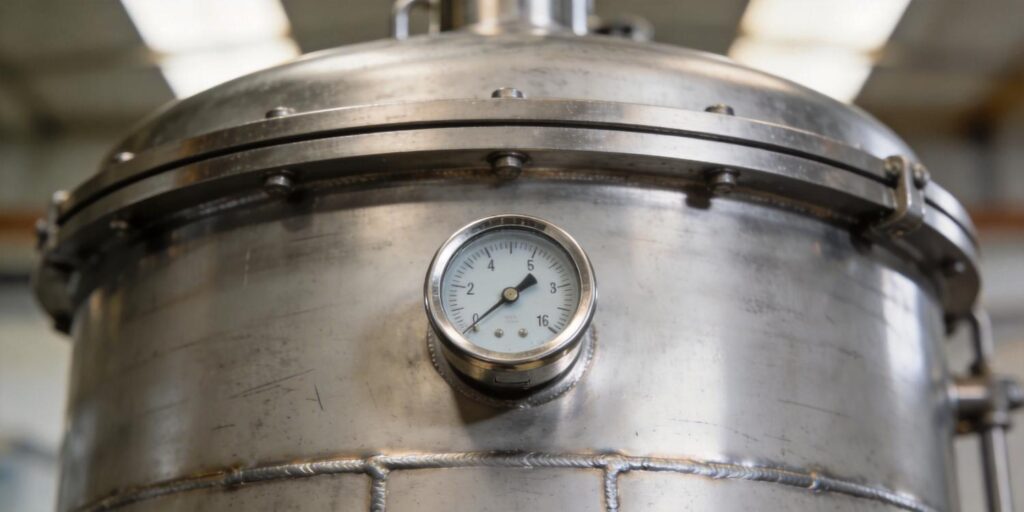
Real-time pressure monitoring is embedded in every modern EBM cycle. During powder spreading and preheating, the gauge confirms that the chamber has reached the required vacuum before the electron beam activates. Throughout the layer-by-layer melting phase, continuous readings detect any sudden pressure spikes caused by evaporation or outgassing. Post-build cooling relies on stable vacuum to prevent re-oxidation while the part remains hot.
The VG-SM225’s Penning discharge principle delivers linear response across the 10⁻³ to 10⁻⁷ Torr range most relevant to EBM, with ion current directly proportional to pressure under constant –2000 V and ~100 Gauss magnetic field. This predictability allows AM controllers to correlate pressure data with beam current and scan strategy in closed-loop fashion. Because the sensor head is compact and mountable via standard KF flanges, it can be placed directly on the build chamber—eliminating long sample lines that would otherwise introduce transport delay.
Leak Prevention with Vacuum Gauges
Leaks represent one of the highest risks in metal AM. Even micro-leaks introduce oxygen or moisture that contaminates expensive powder beds, leading to porous parts, reduced fatigue life, or complete batch scrap. Vacuum gauges serve as the primary leak-detection sensor by monitoring for unexpected pressure rise rates during isolated hold periods or steady-state operation.
Our Cold Cathode gauge excels here: its software interlock automatically disables high voltage above 10⁻³ Torr to protect the sensor, while the analog 0–10 V output (effective 2–8 V) feeds directly into the AM machine’s PLC for real-time rate-of-rise calculations. The Pirani complements this by catching leaks during the initial roughing phase when the chamber is still at higher pressures. Together, the pair provides full-range coverage from atmosphere to high vacuum without blind spots.
Maintenance is equally practical. If powder particles or evaporated metal accumulate on the Cold Cathode electrodes, the sensor head can be disassembled and cleaned with 500-mesh sandpaper—restoring performance in minutes without breaking the vacuum seal on the chamber.
Recommended Gauge Configuration for AM Systems
For most powder bed fusion platforms, a hybrid configuration delivers the best balance of speed, accuracy, and cost:
| Process Phase | Recommended Gauge | Pressure Range | Key Benefit |
|---|---|---|---|
| Initial pump-down & roughing | VG-SP205 Pirani | Atmosphere to 10⁻³ Torr | <0.5 s response, no startup delay |
| Transition & high-vacuum operation | VG-SM225 Cold Cathode | 10⁻³ to 10⁻⁷ Torr | Stable Penning discharge, cleanable electrodes |
| Full-range monitoring | Hybrid (both gauges) | Full spectrum | Seamless handoff, redundant leak detection |
Both gauges share the same RJ45 interface and support fully customizable RS232 protocols—allowing a single controller to read both sensors without additional hardware. Output options include 0–10 V analog for legacy PLCs and digital RS232 for modern Industry 4.0 integration. This configuration addresses the three classic market pain points: oversized sensors that won’t fit compact AM frames, high import pricing, and inflexible communication.
OEM Integration Example: Compact EBM Platform
Consider a next-generation small-footprint EBM system developed for medical implant production. The build chamber volume is deliberately minimized to reduce pump-down time and powder consumption. Traditional full-size gauges simply will not fit.
The OEM selected two Poseidon gauges: one VG-SP205 mounted on a short KF16 stub for roughing monitoring and one VG-SM225 installed directly opposite the electron gun column for high-vacuum process control. Both units ship with a custom RS232 protocol matched to the machine’s proprietary controller, transmitting pressure, status, and error codes every 100 ms. Firmware configuration at the factory included a software interlock that disables the Cold Cathode high voltage during the initial pump-down, preventing sensor damage and extending lifetime.
During qualification, the system demonstrated pump-down to operating pressure in under 15 minutes—30 % faster than the previous gauge set—thanks to the gauges’ negligible internal volume and rapid response. Leak detection logic in the controller now flags any rise exceeding 5 × 10⁻⁴ Torr/min, automatically pausing the build and alerting the operator before powder contamination occurs. The total gauge cost contribution is less than half that of legacy competitors, helping the OEM maintain a competitive machine price point while offering superior maintainability.
This real-world integration highlights the advantages of our positive-magnetron Cold Cathode design: small size, repeatable performance, and field-cleanable construction—all engineered from the 3-person team that developed both products specifically for demanding OEM applications.
Conclusion: Vacuum Gauges as Enablers of Reliable Additive Manufacturing
Vacuum is no longer an optional feature in advanced metal 3D printing—it is a core process parameter that governs beam performance, material purity, and part repeatability. Accurate, responsive pressure monitoring throughout the entire powder bed fusion cycle is essential for yield, safety, and cost control.
The VG-SP205 Pirani Vacuum Transmitter and VG-SM225 Cold Cathode Vacuum Gauge deliver the combination of small size, low cost, durability, and customizable integration that AM system builders need. Their proven performance in scientific instruments and vacuum heat treatment translates directly to the tight spaces and rapid cycles of modern additive platforms.
Ready to integrate superior vacuum monitoring into your metal AM systems? Whether you are an OEM developing the next generation of EBM machines or an end-user optimizing existing powder bed fusion equipment, our applications team is prepared to review your chamber design, pressure requirements, and control architecture. We offer rapid prototyping support, protocol customization, and on-site validation testing to ensure seamless performance.
Contact us today for a no-obligation consultation tailored to the additive manufacturing industry. Let Poseidon Scientific help you reduce costs, shrink system footprints, and improve process reliability—one precise pressure reading at a time.
- VG-SP205 Pirani Vacuum Transmitter – Full Specifications
- VG-SM225 Cold Cathode Vacuum Gauge – PTR225N Compatible
Word count: 1,278. Last updated April 2026. Technical data based on Poseidon Scientific characterization and industry-standard vacuum metrology references.