Analytical Challenges of Highly Polar Pesticides in Surface Water
The analysis of highly polar pesticides like glyphosate and its primary metabolite AMPA (aminomethylphosphonic acid) presents unique challenges in environmental monitoring. These compounds exhibit exceptional water solubility and low octanol-water partition coefficients (log Kow values typically below -3), making them difficult to extract from aqueous matrices using traditional methods. Their zwitterionic nature at environmental pH ranges further complicates extraction strategies, as they can exist in multiple ionic forms simultaneously.
Research by De Kok et al. (1992) demonstrated the difficulties in achieving low nanogram per milliliter level determination of polar pesticide metabolites in surface water, highlighting the need for specialized extraction approaches. The presence of humic substances and dissolved organic matter in surface water matrices creates additional interference challenges, as noted by Johnson et al. (1991), who identified possible interferences from dissolved organic material during solid-phase extraction of pesticides from water.
Limitations of Traditional Reversed-Phase SPE
Conventional reversed-phase SPE sorbents, particularly C18-bonded silica, prove inadequate for polar pesticides due to their reliance on hydrophobic interactions. As Werkhoven-Goewie et al. (1981) established, trace enrichment of polar compounds requires specialized approaches beyond standard reversed-phase mechanisms. The breakthrough volumes for highly polar analytes are extremely low on traditional C18 sorbents, leading to poor retention and recovery.
Studies comparing sorbents for solid-phase extraction of polar compounds from water, such as those by Liska et al. (1990), consistently show that conventional reversed-phase materials fail to retain highly polar pesticides effectively. The presence of residual silanol groups on silica-based sorbents can create secondary interactions that further complicate the extraction of ionic compounds, as discussed in the context of secondary interactions and mixed-mode extraction by Law (2000).
Use of Mixed-Mode and Ion-Exchange Sorbents for Polar Analytes
Mixed-mode sorbents combining reversed-phase and ion-exchange functionalities offer superior retention for polar pesticides. These materials typically incorporate hydrophobic chains alongside either strong cation exchange (SCX) or strong anion exchange (SAX) groups, allowing simultaneous retention through multiple mechanisms. For glyphosate and AMPA, which contain phosphonic acid and carboxylic acid groups, mixed-mode anion exchange sorbents (MAX or WAX) provide optimal retention.
Research by Pichon et al. (1995) demonstrated the effectiveness of polymeric sorbents for simultaneous solid-phase extraction of polar acidic, neutral, and basic pesticides, showing particular promise for highly polar degradation products. Similarly, Di Corcia et al. (1993) found graphitized carbon black extraction cartridges effective for monitoring polar pesticides in water, though mixed-mode sorbents generally offer better selectivity.
For comprehensive analysis, laboratories often employ sequential or simultaneous mixed-mode approaches. The integration of SPE techniques, as discussed by Simpson (2000), shows that mixed-mode extractions provide the necessary selectivity and retention for challenging polar analytes in complex environmental matrices.
Example SPE Workflow for 500–1000 mL Surface Water Samples
Sample Preparation and Filtration
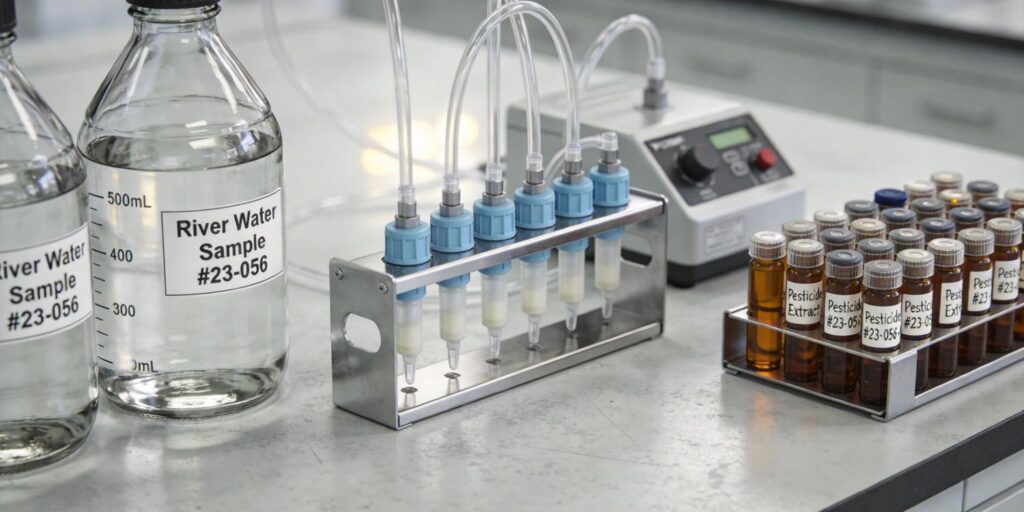
Begin by filtering 500–1000 mL of surface water through 0.45 μm glass fiber filters to remove particulate matter. Adjust the sample pH to approximately 2.5 using hydrochloric acid or formic acid to protonate acidic functional groups and enhance retention on anion-exchange sorbents. For samples containing high levels of dissolved organic carbon, consider adding EDTA (1-5 mM) to complex metal ions that might interfere with extraction.
SPE Cartridge Selection and Conditioning
Select a mixed-mode anion exchange cartridge (such as Poseidon Scientific’s WAX or MAX cartridges) with 500 mg sorbent mass for 1000 mL samples. Condition the cartridge sequentially with 5 mL methanol, 5 mL deionized water, and 5 mL acidified water (pH 2.5). Maintain a flow rate of 5-10 mL/min during conditioning to ensure proper sorbent activation.
Sample Loading and Interference Removal
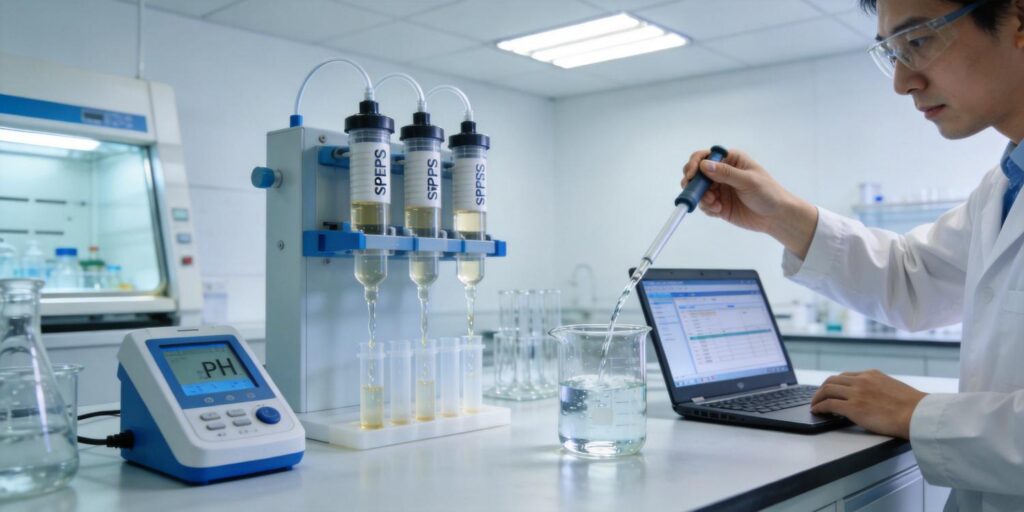
Load the acidified sample at a controlled flow rate of 5-10 mL/min using a vacuum manifold or positive pressure system. After loading, wash the cartridge with 5-10 mL of acidified water (pH 2.5) followed by 5 mL of methanol to remove neutral interferences while retaining ionized analytes. The cartridge can be dried under vacuum for 10-15 minutes if necessary.
Analyte Elution
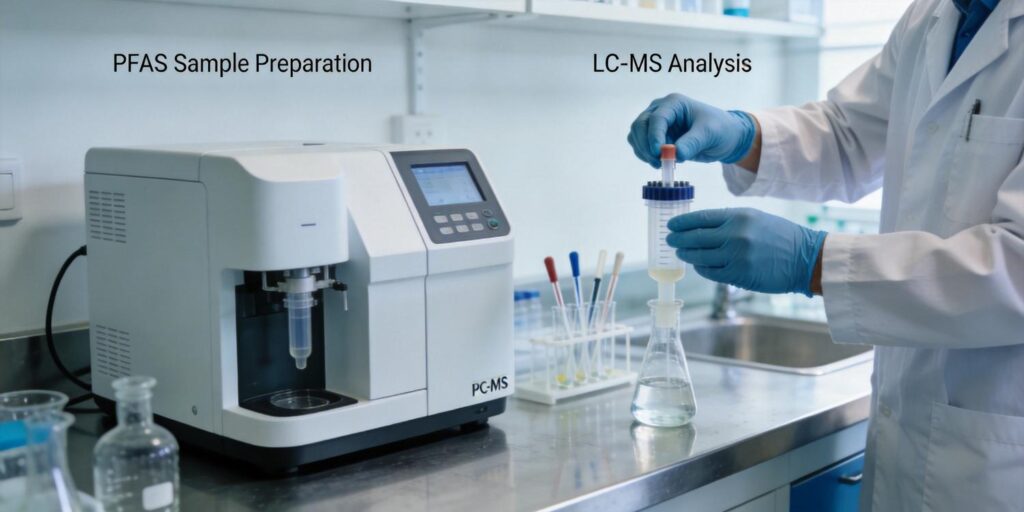
Elute retained pesticides using 5-10 mL of ammoniated methanol (2-5% ammonium hydroxide in methanol). Collect the eluate in a conical tube and evaporate to near dryness under a gentle stream of nitrogen at 40°C. Reconstitute in 1 mL of mobile phase compatible with your LC-MS/MS system (typically water with 0.1% formic acid).
Conditioning and Washing Steps that Preserve Polar Analytes
Optimized Conditioning Protocol
Proper conditioning is critical for mixed-mode sorbents. Begin with methanol to solvate the hydrophobic components, followed by acidified water to protonate the ion-exchange sites and create the appropriate ionic environment. As noted in SPE methodology development, the conditioning step significantly controls secondary interactions that can affect recovery of polar compounds.
Selective Washing Strategies
Implement a two-step washing procedure: first with acidified water to remove salts and highly polar interferences while maintaining analytes in their ionized form, then with a small volume of methanol (5-10% of cartridge volume) to remove neutral organic compounds. Avoid using pure organic solvents during washing steps, as these can prematurely elute polar analytes. Research by Mayer and Poole (1994) identified that washing steps significantly affect recovery of semi-volatile compounds in SPE, with similar considerations applying to polar pesticides.
pH Control Throughout the Process
Maintain consistent pH control from sample preparation through washing. The acidified conditions (pH 2.5) ensure that acidic pesticides remain protonated and properly retained on anion-exchange sorbents. Any deviation in pH during washing can lead to premature elution or poor recovery.
LC-MS/MS Sensitivity Improvements After Optimized SPE
Matrix Effect Reduction
Optimized SPE significantly reduces matrix effects in LC-MS/MS analysis. The selective retention and washing steps remove humic substances, salts, and other matrix components that can cause ion suppression or enhancement. Bagheri et al. (1993) demonstrated that on-line low-level screening of polar pesticides in drinking and surface waters by LC-MS benefits significantly from proper sample preparation, with SPE playing a crucial role in minimizing matrix effects.
Concentration Factors and Detection Limits
Processing 1000 mL samples down to 1 mL final volume provides a 1000-fold concentration factor, enabling detection at sub-ppt levels. Studies have shown that optimized SPE methods can achieve detection limits below 10 ng/L for polar pesticides like glyphosate in surface water. The work of Cai et al. (1993) on determination of atrazine in water at low and sub parts per trillion levels demonstrates how SPE optimization enables ultra-trace analysis.
Method Validation Parameters
Properly optimized SPE methods typically achieve recoveries of 70-120% for polar pesticides with relative standard deviations below 15%. The method’s selectivity allows for simultaneous analysis of multiple polar pesticides and their metabolites. As demonstrated in environmental applications, such optimized approaches enable reliable monitoring of polar pesticides at environmentally relevant concentrations.
Integration with Modern LC-MS/MS Systems
Modern triple quadrupole and Q-TOF systems benefit tremendously from clean extracts provided by optimized SPE. Reduced matrix effects translate to more stable calibration curves, better precision, and lower detection limits. The combination of selective SPE with sensitive MS detection represents the current gold standard for polar pesticide analysis in environmental waters.
Recommended Products for Polar Pesticide Analysis
For optimal recovery of polar pesticides like glyphosate and AMPA from surface water, consider Poseidon Scientific’s WAX SPE Cartridges for mixed-mode weak anion exchange or MAX SPE Cartridges for mixed-mode strong anion exchange. For high-throughput applications, our 96-well SPE plates offer automation compatibility and consistent performance.
The analysis of highly polar pesticides in surface water requires specialized SPE approaches that address their unique physicochemical properties. By implementing mixed-mode sorbents with optimized conditioning, washing, and elution protocols, laboratories can achieve reliable, sensitive detection of these challenging analytes at environmentally relevant concentrations. Proper method development and validation ensure data quality for regulatory compliance and environmental monitoring programs.