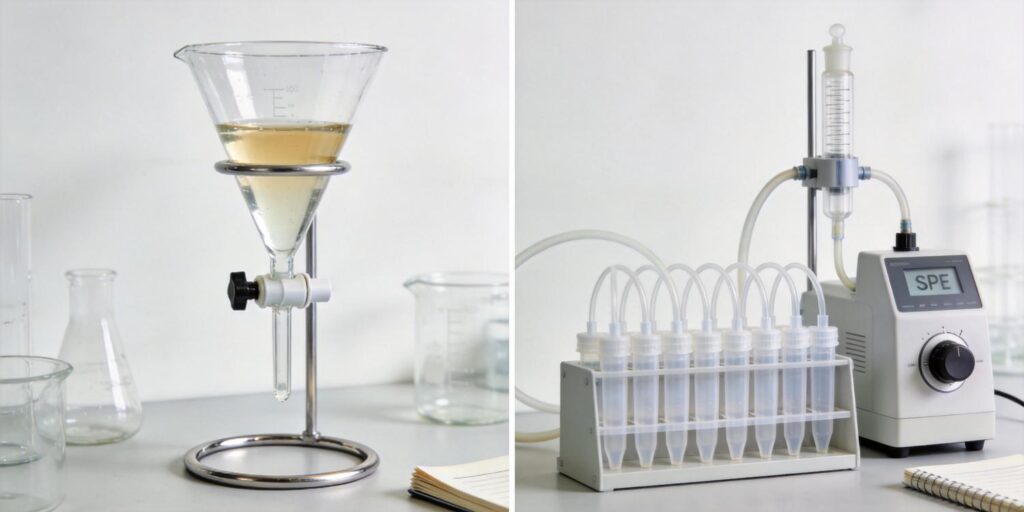
Overview of LLE Workflow
Liquid-Liquid Extraction (LLE) represents one of the most fundamental sample preparation techniques in analytical chemistry. The traditional LLE workflow involves several sequential steps that have remained largely unchanged for decades. First, the aqueous sample is placed in a separatory funnel with an immiscible organic solvent. The mixture is then vigorously shaken to maximize contact between the two phases, allowing analytes to partition between them based on their relative solubilities.
The extraction process depends on the equilibrium distribution or partition coefficient, which describes the ratio of analyte concentrations in the two liquid phases. As Simpson and Wells (2000) explain, “Liquid-liquid extraction, batch adsorption, etc., are equilibrium processes. The problem with using an equilibrium process is that you may never know when equilibrium has been reached, and the equilibrium distribution may necessitate multiple extractions.”
After shaking, the mixture is allowed to settle, forming two distinct layers. The organic layer containing the extracted analytes is then separated, often requiring multiple extractions to achieve satisfactory recovery. This process is fundamentally limited by the equilibrium principle – repeated extractions yield recovery closer to 100% without ever achieving complete extraction, much like “a frog jumps 50% of the distance out of a well each time it jumps, it will, theoretically, never succeed in achieving 100% of the distance.”
Limitations of LLE
Emulsion Formation and Manual Labor
One of the most frustrating aspects of LLE is emulsion formation, particularly when dealing with “real-world” samples containing surfactants or complex matrices. As noted in the literature, “For anyone who has ever experienced the frustration of attempting to ‘break’ an emulsion formed while extracting ‘real-world’ samples by LLE, this advantage alone might make SPE attractive.” Emulsions can significantly delay analysis and reduce recovery efficiency.
Solvent Consumption and Safety Concerns
LLE requires large volumes of organic solvents, creating both economic and environmental challenges. The technique exposes operators to potentially hazardous organic solvents and generates substantial waste. In today’s regulatory environment, “it costs more to dispose of solvents today than it does to buy them,” making solvent reduction a critical consideration for modern laboratories.
Limited Selectivity and Reproducibility
LLE is a general technique that extracts many compounds simultaneously, offering limited selectivity. Different analytes may exhibit vastly different distribution coefficients between extracting solvents and various matrices because of other contaminants. This lack of selectivity often necessitates additional cleanup steps and can lead to matrix interferences in subsequent analyses.
Equipment Limitations
Traditional LLE relies on separatory funnels that are “expensive to purchase, tedious to clean, and subject to breakage.” The manual nature of the technique limits throughput and introduces operator-dependent variability that can affect reproducibility.
SPE Advantages in Automation and Reproducibility
Fundamental Theoretical Advantage
SPE offers a fundamental theoretical advantage over LLE: it is a non-equilibrium procedure. Unlike LLE’s equilibrium-based approach, SPE operates on chromatographic principles where analytes are retained on a solid phase and then selectively eluted. This allows for more predictable and controllable extraction processes.
Automation Capabilities
SPE can be automated quite easily with a variety of currently available equipment. Automated SPE workstations eliminate many of the variables associated with manual methods, resulting in improved precision, accuracy, and recovery. As Jordan (2000) notes, “Automated SPE sample preparation eliminates many of those variables associated with manual SPE. The result can be improved precision, accuracy and recovery, and this is achieved because automated equipment performs an identical sequence of steps on each sample.”
96-Well Plate Technology
The development of 96-well plate technology has revolutionized SPE automation, enabling high-throughput processing of multiple samples simultaneously. This format is particularly valuable in pharmaceutical and clinical laboratories where large sample volumes must be processed efficiently. The schematic diagram of a 96-well SPE extraction plate system demonstrates how modern SPE technology enables parallel processing rather than the serial processing characteristic of LLE.
Reproducibility and Documentation
In the world of ever-increasing regulatory pressures, automated SPE provides formal documentation of how sample preparation is done, recording in electronic form precise details of every step of every extraction. This level of documentation is difficult to achieve with manual LLE methods.
Solvent and Sample Volume Reduction
SPE allows for lower sample quantities and lower solvent volumes. Reduced-volume columns enable elution in smaller volumes of solvent, which can be dried down quickly. This is especially important considering that “lab personnel need to be mindful of solvent usage as it costs more to dispose of solvents today than it does to buy them.”
Example Analytical Comparisons
Opiate Extraction from Urine
A compelling comparison between LLE and SPE can be seen in opiate extraction from urine. Figure 1 from forensic applications shows a liquid-liquid extraction of opiates from urine with high levels of impurities and low recoveries. In contrast, Figure 2 demonstrates an extraction using C18 SPE columns, showing significantly cleaner extracts and higher recoveries. The progression continues with Figure 3, which shows extraction using high-efficiency copolymeric SPE columns, representing the state-of-the-art in SPE technology.
Barbiturate Analysis
Similar improvements are evident in barbiturate analysis. Figure 4 shows barbiturate extraction from urine using C8 SPE columns, while Figure 5 demonstrates extraction using copolymeric SPE columns. The copolymeric phases, introduced in 1986, have had the most significant impact on SPE and its application in separating many classes of drugs from their biological matrices.
Recovery Performance
SPE recoveries should exceed 90% absolute recovery. If you don’t get that kind of recovery, you are not adjusting other parameters (such as solubility, pH, and solvent strength) correctly. Liquid-liquid extraction not only has trouble achieving high recovery on a reliable, reproducible level but also, the more extractions you need to do, the more of your sample you lose. SPE, on the other hand, actually concentrates your sample on the column and allows for reproducible results at very low levels of analytes.
Environmental Applications
For extracting large volume environmental samples, SPE offers numerous advantages over LLE. Exposure to and consumption of large volumes of organic solvents is avoided; operator dedication to manually shaken separatory funnels is eliminated; increased production through multiple simultaneous extractions is realized; and the formation of emulsions is reduced.
Method Development Efficiency
SPE allows for shorter sample extraction times, especially when back-extractions are required. In SPE, the analyst can switch from organic solvents to aqueous solvents and back to organic solvents in a matter of 15 minutes, a flexibility not possible with traditional LLE methods.
Selectivity and Cleanliness
LLE is a general technique that extracts many compounds, whereas SPE gives the analyst the ability to extract a broad range of compounds with increased selectivity. This selectivity is achieved through various SPE modes including reversed-phase, normal-phase, ion-exchange, and mixed-mode mechanisms, allowing for targeted extraction of specific analyte classes while minimizing matrix interferences.
The practical comparison between SPE and LLE clearly demonstrates why SPE has become the preferred sample preparation technique in modern analytical laboratories. While LLE served analytical chemistry well for many years, the limitations in automation, reproducibility, solvent consumption, and selectivity have driven the widespread adoption of SPE technology across pharmaceutical, environmental, clinical, and forensic applications.