
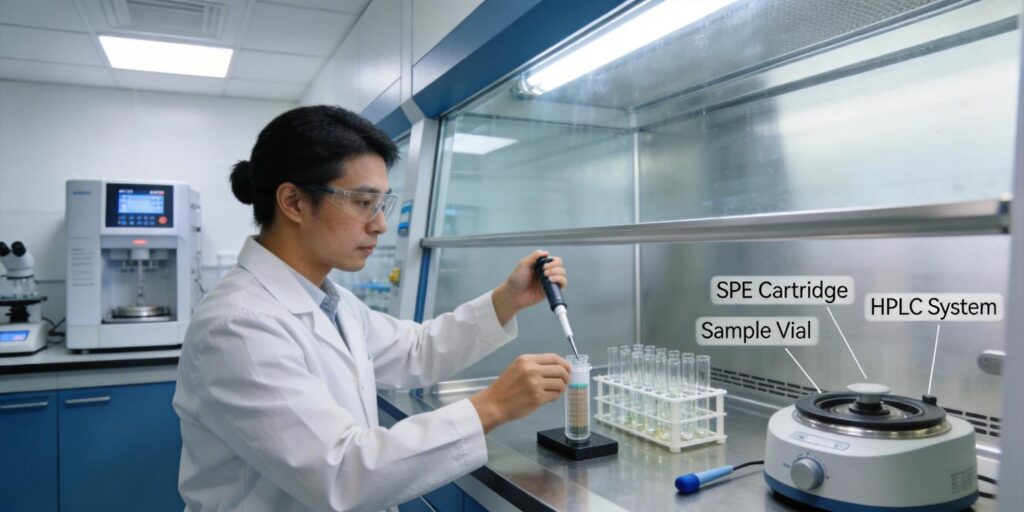
The Evolution of Sample Preparation Techniques
Sample preparation has undergone a remarkable transformation over the past century, evolving from rudimentary separation methods to sophisticated, automated techniques. The journey began with early forms of chromatography that can be traced back to 23 AD, though the modern era truly began with Tswett’s 1906 work on chromatography. However, it wasn’t until the 1970s that solid phase extraction (SPE) emerged as a distinct scientific technique for sample preparation.
The development of SPE progressed through several distinct phases. From initial latency prior to 1968, the technology moved through exponential growth periods (1968-1977, 1977-1989, and 1989-present). The introduction of prepackaged, disposable cartridges containing bonded silica sorbents in October 1977 marked a pivotal moment, making the procedure more convenient and initiating widespread adoption. The first commercialized SPE device, the Sep-Pak from Waters, represented a serial-processing cartridge that revolutionized how laboratories approached sample cleanup.
Modern SPE originated in 1974 when researchers Reginald Adams, Thomas Good, and Michael Telepchak discovered that C18 column packing material inadvertently falling into urine samples could extract steroids of interest. This accidental discovery led to the development of specialized SPE devices that resemble those used today. The introduction of copolymeric phases in 1986 had the most significant impact on SPE, enabling the separation of many classes of drugs from their biological matrices.
Key Milestones in SPE Development
- 1974: Modern SPE discovered through accidental contamination of samples with HPLC packing material
- 1977: Introduction of prepackaged, disposable cartridges with bonded silica sorbents
- 1978: First article using SPE on bonded phase silica published
- 1980: Ion-exchange columns adopted for sample preparation
- 1986: First multimodal column (copolymeric phase) introduced
- 1989: SPE discs (membranes) introduced, initiating another phase of development
- 1993: Microtiter plates introduced for high-throughput applications
Advantages of SPE vs. Older Methods
Solid phase extraction offers numerous advantages over traditional liquid-liquid extraction (LLE), making it the preferred choice for modern analytical laboratories. The fundamental difference lies in SPE being a non-equilibrium procedure, while LLE is an equilibrium process. This distinction provides SPE with significant theoretical and practical advantages.
Technical Superiority
SPE allows for improved throughput through parallel versus serial processing, decreased organic solvent usage and waste generation, and higher, more reproducible recoveries. Unlike LLE, which can suffer from emulsion formation, SPE eliminates this problem entirely. The technique offers tunable selectivity through various SPE phase choices and solvent mixtures, and it’s readily automated for high-throughput applications.
From a recovery perspective, SPE consistently achieves over 90% absolute recovery when parameters are correctly adjusted, while LLE struggles to achieve high recovery on a reliable, reproducible level. SPE actually concentrates samples on the column, allowing for reproducible results at very low analyte levels. The technique’s ability to use lower sample quantities and lower solvent volumes is particularly important today, as disposal costs for solvents often exceed purchase costs.
Practical Benefits
| Advantage | SPE | Traditional LLE |
|---|---|---|
| Throughput | Parallel processing possible | Serial processing only |
| Solvent Usage | Significantly reduced | High volumes required |
| Emulsion Formation | None | Common problem |
| Recovery | Consistently >90% | Variable, often lower |
| Automation | Easily automated | Difficult to automate |
| Selectivity | Tunable through phase selection | Limited by solvent choice |
SPE also provides cleaner extracts with reduced contamination and solvent impurities. The technique allows analysts to switch from organic solvents to aqueous solvents and back to organic solvents in a matter of 15 minutes, a process that’s much more challenging with LLE, especially when back-extractions are required.
Typical Analytical Workflows
Modern analytical laboratories employ SPE in diverse workflows across pharmaceutical, environmental, clinical, and food safety applications. The typical SPE process involves five fundamental steps that can be adapted to various analytical requirements.
Standard SPE Procedure
- Conditioning: The sorbent is activated with an appropriate solvent that conditions the surface of the solid phase, typically using methanol or acetonitrile followed by a weak solvent like water or buffer
- Sample Loading: The sample is applied to the conditioned cartridge, with analytes being retained while matrix components pass through
- Washing: Interfering compounds are removed using solvents that won’t elute the target analytes
- Drying: The bed is dried when elution solvent is immiscible with wash solvents and sample
- Elution: Analytes are eluted in the smallest possible volume of appropriate solvent
Application-Specific Workflows
SPE finds application in several key areas of analytical chemistry:
Pharmaceutical Analysis
In pharmaceutical laboratories, SPE is essential for pharmacokinetic studies, dissolution testing, and combinatorial reaction cleanup before LC-MS analysis. The technique isolates analytes from complex matrices like plasma and urine while removing “column killers” or major interferences. SPE significantly increases gas and liquid chromatography column life while reducing downtime on expensive instruments like GC-MS and LC-MS systems for source cleaning.
Environmental Monitoring
Environmental laboratories rely on SPE for trace enrichment of contaminants in water samples. The technique allows for the analysis of pesticides, polycyclic aromatic hydrocarbons, and other environmental pollutants at trace levels. SPE’s ability to handle large volume samples efficiently makes it ideal for environmental applications where analytes are often present at extremely low concentrations.
Clinical and Forensic Applications
Clinical and forensic laboratories use SPE for drug testing, toxicology screening, and therapeutic drug monitoring. The technique’s selectivity and sensitivity make it ideal for detecting drugs of abuse and their metabolites in biological matrices. SPE provides cleaner extracts than traditional methods, reducing matrix effects and improving analytical accuracy.
Modern SPE Formats and Automation
Today’s laboratories can choose from various SPE formats to match their specific needs:
- Cartridges: Traditional format for single-sample processing
- 96-Well Plates: High-throughput format for automated systems
- Discs/Membranes: Ideal for large volume samples or samples with high particulate content
- Automated Systems: Integrated SPE workstations that handle multiple samples simultaneously
The integration of SPE with analytical instruments has created powerful hyphenated techniques. SPE can be coupled directly with LC, GC, CE, and MS systems, allowing for automated sample preparation and analysis. This integration reduces manual handling, improves reproducibility, and increases laboratory throughput.
Future Directions
SPE continues to evolve with new developments in sorbent chemistry, device formats, and automation. The future of SPE lies in miniaturization, increased selectivity through molecularly imprinted polymers, and integration with microfluidic devices. As analytical requirements become more demanding, SPE will continue to adapt, providing laboratories with the sample preparation capabilities needed for tomorrow’s analytical challenges.
The importance of SPE in modern analytical laboratories cannot be overstated. As the most commonly used sample preparation technique introduced in the last twenty years, SPE has become essential for laboratories seeking to improve analytical accuracy, increase throughput, and reduce costs. With its proven advantages over traditional methods and continued technological advancement, SPE remains at the forefront of sample preparation technology.


