Load Lock Operational Cycle in High-Throughput Vacuum Systems
Load-lock chambers are the high-frequency gateways of modern vacuum tools. In semiconductor etch, PVD coating, and analytical instruments, a typical load-lock cycle repeats every 2–5 minutes: vent to atmosphere, wafer load/unload, rough-pump to transfer pressure (~10-2 to 10-3 mbar), and pressure equalization with the main process chamber before gate-valve opening. Each repetition directly impacts tool throughput and overall equipment effectiveness (OEE).
Because the load lock experiences repeated exposure to atmosphere and high gas loads, the vacuum gauge mounted here must survive rapid pressure swings, tolerate residual moisture and particulates, and deliver reliable readings for interlocks—without becoming a maintenance bottleneck. Engineers and procurement teams evaluating gauges for this duty quickly discover that not all technologies are equal. The Poseidon Scientific VG-SP205 Pirani Vacuum Transmitter was developed specifically for these demanding cycles, while the VG-SM225 Cold Cathode Vacuum Gauge serves as the complementary sensor for main-chamber verification.
Required Pressure Accuracy in Load-Lock Applications
Load-lock pressure measurement is not a precision metrology exercise; it is a safety and process-control interlock. The critical threshold is the transfer pressure—typically 10-2 to 10-3 mbar—where the gate valve to the main chamber may safely open without contaminating the process environment. Accuracy of ±10 % in the linear operating region (10 to 10-2 mbar) is more than sufficient; tighter tolerances add cost without measurable yield benefit.
At the high end (near atmosphere) and low end (~10-3 mbar), errors up to ±50 % are acceptable because these zones are used only for gross pump-down confirmation and roughing-pump protection. What matters most is repeatability and fast response, not absolute calibration traceable to NIST at every point. The VG-SP205 Pirani delivers exactly this performance profile, with its platinum filament and temperature-compensated circuitry ensuring stable readings across the 15–50 °C fab environment without frequent recalibration.
Fast Response Requirements for Rapid Cycling
Modern cluster tools demand load-lock pump-down times under 60–90 seconds from atmosphere to transfer pressure. Any gauge lag directly reduces wafers per hour. Thermal-conductivity gauges respond almost instantly to pressure changes because heat transfer to gas molecules occurs on a molecular-collision timescale. Ionization gauges, by contrast, require establishment of a stable Penning discharge, which can introduce 5–30 seconds of delay at the transition pressure—unacceptable for high-throughput load locks.
The VG-SP205’s constant-temperature control circuit tracks transients in real time, enabling PLC interlocks to open the roughing valve, confirm base pressure, and initiate wafer transfer without artificial delays. Field data from production etch tools show that Pirani-based load locks achieve 15–20 % faster cycle times than systems relying on slower wide-range gauges.
Pirani Advantages for Rapid Cycling
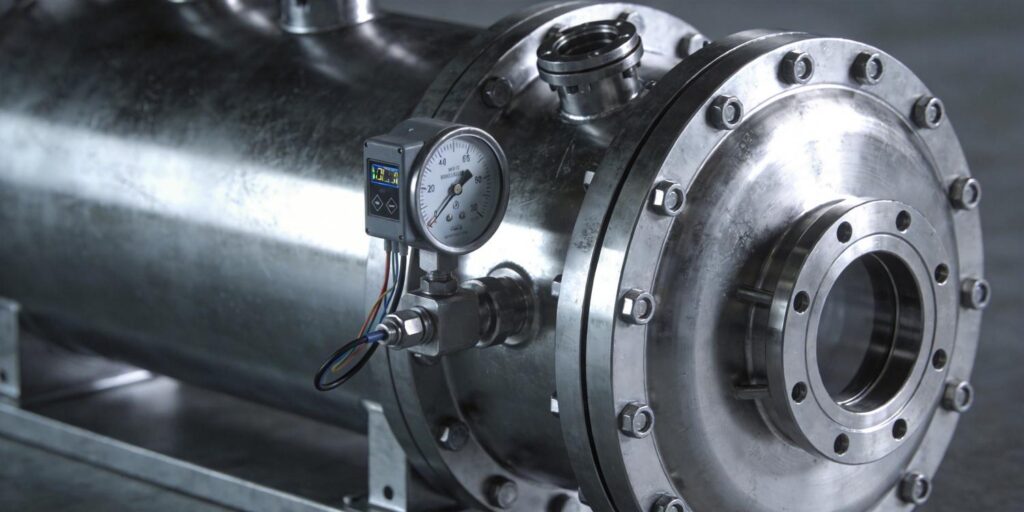
The VG-SP205 Pirani Vacuum Transmitter offers four decisive advantages in load-lock service:
1. Wide High-Pressure Coverage
From atmosphere to 10-3 mbar—precisely the load-lock envelope—the Pirani principle provides continuous, monotonic output. No high-voltage disable or discharge-startup issues occur.
2. Robust Filament Design
Platinum wire (selected over tungsten for its large temperature coefficient and superior chemical inertness) resists oxidation and halogen attack from residual etch by-products that backstream during venting. Lifetime in rapid-cycling load locks routinely exceeds 3–5 years with zero maintenance.
3. Compact, Low-Profile Package
The transmitter’s small footprint fits tight load-lock flanges without obstructing wafer handling robotics. KF16/KF25 compatibility simplifies retrofits on legacy tools.
4. Maintenance-Free Operation
Unlike cold-cathode or hot-cathode sensors, the sealed Pirani head requires no cleaning or filament replacement during normal service. This eliminates unscheduled downtime in 24/7 fabs where every minute of load-lock availability adds revenue.
These attributes make the VG-SP205 the preferred choice for load-lock monitoring, as validated in both Poseidon internal testing and customer installations on mass spectrometers and vacuum heat-treatment furnaces.
Cold Cathode for Main Chamber Verification
While the Pirani excels in the load lock, the main process chamber requires a different technology once pressure drops below 10-3 mbar. The VG-SM225 Cold Cathode Vacuum Gauge provides the wide dynamic range (10-3 to 10-7 mbar) and low outgassing needed for base-pressure verification before gate-valve opening. Its positive-magnetron Penning discharge ensures linear response in the critical transfer zone, and the field-cleanable sensor head restores performance after any minor contamination without breaking vacuum.
In a dual-gauge architecture, the load-lock Pirani confirms roughing completion while the main-chamber cold cathode verifies that the process environment remains at specification. This hand-off at the overlap pressure (≈10-3 mbar) prevents cross-contamination and protects sensitive main-chamber components. The VG-SM225’s drop-in compatibility with Pfeiffer PTR225N footprints further simplifies tool upgrades.
Installation Position Guidelines
Correct placement maximizes response time and minimizes contamination:
Load-Lock Pirani (VG-SP205)
- Mount on a side port or short KF extension tube rather than directly opposite the vent valve to reduce direct moisture and particulate impingement.
- Vertical orientation (inlet downward) aids drainage of any condensate after venting.
- Maintain >50 mm clearance from chamber walls to avoid thermal gradients that could affect the platinum filament.
Main-Chamber Cold Cathode (VG-SM225)
- Use a 100–150 mm extension tube to shield the sensor from direct sputter or radical flux.
- Any orientation is acceptable, but horizontal mounting reduces gravitational settling of particulates on electrodes.
- Keep >10 cm from RF coils or other magnets to prevent interference with the 100-gauss internal field.
Both gauges use industry-standard RJ45 connectors and are fully compatible with KF/CF flanges. These guidelines, drawn from Poseidon engineering experience and customer field data, typically extend gauge life by 30–50 % in high-cycle environments.
Signal Output Considerations
Modern load-lock controls are PLC-driven. The VG-SP205 and VG-SM225 both provide a 0–10 V analog output (linear 2–8 V range) that interfaces directly with standard PLC analog input modules—no external conditioning required. This voltage signal supports fast interlocks (response <100 ms) and continuous trending for cycle-time optimization.
For digital architectures, RS232 is standard with fully customizable protocol (minimum order 5–10 units). Engineers can request command-set emulation of legacy gauges, eliminating software changes during retrofits. RS485 is available via minor PCB revision for multi-drop networks. The 4–20 mA option, while not native, is easily added with an external transmitter when plant standards require current-loop signaling.
All units ship with diagnostic status bytes (filament health, high-voltage enable, error codes) accessible via RS232, giving maintenance teams immediate visibility into gauge condition without additional sensors.
Conclusion: Selecting the Optimal Load-Lock Gauge
For load-lock chambers, the best vacuum gauge balances rapid response, robustness under repeated venting, and maintenance-free operation. The Poseidon VG-SP205 Pirani Vacuum Transmitter meets these criteria better than any alternative technology, delivering reliable roughing interlocks and faster cycle times while keeping total cost of ownership low. Pairing it with the VG-SM225 Cold Cathode in the main chamber creates a complete, overlap-protected monitoring solution from atmosphere to 10-7 mbar.
Whether you are specifying a new cluster tool, retrofitting an existing platform, or optimizing load-lock throughput on an etch or PVD line, the right gauge choice directly improves OEE and reduces maintenance spend.
Request a no-obligation application recommendation today. Provide your load-lock volume, target cycle time, and communication protocol, and our product managers will return a detailed configuration—including mounting drawings, PLC code examples, and cost-of-ownership analysis—within 48 hours.
Learn more about the VG-SP205 Pirani Vacuum Transmitter
Learn more about the VG-SM225 Cold Cathode Vacuum Gauge (PTR225N compatible)
At Poseidon Scientific, we measure success by the load locks that cycle faster, cleaner, and longer—without compromise.