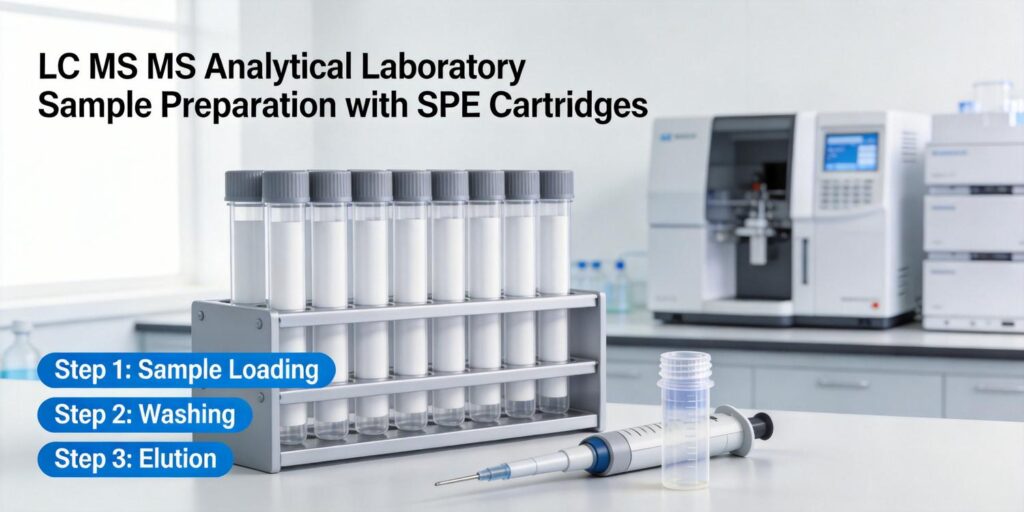
Requirements of LC-MS/MS Detection
Liquid Chromatography-Tandem Mass Spectrometry (LC-MS/MS) represents one of the most powerful analytical techniques available today, combining the separation capabilities of liquid chromatography with the exceptional sensitivity and specificity of mass spectrometry. However, this sophisticated instrumentation places stringent demands on sample quality that cannot be overlooked.
LC-MS/MS systems are particularly vulnerable to matrix effects, where co-eluting compounds can suppress or enhance analyte ionization, leading to inaccurate quantification. As noted in the literature, “An undesirable feature of atmospheric pressure ionization-MS analysis is suppression of ionization by co-extracted endogenous interferences from biofluids.” This phenomenon, known as ion suppression, can result in false negatives and compromised data integrity.
The sensitivity of modern LC-MS/MS instruments also makes them susceptible to fouling from sample components. Proteins, lipids, and other macromolecules can deposit in the transfer capillary and interface, leading to rapid decline in signal intensity and spectral quality. Research has shown that “components of the sample (often proteins or other macromolecules), which deposited in the transfer capillary/interface to the MS system” can degrade instrument performance over time.
Key Requirements for LC-MS/MS-Compatible Samples:
- Minimal Matrix Effects: Samples must be free from compounds that interfere with ionization processes
- Low Protein Content: Proteins must be removed to prevent source contamination and clogging
- Compatible Solvent Systems: Final extracts should be in solvents compatible with LC mobile phases
- Concentration Factor: Samples often need concentration to achieve required detection limits
- Cleanliness: Removal of late-eluting compounds that could interfere with subsequent analyses
Matrix Cleanup Importance
Matrix cleanup is not merely an optional step in LC-MS/MS analysis—it’s a critical requirement for obtaining reliable, reproducible results. Biological samples, in particular, present significant challenges due to their complex composition. As one source notes, “Biological samples are notoriously dirty; injecting them with minimum cleanup onto very sensitive and expensive instruments makes very little sense.”
The primary goals of matrix cleanup include:
1. Removal of Ionization Interferents
Endogenous compounds such as salts, phospholipids, and metabolites can compete with analytes during the ionization process, leading to signal suppression or enhancement. Selective SPE extraction applications are required to avoid false negatives caused by these interferences.
2. Protection of Instrumentation
SPE has been shown to significantly increase gas (GC) and liquid chromatography (LC) column life while reducing downtime on equipment like GC-MS and LC-MS systems for source cleaning. The removal of “column killers” and major interferences prevents fouling of expensive instrumentation.
3. Enhancement of Sensitivity
By removing matrix components that cause ion suppression, SPE actually improves method sensitivity. Cleaner extracts allow for better detection of trace analytes, which is particularly important in pharmaceutical development where “assay sensitivity is a major goal of pharmacokinetic studies.”
4. Improvement of Data Quality
Clean extracts yield cleaner chromatograms with fewer interfering peaks, making data interpretation more straightforward and reliable. This is especially critical in regulated environments where data integrity is paramount.
SPE Method Workflow
Solid Phase Extraction (SPE) has emerged as the gold standard for sample preparation in LC-MS/MS analysis due to its selectivity, efficiency, and compatibility with automation. The fundamental SPE workflow consists of five critical steps:
Step 1: Conditioning
The SPE sorbent must be prepared to accept the sample. This typically involves passing 0.5 to 2 mL of methanol or acetonitrile through the cartridge, followed by 0.5 to 2 mL of water or aqueous buffer. This step “wets the surface of the sorbent & penetrates bonded alkyl phases, allowing water to wet the silica surface efficiently.” Proper conditioning is essential for reproducible analyte recovery.
Step 2: Sample Loading
The prepared sample is applied to the conditioned SPE cartridge. Flow rates during loading are critical—typically 1-3 drops per second—as recovery is inversely proportional to flow rate. The sample must be in a form compatible with SPE, often requiring pH adjustment or dilution with appropriate buffers.
Step 3: Washing
Interfering compounds are removed using solvents that won’t elute the target analytes. Wash solvents are carefully selected based on the retention mechanism and analyte properties. For biological samples, washing with pure water helps eliminate excess ions that could affect MS performance.
Step 4: Elution
Target analytes are recovered in the smallest possible volume using solvents of appropriate elution strength. For LC-MS applications, “elution using a pure organic solvent, without modifiers or buffer ions is desirable” to minimize ionization interference. Common elution solvents include methanol, acetonitrile, or mixtures with appropriate modifiers.
Step 5: Reconcentration (if needed)
The eluate may be evaporated and reconstituted in a solvent compatible with the LC mobile phase. This step provides additional concentration and ensures solvent compatibility with the analytical system.
SPE Formats and Selection:
Modern SPE is available in various formats to suit different applications:
- Cartridges: Traditional format for manual processing
- 96-Well Plates: Ideal for high-throughput applications and automation
- Disks: Recommended for large volume samples or samples with high particulate content
The choice of SPE sorbent is critical and depends on analyte properties. Common options include:
- Reversed-Phase (C18, C8, HLB): For non-polar to moderately polar compounds
- Mixed-Mode (MCX, MAX, WCX, WAX): Combine reversed-phase and ion-exchange mechanisms for enhanced selectivity
- Ion-Exchange: For charged compounds based on their ionic properties
Reducing Ion Suppression
Ion suppression remains one of the most significant challenges in LC-MS/MS analysis, particularly when dealing with complex biological matrices. Effective strategies for minimizing this phenomenon are essential for method reliability.
1. Selective SPE Sorbent Selection
Mixed-mode SPE sorbents offer superior selectivity for reducing matrix effects. These sorbents utilize dual retention mechanisms (reversed-phase and ion-exchange) to provide orthogonality and enhanced cleanup. As research indicates, “polymers or sorbents which eliminate the need for modifiers or buffers (to disrupt secondary interactions) during elution are commonly encountered” for LC-MS applications.
2. Optimized Wash Steps
Thorough washing with appropriate solvents can remove many of the compounds responsible for ion suppression. For biological samples, washing with ammonium acetate buffers followed by pure water has been shown to eliminate excess ions that could interfere with ionization processes.
3. Proper Sample Pretreatment
Protein precipitation, often combined with SPE, can significantly reduce matrix effects. However, as noted in the literature, “simple protein precipitation with acetonitrile or another common solvent and application of the filtrate to the LC-MS system reduced the deleterious effect of the unobserved co-analytes.”
4. Use of Internal Standards
Stable isotope-labeled internal standards (SIL-IS) are the gold standard for compensating for ion suppression effects. These compounds experience the same matrix effects as the analytes, allowing for accurate quantification even in the presence of suppression.
5. Method Development Considerations
During SPE method development, several factors can be optimized to minimize ion suppression:
- pH Control: Adjusting sample pH to ensure analytes are in their optimal ionic state
- Solvent Selection: Using elution solvents that minimize co-elution of interferents
- Flow Rate Optimization: Controlling flow rates during SPE steps to maximize selectivity
- Sorbent Capacity: Ensuring the SPE sorbent has sufficient capacity to handle matrix components
6. Advanced SPE Techniques
Recent developments in SPE technology offer enhanced capabilities for reducing ion suppression:
- On-line SPE: Direct coupling of SPE with LC-MS can improve sensitivity and reduce sample handling
- Small Particle Sorbents: Using smaller particle sizes in SPE cartridges can improve separation during elution and provide tighter analyte bands
- High-Capacity Sorbents: Modern polymeric sorbents offer higher capacity for polar compounds, improving cleanup efficiency
Practical Implementation Tips:
- Characterize Matrix Effects: Use post-column infusion or standard addition methods to identify suppression regions
- Optimize Chromatography: Ensure adequate separation of analytes from matrix components
- Validate Methods: Include matrix effect assessments in method validation protocols
- Monitor Performance: Regularly check system suitability and recovery to detect changes in matrix effects
In conclusion, effective sample preparation through well-designed SPE methods is not just a preliminary step in LC-MS/MS analysis—it’s a fundamental component of method success. By understanding the requirements of LC-MS/MS detection, appreciating the importance of matrix cleanup, implementing proper SPE workflows, and employing strategies to reduce ion suppression, analysts can achieve the sensitivity, specificity, and reliability required for modern analytical challenges.
For laboratories seeking to optimize their LC-MS/MS sample preparation, Poseidon Scientific offers a comprehensive range of HLB SPE cartridges, MAX SPE cartridges, MCX SPE cartridges, WAX SPE cartridges, WCX SPE cartridges, and 96-well SPE plates designed specifically for challenging analytical applications.