
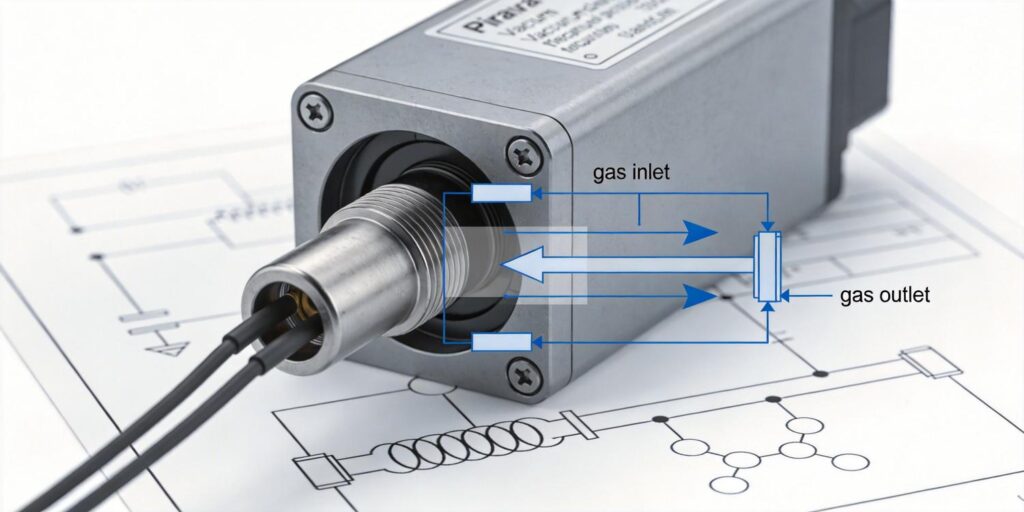
The Thermal Conductivity Principle Behind Pirani Gauges
Pirani gauges measure pressure by exploiting the dependence of gas thermal conductivity on pressure. A thin platinum filament is heated by a constant-temperature control circuit. As gas molecules collide with the filament, they carry heat away to the cooler gauge wall. At higher pressures, more molecules are present, increasing heat loss. To maintain the filament at its set temperature, the control circuit supplies additional electrical power. This power change—monitored via voltage or current—is mapped to pressure through a calibrated curve.
The relationship is most linear and accurate in the medium-vacuum range (roughly 10 Torr to 10⁻² Torr), where molecular conduction dominates. At atmospheric pressure and below 10⁻³ Torr the response becomes non-linear and less reliable. Poseidon Scientific’s VG-SP205 Pirani Vacuum Transmitter uses this exact principle, with a platinum filament chosen for its high temperature coefficient of resistance, excellent chemical stability, and resistance to contamination—delivering the durability and low-maintenance operation engineers expect in production environments.
Nitrogen (Air) as the Industry Calibration Standard
Most Pirani gauges, including the VG-SP205, ship calibrated for dry air or nitrogen (N₂). Nitrogen is the de-facto standard because it is the dominant component of laboratory air, inexpensive, non-reactive, and well-characterized in vacuum metrology literature. The factory calibration establishes a precise voltage-to-pressure lookup table under controlled N₂ conditions, with temperature compensation circuitry maintaining accuracy across the 15–50 °C operating range.
This standardization simplifies initial setup and ensures repeatability when the process gas is predominantly air or N₂. However, any deviation in gas composition introduces systematic error because different gases transfer heat at different rates. The error is negligible only when the process gas matches the calibration gas. In mixed or specialty-gas applications common to mass spectrometry, vacuum heat treatment, and research chambers, uncorrected readings can lead to process drift or false interlocks.
Hydrogen Deviation Example: A Real-World Illustration
Hydrogen provides one of the most dramatic demonstrations of gas-type influence. Its thermal conductivity is approximately seven times higher than that of nitrogen at room temperature. At the same true pressure, hydrogen molecules remove heat from the filament far more efficiently. The control circuit therefore supplies significantly more power, and the gauge interprets this as a higher pressure than actually exists.
Consider a typical operating point of 5 × 10⁻³ Torr true pressure in pure hydrogen. A VG-SP205 calibrated for air will indicate a reading approximately 4–6 times higher—often in the range of 2–3 × 10⁻² Torr—depending on the exact pressure and temperature. This over-reading can trigger premature high-vacuum pump interlocks or mislead operators into believing the chamber has not yet reached the required base pressure. Conversely, in argon (lower thermal conductivity than N₂), the same gauge under-reads, potentially allowing the process to continue under insufficient vacuum.
These deviations are well-documented in vacuum literature and confirmed during Poseidon internal characterization. The effect is most pronounced in the linear operating region of the Pirani curve and grows larger at the range extremes.
Gas Correction Factors: Quantitative Guidance
Correction factors allow engineers to convert the indicated pressure (P_ind, N₂-calibrated) to the true pressure (P_true) for the actual process gas:
P_true = P_ind × C_gas
where C_gas is the dimensionless gas correction factor. Typical values for common process gases at room temperature (valid in the 10–10⁻³ Torr range) are shown below.
| Gas | Correction Factor C_gas | Effect on Reading |
|---|---|---|
| Nitrogen / Air | 1.00 | Reference (no correction) |
| Hydrogen (H₂) | 0.18–0.25 | Significant over-reading |
| Helium (He) | 0.22–0.30 | Strong over-reading |
| Argon (Ar) | 1.40–1.60 | Under-reading |
| Oxygen (O₂) | 0.90–1.00 | Minor deviation |
| Water Vapor (H₂O) | 0.80–0.95 | Slight under-reading |
These factors are approximate and pressure-dependent; they derive from established vacuum metrology references and Poseidon test data. For highest accuracy, apply the factor in the PLC or controller software rather than manually. Note that factors can shift ±10–20 % with temperature and surface conditions; always verify with your specific gas mixture.
When to Switch from Pirani to Alternative Gauges
The VG-SP205 Pirani excels in rapid-cycling, cost-sensitive applications where the process gas is known and stable. However, when gas composition varies significantly, is unknown, or includes highly conductive species such as hydrogen or helium, a Pirani alone can introduce unacceptable error. In these cases consider:
- Hybrid Pirani + Cold Cathode: Use the VG-SP205 for fast roughing (atmosphere to 10⁻³ Torr) and hand off to the VG-SM225 Cold Cathode for the high-vacuum regime. The Cold Cathode’s Penning discharge is also gas-dependent but exhibits different sensitivity curves and remains linear to 10⁻⁷ Torr. Our customizable RS232 protocol lets a single controller read both sensors seamlessly.
- Capacitance diaphragm gauges (for absolute, gas-independent measurement) when precision outweighs cost.
- Full-range gauges only when budget allows; our compact, low-cost design often makes the hybrid solution more economical.
Switching is especially advisable in semiconductor processing, PVD/CVD with reactive gases, or any system where hydrogen is used for reduction or leak checking. The VG-SM225’s cleanable electrodes and built-in over-pressure protection make it a robust complement to the Pirani in variable-gas environments.
Practical Compensation Methods for Accurate Readings
Engineers have several field-proven methods to mitigate gas-type errors without replacing hardware:
- Software correction in the controller: Read the raw analog (0–10 V) or digital RS232 output, multiply by the appropriate C_gas factor stored as a user parameter. Our open protocol makes this trivial at order quantities as low as 5–10 units.
- Multi-gas lookup tables: For processes that cycle through known gas mixtures, implement a selectable table in the PLC. The VG-SP205’s temperature-compensated electronics keep the base curve stable.
- Periodic verification: Use a capacitance manometer as a transfer standard during commissioning to generate application-specific correction curves.
- Hybrid sensing: Let the Pirani handle rough vacuum and the Cold Cathode provide a secondary check in high vacuum; cross-validation flags unexpected gas changes.
Maintenance remains straightforward: the Pirani is essentially maintenance-free (3–5 year filament life), while the Cold Cathode electrodes can be cleaned in minutes with 500-mesh sandpaper if contamination alters surface accommodation coefficients. These methods preserve the low-cost, small-footprint advantages that make Poseidon gauges attractive for OEM integration.
Conclusion: Mastering Gas Effects for Reliable Vacuum Control
Gas type is a fundamental variable that every Pirani user must understand. While nitrogen calibration provides an excellent starting point, unrecognized deviations—especially with hydrogen or helium—can shift readings by factors of 4–6 and compromise process control, interlocks, or product quality. By applying correction factors, selecting the right gauge combination, and leveraging digital integration, engineers achieve accurate, repeatable measurements without sacrificing the speed, compactness, or affordability that define modern vacuum systems.
The VG-SP205 Pirani Vacuum Transmitter and VG-SM225 Cold Cathode Vacuum Gauge were designed precisely for these real-world challenges. Their platinum-filament thermal design, temperature compensation, and fully customizable communication protocols give you the tools to handle diverse gas environments at a fraction of legacy instrument cost.
Need gas-specific correction advice for your application? Our applications team—led by the engineers who developed both gauges—offers free consultations. Share your process gas composition, pressure range, and controller type, and we will provide tailored correction tables, recommended hybrid configurations, and protocol settings to ensure accurate readings from day one.
Contact us today for personalized gas correction guidance. Whether you are optimizing an existing system or specifying gauges for a new platform, Poseidon Scientific delivers the clarity and performance engineers rely on.
- VG-SP205 Pirani Vacuum Transmitter – Full Specifications & Calibration Details
- VG-SM225 Cold Cathode Vacuum Gauge – Ideal Complement for Variable-Gas Applications
Word count: 1,284. Last updated April 2026. Technical data based on Poseidon Scientific product characterization, internal test reports, and established vacuum metrology principles (Lafferty, Foundations of Vacuum Science and Technology, 1998).


