
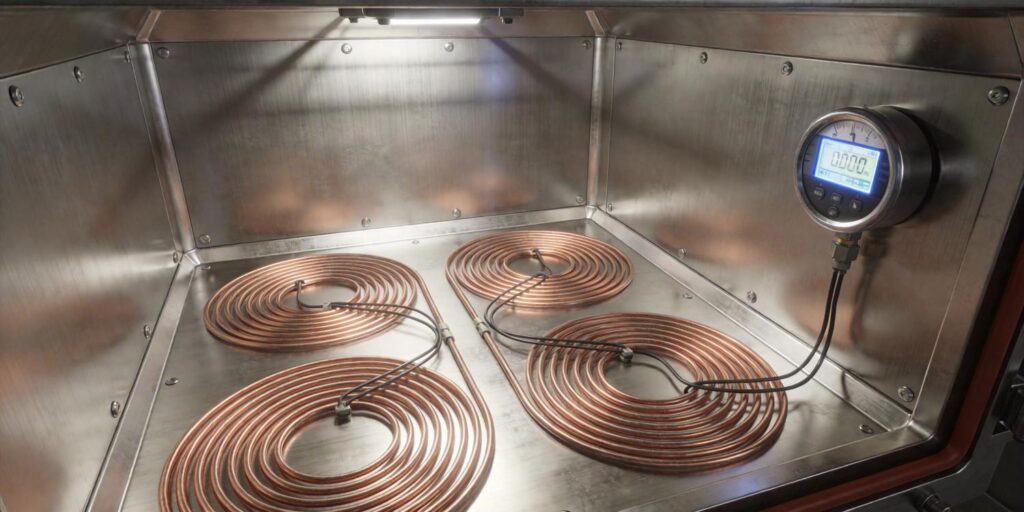
Define Material Outgassing
Outgassing is the spontaneous release of trapped or adsorbed gases from the surfaces and bulk of materials inside a vacuum chamber. These gases—primarily water vapor, hydrogen, carbon monoxide, and hydrocarbons—originate from atmospheric exposure, manufacturing residues, or dissolved species within metals, polymers, and ceramics. In high-vacuum systems the dominant source is physisorbed and chemisorbed water on stainless-steel walls, with typical initial rates of 10⁻⁶ to 10⁻⁷ mbar·L/s·cm² at room temperature.
As pressure drops below 10⁻³ mbar, the chamber volume itself contributes negligible gas load compared with surface outgassing. The process follows desorption kinetics: molecules must overcome an activation energy barrier to leave the surface. At ambient temperature this is slow; at elevated bake-out temperatures it accelerates exponentially. Poseidon Scientific’s VG-SP205 Pirani and VG-SM225 Cold Cathode gauges are designed with low-outgassing materials (stainless steel electrodes, PEEK insulators, platinum filament) and minimal internal surface area, but they cannot eliminate the chamber’s own outgassing—only measure its effect accurately.
Pump-Down Plateau Phenomenon
During pump-down the pressure versus time curve typically shows three phases: rapid viscous-flow drop, transition to molecular flow, and a long plateau where further reduction slows dramatically. This plateau occurs when the net gas load from outgassing exactly balances the pumping speed of the high-vacuum pump. Mathematically, ultimate pressure pult ≈ Qoutgas / Spump, where Qoutgas is the total outgassing flow rate and Spump is effective pumping speed.
In practice the outgassing rate itself decays slowly with time—often following an empirical Q ∝ t⁻¹ or t⁻⁰.⁵ relationship for water-dominated systems. The plateau can last hours or days unless mitigated. Both the VG-SP205 Pirani (atmosphere to 10⁻³ mbar) and VG-SM225 Cold Cathode (10⁻³ to 10⁻⁷ mbar) will faithfully track this plateau because their outputs remain monotonic and stable in the overlap region at 10⁻³ mbar. The cold cathode’s Penning discharge, however, is far less perturbed by residual water vapor than a hot-cathode gauge would be, delivering cleaner high-vacuum data once the plateau is reached.
Differentiating Leak vs Outgassing
Operators frequently confuse a real leak with outgassing because both prevent the system from reaching base pressure. The diagnostic test is isolation: close all valves and monitor the rate-of-rise (dP/dt).
- Leak: constant inflow produces a linear pressure rise independent of time. The slope remains the same whether you wait 10 minutes or 10 hours.
- Outgassing: desorption slows with time; the rate-of-rise curve is concave downward and often fits Q = Q₀ t⁻ⁿ (n ≈ 0.5–1.0). After 30–60 minutes of isolation the rise flattens noticeably.
Cross-check with a residual gas analyzer (RGA) if available: leaks typically show atmospheric ratios (N₂:O₂ ≈ 4:1), while outgassing is dominated by H₂O (mass 18) and H₂ (mass 2). The VG-SM225 Cold Cathode’s cleanable electrodes and automatic HV protection above 10⁻³ mbar make it ideal for repeated isolation tests without risk of contamination or damage, unlike hot-cathode designs that add their own outgassing during the test.
Gauge Sensitivity Role
All vacuum gauges exhibit gas-species dependence, but the effect is magnified in the presence of outgassing because the residual gas mixture is rarely pure nitrogen (the usual calibration gas). Pirani gauges rely on thermal conductivity, which varies strongly with molecular weight: helium reads high, water vapor reads low. Ionization gauges (cold cathode included) have sensitivity factors S that differ by gas: SAr ≈ 1.2 × SN₂, SH₂ ≈ 0.4 × SN₂.
The VG-SM225 Cold Cathode, calibrated for air/nitrogen, will therefore read slightly low if hydrogen dominates outgassing. However, its Penning-discharge mechanism produces far less self-outgassing than a hot filament, and the ion current remains proportional to total gas density even in mixed atmospheres. In contrast, a hot-cathode gauge can locally heat walls and electrodes, increasing the very outgassing it is trying to measure. Poseidon’s compact magnetron geometry (≈100 gauss, stainless-steel electrodes) minimizes this artifact while delivering stable 0–10 V analog and customizable RS232 output across 10⁻³ to 10⁻⁷ mbar.
Mitigation Techniques (Bake-Out)
The most effective and widely adopted mitigation is thermal bake-out. Raising chamber walls to 150–250 °C (or 400–450 °C for glass systems) dramatically increases desorption rates, reducing outgassing by 2–4 orders of magnitude within 24–48 hours. After cool-down the new base pressure is limited primarily by hydrogen diffusion from the bulk metal.
Additional proven techniques include:
- Electropolishing or glow-discharge cleaning to reduce surface roughness and oxide layers
- Pre-baking components in a separate oven before assembly
- Using low-outgassing materials (316L stainless, OFHC copper, Viton-free seals)
- Continuous pumping with a turbo or cryopump during the bake to remove desorbed gas immediately
During bake-out the VG-SP205 Pirani safely monitors the roughing phase (atmosphere to 10⁻³ mbar) with zero risk to its platinum filament, while the VG-SM225 automatically disables high voltage above 10⁻³ mbar via firmware and hardware interlock—protecting electrodes from sputtering or arcing. Once cooled, both gauges return to calibrated accuracy without recalibration.
Application Example in Thin Film System
Consider a 500 mm PVD sputtering chamber depositing optical coatings on glass substrates. The process requires a base pressure of 5 × 10⁻⁶ mbar before argon backfill to 8 × 10⁻³ mbar. Without proper outgassing control the pump-down curve plateaus at 2 × 10⁻⁵ mbar after 2 hours, and residual water vapor incorporates into the growing film, raising absorption and reducing yield.
Engineers installed a Poseidon dual-gauge set: VG-SP205 Pirani on the foreline and VG-SM225 Cold Cathode on the chamber dome. The Pirani tracked roughing accurately; the cold cathode revealed the true high-vacuum plateau. A 24-hour 200 °C bake-out reduced outgassing flow by >100×, dropping base pressure to 8 × 10⁻⁷ mbar within 90 minutes of cool-down. The cold cathode’s cleanable electrodes required only one 10-minute polish after 18 months of daily cycles. Process yield improved from 72 % to 96 %, and the system now logs continuous full-range data (atmosphere to 10⁻⁷ mbar) via customizable RS232 for traceability.
This real production case demonstrates why outgassing management and accurate high-vacuum measurement are inseparable: the gauge must faithfully report the plateau without adding its own gas load.
Eliminate Outgassing Uncertainty in Your High-Vacuum Process
Outgassing is an unavoidable reality of vacuum technology, but its effects on pump-down curves, ultimate pressure, and process yield can be quantified, differentiated from leaks, and dramatically reduced through bake-out and proper gauge selection. Poseidon Scientific’s VG-SP205 Pirani Vacuum Transmitter and VG-SM225 Cold Cathode Vacuum Gauge form the ideal measurement pair: low self-outgassing, automatic overpressure protection, cleanable design, and seamless overlap at 10⁻³ mbar—delivering continuous, reliable data from atmosphere to 10⁻⁷ mbar at a fraction of imported-system cost.
Our engineering team has supported hundreds of thin-film, mass-spectrometer, and vacuum-furnace installations with complete outgassing mitigation strategies. Send us your chamber volume, surface materials, target base pressure, and pump-down curve, and we will return a tailored recommendation—including bake-out protocol, gauge placement, PLC logging script, and costed BOM—within 48 hours at no charge.
Ready to achieve true high-vacuum performance?
- VG-SP205 Pirani Vacuum Transmitter – overload-proof roughing and transition monitoring
- VG-SM225 Cold Cathode Vacuum Gauge – precision high-vacuum measurement with minimal self-outgassing
Contact us today for your no-obligation application review. Let Poseidon Scientific help you turn outgassing from a process limiter into a well-understood, fully controlled variable.


