Overview of PFAS Contamination in Drinking Water
Per- and polyfluoroalkyl substances (PFAS) represent a class of synthetic chemicals that have become a significant environmental concern in drinking water systems worldwide. These compounds, characterized by their strong carbon-fluorine bonds, exhibit exceptional thermal and chemical stability, making them persistent in the environment and resistant to conventional water treatment processes.
The primary sources of PFAS contamination in drinking water include industrial discharges from manufacturing facilities, firefighting foam runoff from military bases and airports, and landfill leachate. The most commonly detected PFAS compounds in drinking water include perfluorooctanoic acid (PFOA), perfluorooctane sulfonic acid (PFOS), perfluorononanoic acid (PFNA), and perfluorohexane sulfonic acid (PFHxS). These compounds have been linked to various health concerns, including developmental effects, immune system suppression, and increased cancer risk, leading to increasingly stringent regulatory limits worldwide.
According to EPA health advisories, the lifetime health advisory levels for PFOA and PFOS in drinking water are currently set at 0.004 parts per trillion (ppt) and 0.02 ppt, respectively, highlighting the extreme sensitivity required for analytical methods. This ultra-trace level detection necessitates robust sample preparation techniques to achieve the required sensitivity while minimizing matrix interferences.
Typical EPA PFAS Analytical Workflow
The EPA has developed several validated methods for PFAS analysis in drinking water, including EPA Methods 537, 537.1, and 533. These methods provide comprehensive frameworks for sample collection, preparation, and analysis, with Method 537.1 being the most widely adopted for drinking water analysis. The typical workflow follows these key stages:
- Sample Collection and Preservation: Proper collection techniques to prevent contamination
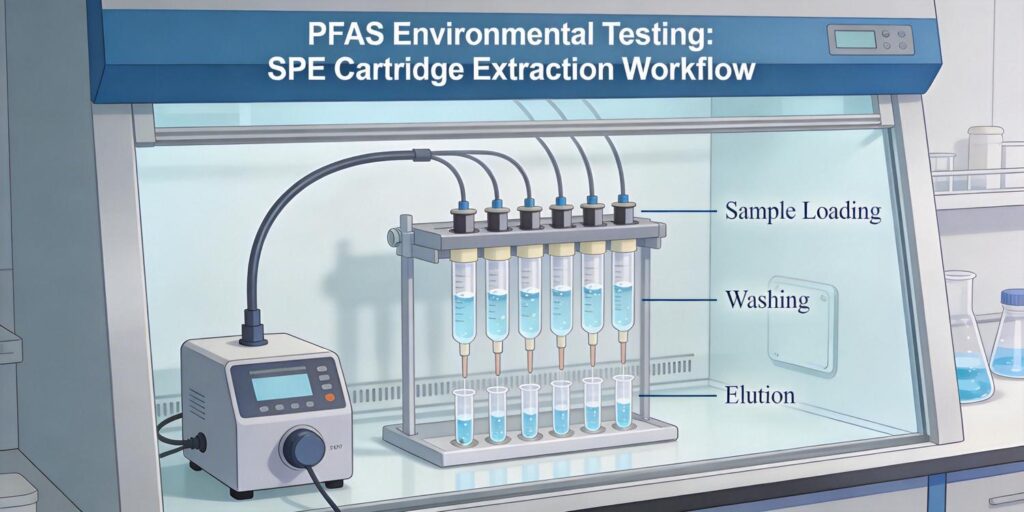
- Solid-Phase Extraction (SPE): Concentration and cleanup of target analytes
- Liquid Chromatography Separation: Separation of PFAS compounds
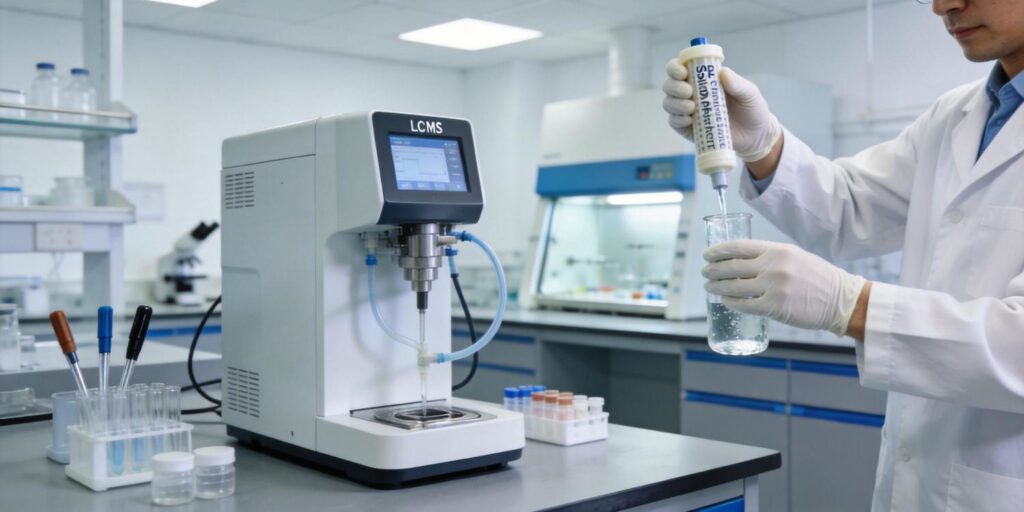
- Tandem Mass Spectrometry Detection: Quantification at ultra-trace levels
The SPE step is particularly critical, as it serves to concentrate the analytes from large sample volumes while removing matrix interferences that could compromise detection sensitivity. The choice of SPE sorbent chemistry significantly impacts method performance, with mixed-mode anion exchange sorbents being preferred for their ability to retain acidic PFAS compounds through both hydrophobic and ion-exchange interactions.
Sample Collection and Preservation Methods
Proper sample collection and preservation are essential for accurate PFAS analysis, given the ubiquitous nature of these compounds in laboratory environments and consumer products. The following protocols should be strictly followed:
Collection Materials
Use only high-density polyethylene (HDPE) or polypropylene containers that have been pre-cleaned and tested for PFAS background. Glass containers should be avoided due to potential adsorption issues. All collection equipment, including tubing and pumps, must be PFAS-free and dedicated to PFAS sampling.
Preservation Protocol
Immediately after collection, samples should be preserved with 0.5% (v/v) ammonium hydroxide to maintain pH > 9. This alkaline condition helps prevent adsorption of PFAS to container walls and maintains the anionic form of the compounds for optimal SPE recovery. Samples should be stored at 4°C and analyzed within 28 days of collection.
Field Blanks and Quality Controls
Include field blanks consisting of PFAS-free water processed through all collection equipment to monitor for contamination. Trip blanks should accompany samples from the laboratory to the field and back to account for transportation-related contamination.
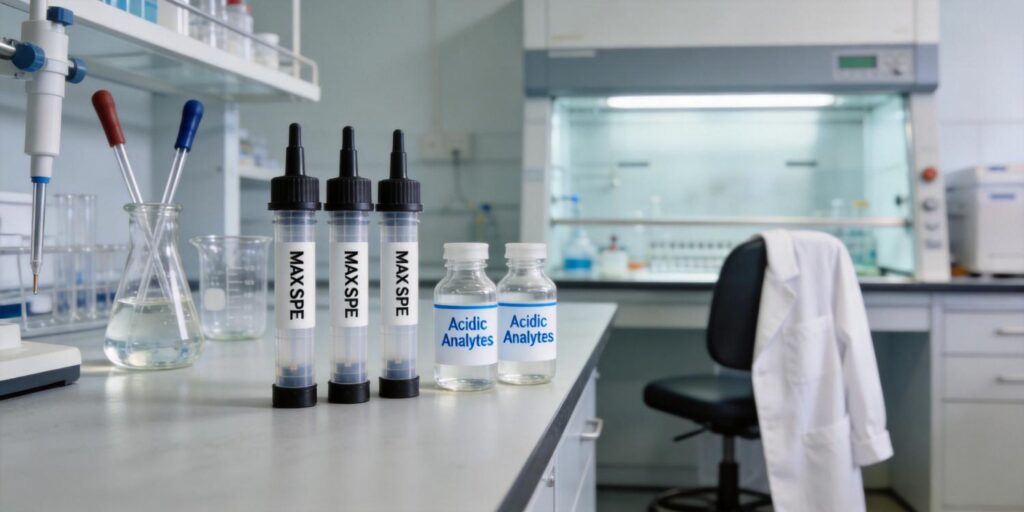
MAX SPE Cartridge Conditioning (MeOH → Water)
The conditioning step is critical for activating the mixed-mode sorbent and ensuring optimal analyte retention. For PFAS analysis using MAX (Mixed-mode Anion eXchange) cartridges, the following conditioning protocol is recommended:
Conditioning Procedure
- Methanol Activation: Pass 5-10 mL of high-purity methanol through the cartridge at a flow rate of 1-2 mL/min. This step wets the hydrophobic surface and prepares the sorbent for aqueous samples.
- Water Rinse: Follow with 5-10 mL of reagent-grade water (pH adjusted to match sample pH) to remove excess methanol and condition the sorbent for aqueous sample loading.
- pH Adjustment: For optimal retention of acidic PFAS compounds, the final conditioning step should include 5-10 mL of ammonium hydroxide solution (0.1% in water) to ensure the sorbent is in the hydroxide form.
Critical Considerations
The cartridge must not be allowed to dry between conditioning and sample loading, as this can lead to poor analyte recovery and irreproducible results. The flow rate during conditioning should be controlled to ensure complete wetting of the sorbent bed. For 6 cc/150 mg MAX cartridges typically used in PFAS analysis, a flow rate of 1-2 mL/min provides optimal conditioning.
Loading Large Volume Water Samples (250–500 mL)
Large volume sample loading is necessary to achieve the required detection limits for PFAS analysis. The following considerations are essential for successful large volume SPE:
Sample Preparation Before Loading
- pH Adjustment: Adjust sample pH to 9-10 using ammonium hydroxide to ensure PFAS compounds are in their anionic form for optimal retention on MAX sorbent.
- Particulate Removal: Filter samples through 0.45 μm glass fiber filters to remove particulates that could clog the SPE cartridge.
- Internal Standard Addition: Add isotopically labeled PFAS internal standards before SPE to monitor extraction efficiency and compensate for matrix effects.
Loading Parameters
For 250-500 mL samples, use 6 cc/150 mg MAX cartridges with appropriate reservoir extensions. Maintain a consistent flow rate of 5-10 mL/min using vacuum or positive pressure. Slower flow rates (1-2 mL/min) may improve recovery for some PFAS compounds but increase processing time.
Breakthrough Monitoring
Monitor for breakthrough by analyzing a small aliquot of the effluent during loading. For ultra-trace analysis, consider using two cartridges in series to ensure complete retention of target analytes.
Washing Steps to Remove Inorganic Salts
Effective washing is crucial for removing matrix interferences while retaining target PFAS compounds. The washing protocol for MAX cartridges typically includes:
Primary Wash: Ammonium Acetate Buffer
Pass 5-10 mL of 25 mM ammonium acetate in water (pH 4-5) through the cartridge. This acidic wash removes weakly retained neutral and basic compounds while maintaining PFAS retention through ion-exchange interactions.
Secondary Wash: Methanol-Water Mixture
Follow with 5-10 mL of 25% methanol in water to remove additional polar interferences and residual salts. This step helps reduce matrix effects in subsequent LC-MS/MS analysis.
Drying Step
After washing, dry the cartridge completely by applying vacuum for 5-10 minutes or using a centrifugal drying step. Complete drying is essential to prevent dilution of the elution solvent with residual water, which could reduce elution efficiency.
Elution Using Methanol with Ammonium Hydroxide
The elution step must effectively disrupt both hydrophobic and ion-exchange interactions to achieve quantitative recovery of PFAS compounds. The recommended elution protocol is:
Elution Solvent Composition
Use 5-10 mL of methanol containing 2-5% ammonium hydroxide. The alkaline methanol effectively neutralizes the ion-exchange sites while providing sufficient elution strength for hydrophobic interactions.
Elution Technique</h
Apply elution solvent in two aliquots (e.g., 2 × 5 mL) with a 1-2 minute soak time between aliquots. Collect the eluate in a clean, PFAS-free collection tube. Maintain a slow flow rate (0.5-1 mL/min) to ensure complete elution.
Concentration and Reconstitution
Evaporate the eluate to near dryness under a gentle stream of nitrogen at 40-45°C. Reconstitute in 1 mL of initial mobile phase composition (typically 95:5 water:methanol) for LC-MS/MS analysis. For maximum sensitivity, consider reconstituting in a smaller volume (e.g., 250 μL) if compatible with the analytical system.
LC-MS/MS Detection Parameters
The final analytical step requires optimized LC-MS/MS conditions to achieve the required sensitivity and selectivity for PFAS compounds:
Chromatographic Conditions
- Column: C18 or equivalent reversed-phase column (e.g., 2.1 × 100 mm, 1.7 μm)
- Mobile Phase: A: 2 mM ammonium acetate in water; B: Methanol
- Gradient: 10-95% B over 10-15 minutes
- Flow Rate: 0.3-0.5 mL/min
- Column Temperature: 40°C
- Injection Volume: 5-10 μL
Mass Spectrometry Parameters
- Ionization Mode: Electrospray ionization (ESI) negative mode
- Source Temperature: 150°C
- Desolvation Temperature: 500°C
- Cone Gas Flow: 50 L/hr
- Desolvation Gas Flow: 1000 L/hr
- Collision Energy: Compound-specific optimization (typically 15-40 eV)
MRM Transitions
Monitor two MRM transitions per compound for confirmation, with the most intense transition used for quantification. Common transitions include:
- PFOA: 413 → 369 (quantifier), 413 → 169 (qualifier)
- PFOS: 499 → 80 (quantifier), 499 → 99 (qualifier)
- PFNA: 463 → 419 (quantifier), 463 → 169 (qualifier)
Quality Control Measures
Include laboratory control samples, matrix spikes, and continuing calibration verification samples in each analytical batch. Monitor internal standard responses to identify matrix effects or extraction issues. Maintain calibration curves with correlation coefficients (r²) > 0.995.
Conclusion
Effective SPE sample preparation is fundamental to successful PFAS analysis in drinking water at the ultra-trace levels required by current regulations. The MAX SPE cartridge, with its mixed-mode retention mechanism, provides the necessary selectivity and capacity for concentrating PFAS compounds while removing matrix interferences. By following optimized protocols for conditioning, loading, washing, and elution, laboratories can achieve the high recoveries and low detection limits needed for regulatory compliance monitoring.
For laboratories seeking alternative SPE solutions, Poseidon Scientific’s MAX SPE cartridges offer comparable performance with rigorous quality control. Additionally, WAX cartridges may provide alternative selectivity for specific PFAS compounds, while 96-well SPE plates enable high-throughput analysis for large monitoring programs.
As PFAS regulations continue to evolve and detection limits become increasingly stringent, robust sample preparation methods will remain essential for accurate drinking water analysis and public health protection.