The Critical Ultra-High Vacuum Region in Research Mass Spectrometry Systems
Research mass spectrometry (MS) demands precise control of gas density to ensure accurate ion trajectories, minimal scattering, and high signal-to-noise ratios. In quadrupole, time-of-flight, or sector-field analyzers, the mean free path of ions must exceed the instrument path length—typically requiring pressures below 10−6 Torr in the analyzer chamber and often 10−8 Torr or lower for optimal resolution. The ion source itself operates at slightly higher pressures (around 10−5 to 10−6 Torr) while the foreline and roughing stages transition from atmosphere down to 10−3 Torr.
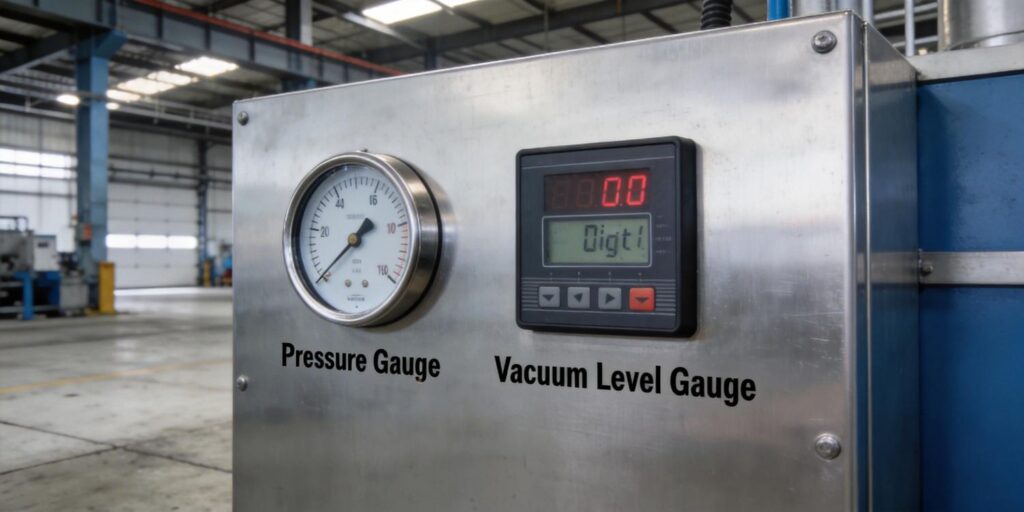
Without reliable vacuum monitoring across this full range, operators risk undetected leaks, outgassing spikes, or pump failures that degrade spectral quality or damage sensitive detectors. The Poseidon Scientific VG-SP205 Pirani Vacuum Transmitter handles the rough vacuum regime (atmosphere to 10−3 Torr), while the VG-SM225 Cold Cathode Vacuum Gauge covers the high-vacuum transition and operating window (10−3 to 10−7 Torr). Together they provide seamless, cost-effective monitoring tailored to compact research MS platforms where space and budget constraints rule out bulkier imported solutions.
Gauge Selection Strategy for Mass Spectrometry Applications
Selecting the right vacuum gauge pair begins with matching measurement ranges to system stages. The VG-SP205 Pirani uses thermal conductivity to deliver fast, maintenance-free readings from atmosphere down to 10−3 Torr—ideal for foreline monitoring during pump-down and for confirming safe crossover before activating high-vacuum pumps. Its platinum filament and temperature-compensated circuitry ensure stability across 15–50 °C operating conditions common in laboratory environments.
For the critical high-vacuum region, the VG-SM225 Cold Cathode employs Penning discharge in a compact positive-magnetron geometry. With a –2000 V operating voltage and ~100 gauss magnetic field, it provides linear ion-current response from 10−3 Torr down to 10−7 Torr—precisely the window required for MS chamber monitoring. Its small footprint (significantly smaller than most MKS or INFICON equivalents) fits tight MS enclosures, while the RJ45 interface supports customizable RS232 protocols for direct integration with instrument control software.
Procurement teams value the Poseidon advantage: self-developed units at 3000–3500 RMB manufacturing cost versus 5000–10000 RMB for imported alternatives, with full protocol customization available even for 5–10 unit orders. In validated mass spectrometry installations, this dual-gauge strategy eliminates the need for expensive wide-range ionization gauges while maintaining full coverage from atmosphere to operating vacuum.
Why Cold Cathode Over Hot Cathode in Research MS?
Hot-cathode gauges introduce filament outgassing and electron-stimulated desorption—undesirable in ultra-clean MS environments. Cold-cathode designs avoid these issues entirely, delivering cleaner operation and longer electrode life in the low-contamination conditions typical of research spectrometers.
Sensitivity to Contamination and Maintenance Considerations
Mass spectrometry chambers are among the cleanest vacuum environments, minimizing contamination risks for both Pirani and cold-cathode sensors. The VG-SP205 Pirani is inherently immune to electrode contamination; its platinum filament operates without high-voltage discharge, delivering maintenance-free service with 3–5 year lifetimes under typical MS gas loads (primarily nitrogen or helium).
The VG-SM225 Cold Cathode, while more sensitive to surface deposits, benefits from its fully disassemblable sensor head. In clean MS service, carbon buildup or oxide layers appear only after years of operation. Early indicators—startup delay beyond 5 minutes at 10−6 Torr or readings biased low by one decade—prompt a simple 15-minute cleaning: remove the electrode rod, sand the discharge plate and chamber wall with 200–500 mesh paper until metallic luster returns, and reinstall. This restores original sensitivity without affecting factory calibration.
Because research MS systems rarely handle aggressive process gases, electrode lifetime routinely reaches 3–5 years—matching or exceeding competitive units while offering far easier field service. For added protection, the VG-SM225’s software automatically disables high voltage above 10−3 Torr, preventing damage during venting or roughing stages.
Calibration Frequency and Field Verification Practices
Factory calibration establishes the voltage-to-pressure map for each VG-SM225 and VG-SP205 unit using certified reference gauges. Field recalibration is neither required nor recommended for routine operation; the instruments maintain specified accuracy (±50 % in non-linear regions, far tighter in the 10 Torr to 10−2 Torr linear band for Pirani and equivalent linearity for cold cathode) when operated within 15–50 °C.
Best practice in research MS labs calls for annual verification against a portable capacitance manometer or another calibrated gauge at two or three known points (e.g., 10−4, 10−5, and 10−6 Torr). Because the VG-SM225 supports real-time RS232 output of raw ion current and status codes, automated scripts can log drift trends without interrupting operation. In clean environments, calibration drift remains negligible for 12–24 months; any deviation beyond 10–15 % signals the need for electrode cleaning rather than full recalibration.
This low-maintenance approach reduces total cost of ownership versus gauges that demand frequent factory return or complex on-site procedures.
Stability Requirements for Reliable Mass Spectrometry Data
MS spectral stability depends on vacuum pressure remaining within ±10 % of target over measurement cycles. The VG-SP205 Pirani’s temperature-compensated circuitry limits thermal drift to <5 % across its operating range, while the VG-SM225 Cold Cathode exhibits only minor long-term drift (<5 % per year in clean service) thanks to its robust stainless-steel electrodes and PEEK insulators.
Both instruments output a stable 0–10 V analog signal (effective 2–8 V range) plus customizable RS232 digital streams, enabling real-time pressure logging and interlocks. In dual-gauge setups, the system automatically switches monitoring from Pirani to cold cathode at 10−3 Torr, eliminating data gaps during pump-down. Hysteresis between pump-down and vent-up curves—common in cold-cathode designs—is minimized by the VG-SM225’s optimized geometry and remains well within MS tolerance when electrodes are kept clean.
Engineers report that the Poseidon pair delivers the repeatability required for reproducible fragmentation patterns and accurate mass assignments, all at a fraction of the cost of legacy wide-range systems.
Conclusion and Next Steps
Effective vacuum monitoring in research mass spectrometry systems hinges on covering the full pressure spectrum with compact, low-maintenance instruments that integrate seamlessly into existing control architectures. The Poseidon Scientific VG-SP205 Pirani and VG-SM225 Cold Cathode combination meets these demands precisely—delivering proven performance in front- and back-stage MS monitoring while offering unmatched size, cost, and customization advantages over traditional suppliers.
Whether you are designing a new compact spectrometer or upgrading an existing platform, this dual-gauge solution ensures reliable ultra-high vacuum control with minimal downtime and lowest total ownership cost.
Ready to secure stable vacuum monitoring for your mass spectrometry system? Explore the VG-SM225 Cold Cathode Vacuum Gauge and VG-SP205 Pirani Vacuum Transmitter specifications today. Request a sample unit, custom communication protocol, or application engineering support—our team is ready to help you optimize vacuum performance and accelerate your research timeline. Contact Poseidon Scientific now for a competitive quote.