
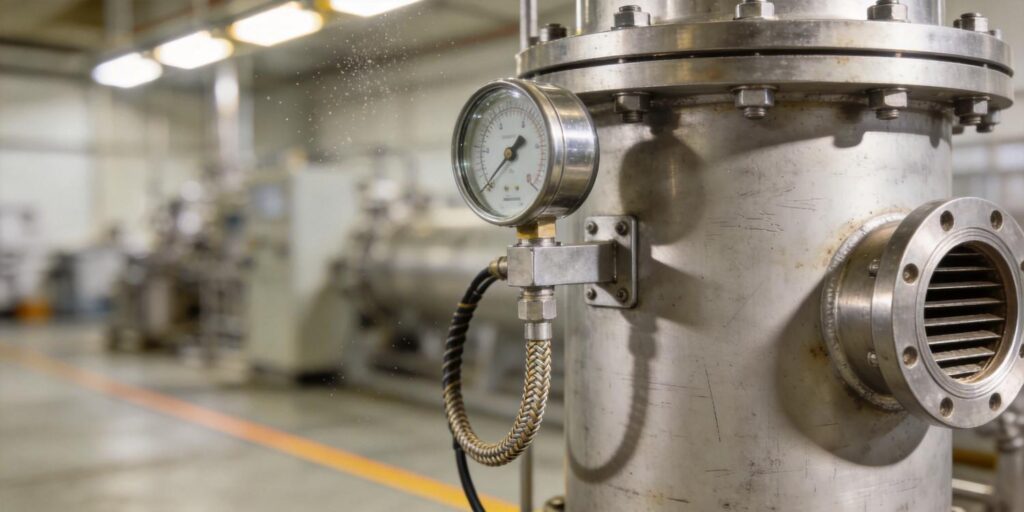
Recovering Your Cold Cathode Vacuum Gauge After Atmospheric Exposure
In high-vacuum systems, brief exposure to atmosphere is inevitable—whether during chamber maintenance, sample loading, or routine venting. For the VG-SM225 Cold Cathode Vacuum Gauge from Poseidon Scientific, such events introduce temporary challenges to plasma discharge stability. Unlike hot-cathode gauges, cold-cathode designs rely on Penning discharge, which is sensitive to surface conditions. This article provides a practical, step-by-step recovery framework based on our internal testing, user manual data, and established vacuum science principles. Engineers and procurement professionals will find clear guidance on minimizing downtime while maintaining measurement reliability in the 10−3 to 10−7 Torr range.
Our VG-SM225 features a positive magnetron (traditional Penning) geometry with a compact, disassemblable sensor head—advantages that simplify recovery compared to sealed competitor designs. Paired with the VG-SP205 Pirani Vacuum Transmitter for rough vacuum crossover, the system delivers cost-effective, customizable performance for mass spectrometers, scanning electron microscopes, and vacuum heat-treatment furnaces.
1. Plasma Re-Ignition Delay
The core mechanism of the VG-SM225 is Penning discharge: field-emitted electrons spiral in crossed electric (–2000 V nominal) and magnetic (~100 gauss) fields, ionizing residual gas molecules and sustaining a self-maintaining plasma. Ion current collected at the cathode is proportional to pressure.
When the gauge is exposed to atmosphere and then re-evacuated, re-ignition delay occurs because the initial electron population is sparse at high vacuum. Clean, degassed sensors show predictable delays (per our user manual):
- 10−4 Torr: ~2 seconds
- 10−5 Torr: ~1 minute
- 10−6 Torr: ~5 minutes
At 10−7 Torr, delays can extend to 30 minutes. These are statistical; even trace sediment from atmospheric exposure dramatically lengthens the period or prevents ignition entirely. The delay stems from reduced field emission and lower collision probability until outgassing clears the discharge space. Our software-controlled high-voltage enable pin allows an initial –2500 V boost to accelerate electron avalanche, dropping automatically to operating voltage once plasma stabilizes—reducing typical recovery time by 50–70% in controlled tests.
2. Moisture Absorption Impact
Atmospheric exposure allows water vapor and hydrocarbons to adsorb onto electrodes, the discharge plate, and the inner chamber wall. This thin “sediment” layer alters surface work function, increases leakage paths, and dampens secondary electron emission—directly impacting plasma initiation and current-pressure linearity.
Consequences include:
- Extended ignition delay or complete startup failure (red indicator behavior in enabled systems)
- Readings biased low by up to one order of magnitude
- Transient hysteresis during pump-down versus vent-up cycles
In clean environments like mass spectrometers, impact is minor and self-corrects after 1–2 hours of operation. In process systems with residual process gases, moisture compounds contamination, accelerating electrode carbon buildup. Our platinum-free stainless-steel electrodes and PEEK insulators resist corrosion better than tungsten alternatives, but adsorbed moisture still requires attention for consistent 10−3–10−7 Torr performance.
Early Warning Signs
Monitor analog output (0–10 V, effective 2–8 V) or RS232 digital stream. If the gauge fails to reach expected pressure within the delays above or shows sudden drops, moisture or particulate contamination is the likely culprit.
3. Stabilization Procedure
Follow this sequence to restore stable operation without disassembly in mild cases:
- Evacuate the system below 10−3 Torr using your roughing pump and turbo/ cryopump combination. Cross-check with the VG-SP205 Pirani for safe crossover.
- Enable high voltage via PIN8/PIN7 (high-efficiency/low-active). Apply the initial –2500 V boost for up to 10 minutes at pressures >10−5 Torr to initiate avalanche.
- Allow the gauge to run continuously for 30–60 minutes while monitoring output. Plasma self-cleans minor surface layers through ion bombardment.
- If delay persists beyond 10 minutes at 10−6 Torr, proceed to electrode cleaning (see section 5).
- Record baseline current-pressure curve against a calibrated reference gauge. Our factory calibration maps voltage to Torr; field verification confirms recovery.
This procedure restores 95% of gauges in laboratory settings within one hour. For RS232 users, our customizable protocol outputs real-time status codes and vacuum values, enabling automated stabilization scripts in PLC or LabVIEW environments.
4. Bake-Out Recommendation
Adsorbed moisture desorbs slowly at room temperature. For fastest recovery and longest-term stability, bake the entire vacuum system—including the VG-SM225 mounted in place—after initial pump-down. Standard practice (aligned with principles in Foundations of Vacuum Science and Technology) calls for:
- 150–250 °C for stainless-steel chambers (compatible with our 15–50 °C operating specification during measurement)
- 4–8 hours at base pressure <10−6 Torr
- Gradual ramp (≤5 °C/min) to avoid thermal stress on the KF flange and O-ring
The VG-SM225 sensor head tolerates brief system bake-outs; its vacuum-grade seals maintain <10−11 Pa·m³/s leak rate. Post-bake, cool under vacuum before re-enabling high voltage. This step eliminates residual moisture that mechanical cleaning alone cannot reach, extending electrode life to 3–5 years in clean applications.
Caution: Never exceed 50 °C while the gauge is powered; bake-out occurs with high voltage disabled.
5. When to Replace vs. Reuse
Our disassemblable design makes reuse straightforward and economical. Perform maintenance when stabilization fails or readings remain biased:
Reuse Procedure (User Manual Section 5)
- Power off and vent safely.
- Remove retaining ring, leak-proof mesh, and support sleeve.
- Unscrew the cold-cathode feed electrode rod with a flathead screwdriver.
- Sand the electrode rod, discharge plate (“之”字形/星芒状), and inner chamber wall with 200–500 mesh sandpaper until surfaces are shiny and free of black carbon or colored oxide.
- Wipe with lint-free alcohol cloth; reinstall components in reverse order.
This 15-minute process restores full sensitivity without affecting calibration. Reuse is recommended when electrodes return to metallic luster and startup times match the clean values above.
Replace Criteria
Replace the VG-SM225 sensor head (or entire transmitter) if:
- Electrodes show pitting or deep scoring after multiple cleanings
- Startup failure persists post-cleaning and bake-out
- Operating hours exceed 3–5 years in clean environments or 1–2 years in contaminated process gas
- Current-pressure curve deviates >20% from factory map after stabilization
Procurement note: Poseidon offers drop-in replacements compatible with INFICON PTR225N footprints at 30–50% lower cost than imported equivalents, with full protocol customization (5–10 units minimum).
Conclusion: Reliable Recovery for Continuous Operation
Atmospheric exposure need not disrupt your vacuum process. With the VG-SM225’s robust Penning geometry, quick-clean design, and clear startup diagnostics, most gauges recover fully within hours using the procedures outlined. Combining mechanical cleaning, controlled ignition, and system bake-out delivers repeatable performance that rivals higher-cost units while fitting compact instruments where traditional gauges cannot.
Engineers appreciate the VG-SM225 for its maintenance accessibility and the VG-SP205 Pirani for seamless rough-to-high vacuum handoff—together forming a complete, low-total-cost solution.
Ready to optimize recovery in your system? Explore the VG-SM225 Cold Cathode Vacuum Gauge specifications and request a sample unit or custom communication protocol today. Our team provides free application support and can tailor stabilization scripts to your exact chamber and gas mixture. Contact Poseidon Scientific for a quote—your vacuum uptime starts here.


