
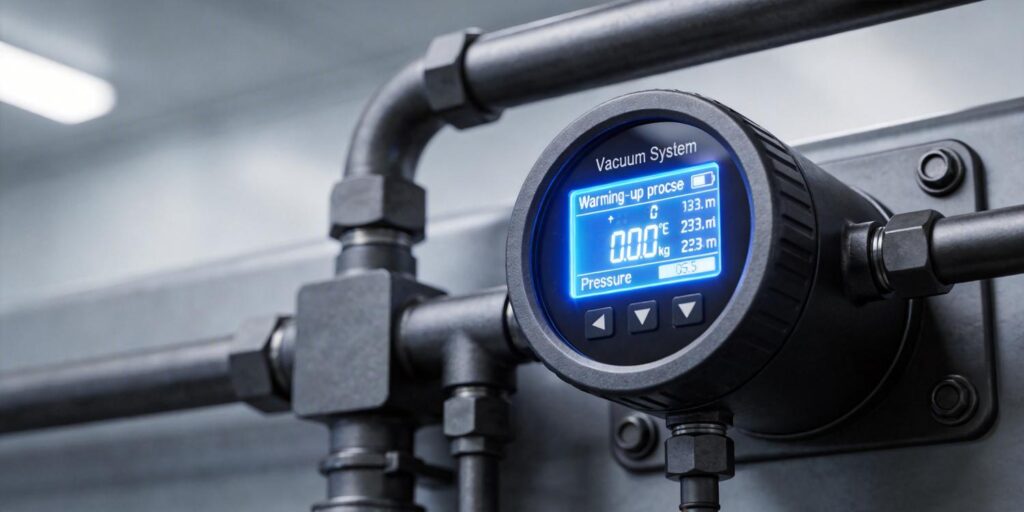
Sensor Thermal Equilibrium Explanation
Vacuum gauges, whether thermal-conductivity or ionization types, require time to reach thermal equilibrium before delivering stable, repeatable readings. In the Poseidon Scientific VG-SP205 Pirani Vacuum Transmitter, a platinum filament is resistively heated to a constant temperature while the electronics monitor the power needed to maintain that set point. Immediately after power-on, the filament, surrounding housing, and internal compensation circuits are at ambient temperature. Heat transfer between the filament and gas molecules, combined with conduction through the sensor body and radiation losses, takes several minutes to stabilize.
The temperature-compensation algorithm—built from extensive factory testing—corrects for ambient changes across the 15–50 °C operating range, yet the physical thermal mass of the assembly still demands a settling period. Below 10⁻³ Torr the Pirani enters the molecular-flow regime where heat loss becomes pressure-independent; any residual temperature gradient introduces offset errors until full equilibrium is achieved. Typical stabilization for the VG-SP205 occurs within 5–10 minutes under normal conditions, aligning with the thermal time constants of platinum wire and stainless-steel construction.
For the VG-SM225 Cold Cathode Vacuum Gauge, thermal equilibrium plays a secondary but still important role. The stainless-steel electrodes and PEEK insulators must reach uniform temperature to minimize surface outgassing and ensure consistent field emission. However, the dominant delay here stems from the Penning discharge physics rather than simple heating: electrons must build a self-sustaining avalanche through repeated ionizing collisions. This process is inherently statistical and pressure-dependent.
Electronic Drift During Startup
Beyond sensor thermal effects, the embedded electronics themselves contribute to the observed 10–20 minute window for full stability. Both the VG-SP205 and VG-SM225 contain precision analog front-ends, microcontrollers, and temperature-compensation circuits powered by a 24 VDC supply. On initial power-up, capacitors charge, reference voltages settle, and op-amp offsets drift as internal components warm from ambient to their steady-state operating temperature (typically 5–8 °C above ambient due to self-heating).
In the Pirani transmitter, the constant-temperature feedback loop is particularly sensitive during the first 10 minutes; minor voltage fluctuations can appear as pressure noise until the loop gain stabilizes. The cold cathode gauge adds high-voltage circuitry: the –2500 V startup rail and –2000 V operating rail must ramp cleanly, and the ion-current amplifier requires several minutes for baseline drift to fall below 1 % of full scale. These electronic settling effects are well-documented in ionization-gauge literature and are the reason manufacturers universally recommend a warm-up period before trusting readings for process control or data logging.
Field experience with Poseidon units confirms that after the initial 10–20 minutes, both analog 0–10 V outputs and customizable RS232 digital streams remain stable to within ±2 % for hours, provided ambient temperature stays within the specified band.
Recommended Stabilization Procedure
To achieve reliable measurements, follow this simple, field-proven procedure with any Poseidon vacuum gauge:
- Install the gauge on the chamber or manifold and apply 24 VDC power (via RJ45 or equivalent).
- Ensure the system pressure is within the gauge’s operating range: atmosphere to 10⁻³ Torr for the VG-SP205 Pirani; 10⁻³ to 10⁻⁷ Torr for the VG-SM225 Cold Cathode.
- For the VG-SM225, confirm the green LED is steady (HV enabled) and allow the ignition delay to complete. Typical times from the product manual are:
Pressure (Torr) Typical Ignition Delay 10⁻⁴ ≈ 2 seconds 10⁻⁵ ≈ 1 minute 10⁻⁶ ≈ 5 minutes At 10⁻⁷ Torr the delay can extend to 30 minutes in clean, degassed conditions; contamination lengthens it further.
- Wait an additional 10–15 minutes after the LED stabilizes or the Pirani output stops drifting. During this period the electronics and sensor reach full thermal equilibrium.
- Verify stability by logging the output for 5 minutes; drift should be <0.5 % of reading.
This procedure ensures the gauge is ready for production use and prevents false trips or erroneous data in automated sequences.
Impact on Automated Systems
In PLC- or SCADA-controlled vacuum tools (mass spectrometers, PVD coaters, vacuum furnaces), the 10–20 minute stabilization window must be explicitly accounted for in the control sequence. Starting a process recipe before the gauge has settled can trigger nuisance interlocks, abort cycles, or record invalid pressure trends that fail downstream quality audits.
Best practice is to incorporate a “gauge ready” flag: the PLC monitors both the cold-cathode HV status (via digital input or RS232) and the rate-of-change of the analog output. Only when drift falls below a configurable threshold (e.g., 0.1 V over 60 seconds) does the system permit pump-down or process-gas introduction. Because both Poseidon gauges share identical RJ45 connectors and support customizable RS232 protocols, implementing this logic requires minimal custom code—often just a few ladder rungs or structured-text blocks.
For high-throughput OEM equipment, the dual-gauge architecture (VG-SP205 + VG-SM225) further mitigates impact: the Pirani can confirm roughing progress within minutes while the cold cathode stabilizes in parallel. The overlap at 10⁻³ Torr allows seamless handoff without extending overall cycle time.
Verification Method Before Production Start
Before releasing a chamber to production, perform a quick stability check that takes less than 30 minutes total:
- Power both gauges (or the single gauge in use) and allow the recommended 10–20 minute warm-up.
- Record the 0–10 V analog output or RS232 pressure value at 1-second intervals for 5 minutes using a data logger or PLC trend.
- Calculate the standard deviation and maximum drift. Acceptable limits: <2 % of reading for the Pirani in its linear band; <5 % for the cold cathode at typical process pressures.
- Cross-check against a known reference (another calibrated gauge or capacitance manometer in the overlap region) if available.
- If drift exceeds limits, verify ambient temperature is 15–50 °C, clean electrodes if the cold cathode LED flashes, and repeat. Persistent issues almost always trace to contamination or power-supply ripple rather than gauge design.
This verification step, performed once per shift or after maintenance, ensures every production run begins with trustworthy vacuum data and provides an auditable record for ISO or SEMI compliance.
Build Stability into Every Vacuum Process
The 10–20 minute warm-up period for vacuum gauges is not an inconvenience—it is a direct consequence of thermal equilibrium physics, electronic settling, and (for cold cathode designs) the statistical nature of Penning discharge ignition. By understanding these mechanisms and applying the straightforward stabilization procedure above, engineers achieve the accuracy and repeatability their processes demand.
Poseidon Scientific’s VG-SP205 Pirani Vacuum Transmitter and VG-SM225 Cold Cathode Vacuum Gauge were engineered with these realities in mind: platinum filaments and temperature-compensated circuits for the Pirani, cleanable electrodes and automatic HV protection for the cold cathode, plus identical footprints and customizable protocols that simplify integration. Whether you run a research mass spectrometer, a 24/7 PVD coater, or a vacuum heat-treatment furnace, these gauges deliver stable readings after the brief recommended wait—while keeping total cost of ownership far below imported alternatives.
Ready to eliminate warm-up surprises in your automated systems? Our team has pre-built PLC function blocks, sample RS232 parsing code, and wiring diagrams for hundreds of installations. Send us your chamber schematic, typical pump-down curve, or control sequence, and we will return a complete stabilization strategy—including exact timing values and interlock logic—within 48 hours at no charge.
Explore the gauges trusted for precise, repeatable vacuum monitoring:
- VG-SP205 Pirani Vacuum Transmitter – thermal-conductivity stability from atmosphere to 10⁻³ Torr
- VG-SM225 Cold Cathode Vacuum Gauge – high-vacuum performance with documented ignition-delay behavior
Contact us today for your no-obligation application review. Let Poseidon Scientific help you lock in stable, production-ready vacuum measurements from the very first cycle.


