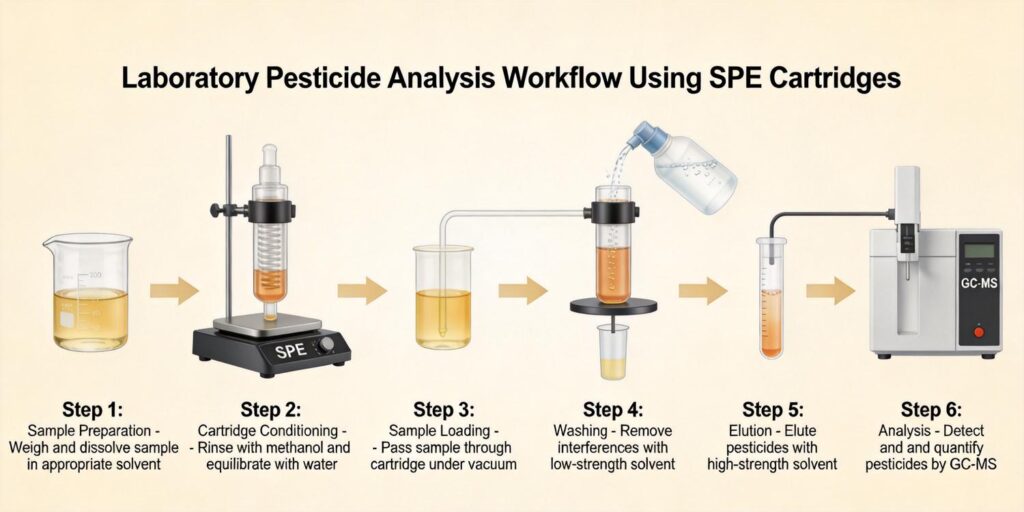
Pesticide Residue Analysis in Tea: A Step-by-Step SPE Workflow
Tea is one of the most widely consumed beverages globally, and its quality and safety are paramount for both consumers and producers. Monitoring pesticide residues in tea leaves is a critical aspect of food safety, as tea plants are often treated with various pesticides during cultivation. Solid-phase extraction (SPE) has emerged as a preferred sample cleanup technique due to its efficiency in removing complex matrix interferences such as pigments, polyphenols, and caffeine. This blog outlines a robust SPE-based workflow for pesticide residue analysis in tea, designed to meet regulatory validation standards.
Why Pesticide Monitoring Matters
Pesticide residues in tea can originate from pre-harvest applications or environmental contamination. Regulatory bodies like the European Union and the U.S. EPA set maximum residue limits (MRLs) for various pesticides in tea. Failure to comply can result in trade rejections and health risks. Effective monitoring requires a sample preparation method that not only extracts a broad range of pesticides but also removes co-extractives that interfere with quantitative analysis.
Sample Preparation: Grinding and Extraction
Tea leaves are first ground to a fine powder (particle size < 0.5 mm) to increase surface area for extraction. A 2–5 g sample is typically homogenized with 20–50 mL of a solvent mixture such as acetonitrile/water (80:20, v/v). The extraction is often assisted by mechanical shaking or sonication for 10–30 minutes, followed by centrifugation at 4000 rpm for 5 minutes. The supernatant is decanted and subjected to SPE cleanup.
SPE Sorbent Selection: Matching Chemistry to Matrix
For tea samples, mixed-mode sorbents offer superior cleanup due to the presence of both hydrophobic and ionic interferences. HLB cartridges (hydrophilic-lipophilic balance) are versatile for retaining a wide range of pesticides while allowing polar matrix components to pass through. Alternatively, MCX cartridges (mixed-mode cation exchange) are effective for basic pesticides, and WCX cartridges for weak cation exchange. For maximum cleanup of pigments and polyphenols, WAX cartridges (weak anion exchange) can be employed. The choice depends on the pesticide classes targeted.
Cartridge Conditioning and Sample Loading
Prior to loading, the SPE cartridge must be conditioned to activate the sorbent. Typically, 3–5 mL of methanol followed by 3–5 mL of water or loading buffer (pH-adjusted) is passed through. The tea extract is then loaded at a flow rate of 1–2 mL/min under gentle vacuum. It is crucial to avoid drying the cartridge between conditioning and loading to maintain consistent retention.
Washing Steps: Removing Pigments and Polyphenols
The washing step is the heart of the cleanup. After sample loading, the cartridge is washed with 2–5 mL of a weak solvent mixture, such as 5% methanol in water or a pH-adjusted buffer, to remove pigments (chlorophyll, theaflavins) and polyphenols (catechins). For 96-well SPE plates used in high-throughput, a vacuum manifold ensures uniform flow. Over-washing can break through analytes, so careful optimization of wash volume and solvent strength is necessary.
Elution Optimization for Pesticide Compounds
Elution is performed with a solvent that disrupts the interactions between the sorbent and the pesticides. For HLB sorbents, acetonitrile or methanol (2–5 mL) is sufficient. For ion-exchange cartridges, acidified or basified organic solvents are used (e.g., 5% ammonium hydroxide in methanol for MCX). The eluate is collected and evaporated to dryness under a nitrogen stream, then reconstituted in a compatible solvent for injection into GC-MS or LC-MS.
Detection and Quantification
Gas chromatography-mass spectrometry (GC-MS) is ideal for volatile and semi-volatile pesticides, while liquid chromatography-tandem mass spectrometry (LC-MS/MS) handles polar and thermally labile compounds. The detection limits must meet MRLs, typically in the 0.01–0.1 mg/kg range.
Food Safety Validation Requirements
Validation according to SANTE guidelines (or equivalent) is mandatory. This includes assessing recovery rates (70–120%), precision (RSD ≤ 20%), linearity (R² > 0.99), matrix effects, and limits of quantification (LOQs). The SPE method should be rugged and reproducible across different tea varieties (green, black, oolong).
Conclusion
SPE-based cleanup remains an indispensable tool for accurate pesticide residue monitoring in tea. By carefully selecting sorbent type, optimizing wash and elution steps, and validating against regulatory criteria, laboratories can ensure reliable results. For a range of high-quality SPE cartridges and plates, Poseidon Scientific offers products designed to meet these demanding applications.