The Growing Need for High-Throughput Biomarker Testing
Clinical biomarker analysis is foundational to modern diagnostics, drug development, and personalized medicine. With the rise of large-scale clinical trials and population screening programs, laboratories face increasing pressure to process hundreds to thousands of samples daily while maintaining high data quality. Traditional solid-phase extraction (SPE) using individual cartridges is not scalable for these demands. The adoption of 96-well SPE plates has become a standard solution to bridge throughput and analytical performance in clinical labs.
Why 96-Well SPE Plates Excel in Clinical Workflows
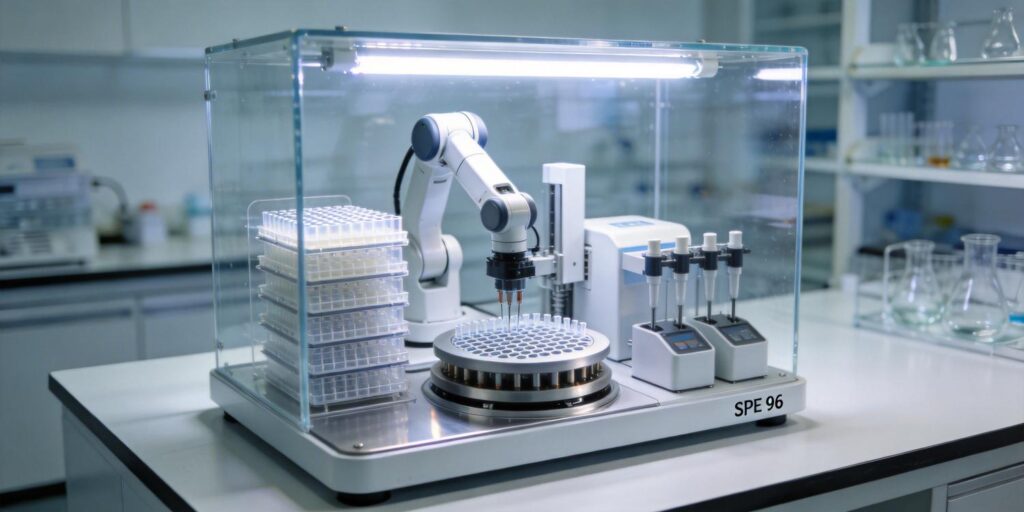
96-well SPE plates, like those offered by Poseidon Scientific, enable parallel processing of 96 samples in a single batch. This format drastically reduces hands-on time and solvent consumption compared to cartridge-based methods. The uniform geometry of each well ensures consistent flow characteristics, which is critical for reproducible retention and elution of target biomarkers. Additionally, the plate format seamlessly integrates with automated liquid handlers and autosamplers, making it ideal for high-throughput LC-MS/MS workflows.
Key Advantages at a Glance
- Parallel Processing: 96 samples simultaneously processed, improving throughput up to 10-fold over cartridge methods.
- Reduced Solvent Use: Typical elution volumes are 50–200 µL, minimizing waste and evaporation steps.
- Automation Compatibility: Designed for robotic pipettors, vacuum manifolds, and positive pressure units.
- Consistent Sorbent Mass: Each well contains an identical amount of sorbent, enhancing well-to-well reproducibility.
Plate Conditioning and Equilibration
Proper conditioning is vital for reproducible SPE. For reversed-phase sorbents (like HLB), the general protocol involves:
- Solvation: Add 1 mL of methanol or acetonitrile per well, let it soak for 1–2 minutes, then apply vacuum.
- Equilibration: Add 1 mL of water or buffer (pH matched to sample) per well, then draw through.
For ion-exchange sorbents (MAX, WAX, MCX, WCX), use buffers at appropriate pH to activate the ion-exchange groups. Always ensure the sorbent does not dry out between conditioning and sample loading.
Automated Sample Loading with Pipetting Robots
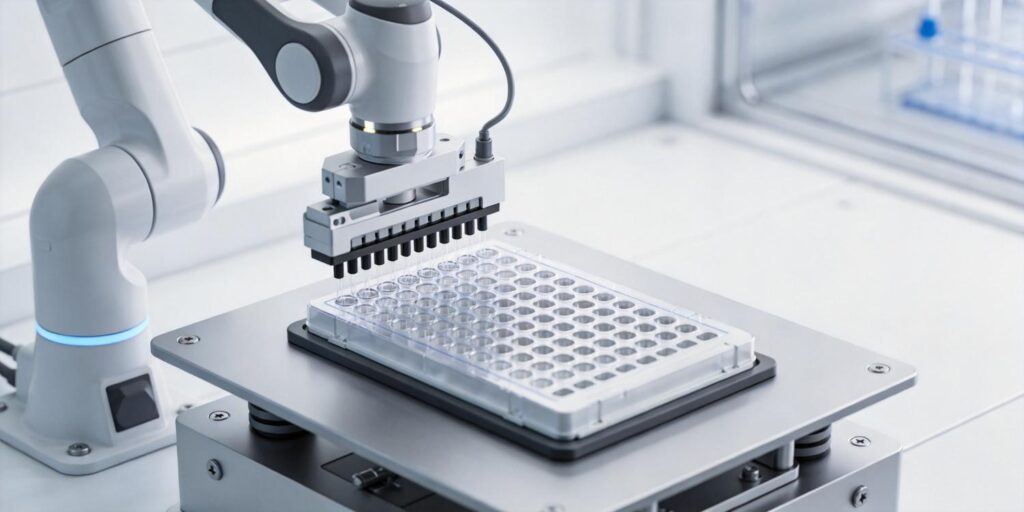
Modern liquid handlers (e.g., Hamilton, Tecan, Beckman) can be programmed to load samples directly onto the 96-well plate. The recommended loading flow rate is 0.5–2 mL/min per well under gentle vacuum or positive pressure. To avoid cross-contamination, use fresh tips for each sample or wash tips thoroughly between transfers. For viscous samples like plasma, diluting with buffer or using a positive displacement pipettor improves accuracy.
Washing and Elution Steps
After sample loading, wash the sorbent with 1–2 mL of a weak solvent (e.g., 5% methanol in water) to remove interfering matrix components. For ion-exchange SPE, a pH-adjusted wash (e.g., 0.1% formic acid for MCX sorbents) can enhance selectivity. Elution is typically performed with 200–500 µL of an organic solvent or buffered solution. For HLB sorbents, pure methanol or acetonitrile is effective; for mixed-mode sorbents, use a combination of organic solvent and volatile salt (e.g., 5% ammonium hydroxide in methanol for MAX). Collect eluates in a deep-well plate compatible with the autosampler.
Integration with LC-MS Autosamplers
One major advantage of 96-well plates is direct compatibility with LC-MS autosampler trays. After elution, the plate can be sealed or covered, placed in the autosampler, and injected sequentially. This eliminates manual transfer steps and reduces the risk of sample mix-up. Ensure the collection plate is made of polypropylene to avoid solvent adsorption and is compatible with the autosampler’s injection needle depth.
Throughput Optimization Tips
- Batch Scheduling: Overlap SPE processing with LC-MS run time. For example, while one plate is running on the LC-MS, condition and load the next plate simultaneously.
- Partial Plate Use: If fewer than 96 samples are available, use only the required number of wells and cover unused wells with sealing tape to maintain vacuum integrity.
- Positive Pressure vs. Vacuum: Positive pressure manifolds provide more consistent flow rates and are less prone to channeling, especially with viscous samples.
Analytical Reproducibility and QC Procedures
To ensure data quality, implement the following QC measures:
- Internal Standards: Spiked into every sample before SPE to correct for recovery variations.
- Matrix Blanks: Process matrix without analyte to monitor contamination.
- Calibration Curve: Prepare standards in the same matrix and process through the entire SPE workflow.
- Duplicate Analysis: Include replicates on the same plate to assess well-to-well variability.
- Carryover Check: After high-concentration samples, inject a blank to check for residual analyte.
Typical acceptance criteria include calibration curve R² > 0.99, internal standard recovery within 80–120%, and replicate CV < 15%. For more information on selecting the right SPE sorbent or plate format, explore Poseidon Scientific's full line of SPE products.