High Throughput Screening Overview
High throughput screening (HTS) represents a paradigm shift in analytical chemistry, enabling laboratories to process hundreds or even thousands of samples simultaneously rather than sequentially. This approach has become essential in pharmaceutical development, clinical diagnostics, environmental monitoring, and food safety testing where large sample volumes demand rapid turnaround times.
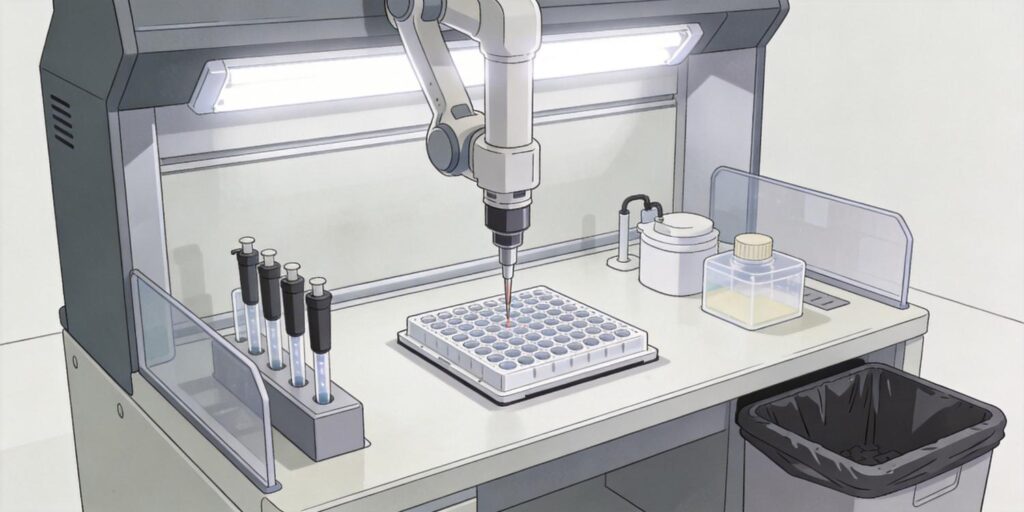
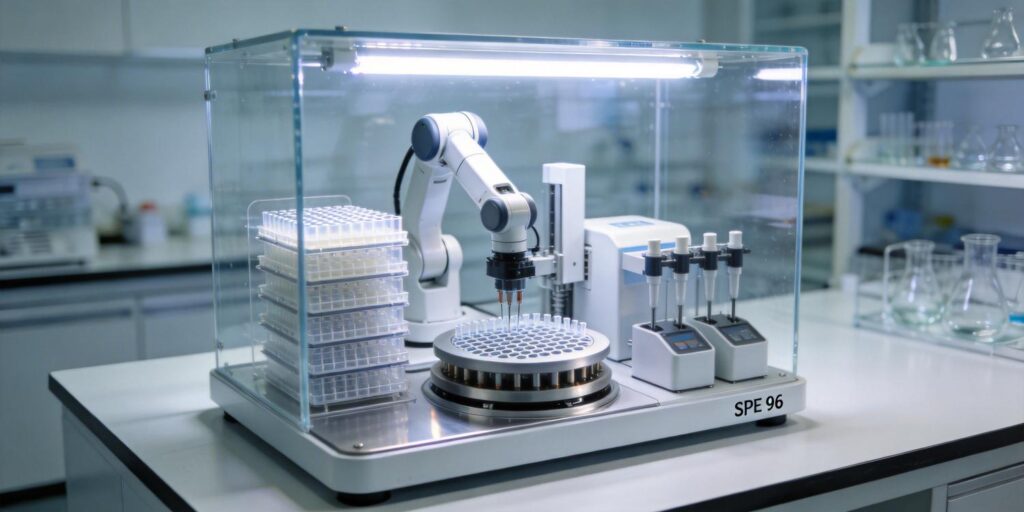
The 96-well SPE plate format emerged as a direct response to this need for parallel processing. As noted in the literature, “the growth of high-speed sample preparation robots that can handle formats like the 96-well SPE plate – a format that is standard in the immunoassay screening industry and combinatorial chemistry lab” has catalyzed significant advancements in sample preparation efficiency. This standardization on the 8 × 12 array format allows laboratories to leverage existing automation infrastructure while achieving unprecedented throughput.
From a technical perspective, 96-well SPE plates typically contain 5 mg to 60 mg of sorbent per well, with specialized μElution plates offering elution volumes as low as 25 μL. This miniaturization enables up to a 15× increase in concentration without requiring evaporation and reconstitution steps, making these plates particularly valuable for LC-MS applications where sample volume and concentration are critical factors.
Automation Benefits
Laboratory Efficiency and Precision
Automation of SPE procedures using 96-well plates offers substantial advantages over manual cartridge-based methods. Research demonstrates that “automation may improve the experimental precision, may decrease the amount of repetitive work performed by technicians and may result in a higher throughput.” This improvement stems from several key factors:
First, automated systems maintain consistent flow rates and timing across all wells, eliminating the human variability inherent in manual processing. Studies show that “a low flow rate is essential to obtain high and reproducible recoveries,” with extraction yields increasing from about 80% to 95% when lowering flow rates from 1.5 to 0.33 mL/minute. Maintaining such precise flow rates manually for extended periods is practically impossible, but automated systems excel at this task.
Reduced Operator Intervention and Error
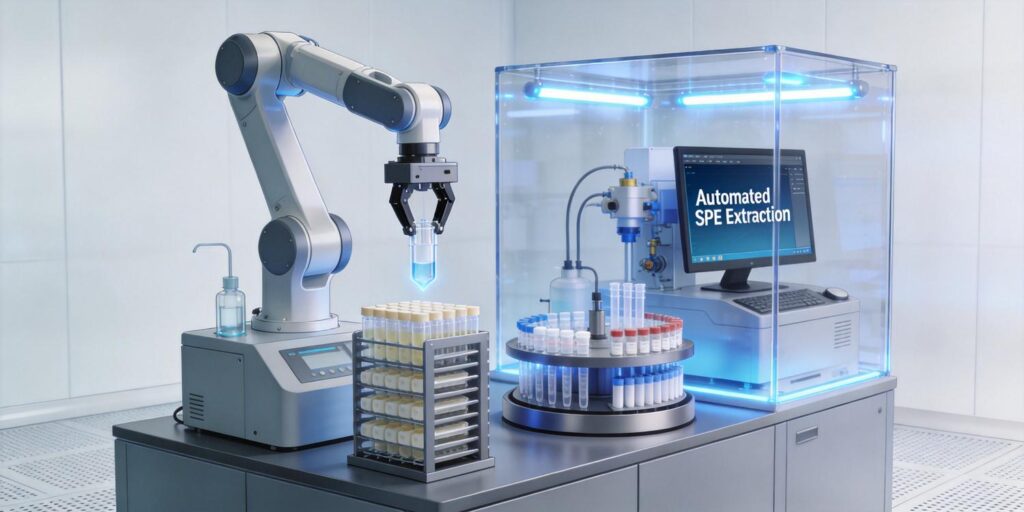
Automated SPE workstations can process samples in either batch or serial modes. In batch processing, “all SPE cartridges are conditioned with first conditioning reagent, all SPE cartridges are then conditioned with the second conditioning reagent,” followed by load, rinse, and elution steps. This approach maximizes efficiency while minimizing operator intervention.
The transition from manual to automated methods follows a structured five-step process: initial experiment, minimizing interferences, optimizing recovery, reducing carryover, and optimizing throughput. Each step builds toward “an automated SPE method that has few interferences, zero carryover, and is optimized for recovery and throughput.”
Cost and Resource Optimization
Beyond technical advantages, automation with 96-well plates offers significant economic benefits. Reduced solvent consumption, lower waste disposal costs, and decreased labor requirements contribute to substantial cost savings over time. The miniaturization inherent in 96-well formats means “smaller elution volumes required, hence smaller samples and wash volumes and smaller total extraction waste.”
Comparison with Cartridges
Format and Throughput Considerations
Traditional syringe-barrel cartridges and 96-well plates serve different operational needs. Cartridges excel in applications requiring larger sample volumes (typically 1-35 mL) and are well-suited for manual processing or smaller batch sizes. They offer flexibility in sorbent mass (from 10 mg to 6 g) and are available in various chemistries including HLB, MCX, MAX, WCX, and WAX phases.
In contrast, 96-well plates are designed specifically for high-throughput applications. Their standardized format integrates seamlessly with liquid handling robots and automated workstations. The plate design typically features “innovative, award-winning, two-stage well design” that ensures high recovery while maintaining compatibility with most robotic systems.
Technical Performance Differences
Research indicates that both formats can achieve excellent recoveries when properly optimized. However, 96-well plates offer advantages in consistency due to their parallel processing nature. When evaluating lot-to-lot reproducibility, studies show that “good extraction yields can be obtained with excellent reproducibilities” across multiple production lots, with relative standard deviations often below 5%.
Flow rate control represents another key differentiator. Automated systems using 96-well plates can precisely control flow rates during critical steps, whereas manual cartridge processing often suffers from variability. This precision becomes particularly important in methods sensitive to flow rates during load and elution steps.
Application-Specific Selection Criteria
Choosing between cartridges and 96-well plates depends on several factors:
- Sample Volume: Cartridges handle larger volumes (up to 35 mL), while 96-well plates typically process 10 μL to 375 μL samples
- Throughput Requirements: 96-well plates process 96 samples simultaneously; cartridges process samples sequentially
- Automation Infrastructure: 96-well plates require compatible robotic systems; cartridges work with manual manifolds or simpler automation
- Method Development Stage: Cartridges offer flexibility during method development; 96-well plates excel in validated, high-volume applications
Application Examples
Pharmaceutical Development and Bioanalysis
In pharmaceutical research, 96-well SPE plates have revolutionized drug discovery and development workflows. The integration of “SPE/LC/MS, then SPE/MS, and even SPE/MS/MS” in pharmaceutical companies and clinical contract laboratories demonstrates the critical role of high-throughput sample preparation in accelerating drug development timelines.
Specific applications include:
- Pharmacokinetic Studies: Processing hundreds of plasma samples from animal studies or clinical trials
- Metabolite Identification: Rapid cleanup of biological samples for metabolite profiling
- High-Throughput Screening: Supporting combinatorial chemistry and drug candidate evaluation
Research shows that “96 well plate SPE ‘blocks’ have been employed for combinatorial chemistry synthesis,” highlighting their versatility beyond traditional sample preparation.
Clinical and Toxicological Analysis
Clinical laboratories benefit significantly from 96-well SPE plates in several key areas:
- Therapeutic Drug Monitoring: Processing large batches of patient samples for drug concentration analysis
- Toxicology Screening: Comprehensive drug screening in urine, blood, and other matrices
- Endocrine Testing: Hormone analysis requiring high sensitivity and specificity
Studies demonstrate successful applications in “drug screening in plasma and whole blood,” with automated procedures showing “excellent reproducibility” and relative standard deviations below 5% even for complex matrices.
Environmental and Food Safety Testing
Environmental laboratories utilize 96-well SPE plates for:
- Water Quality Monitoring: Simultaneous analysis of multiple contaminants in water samples
- Food Contaminant Screening: Pesticide, antibiotic, and toxin analysis in food products
- Regulatory Compliance Testing: High-volume testing required for regulatory submissions
The miniaturization trend in SPE devices, including 96-well plates, addresses the need for “reduction in volume of the SPE device – smaller elution volumes required, hence smaller samples and wash volumes and smaller total extraction waste.”
Emerging Applications and Future Trends
The evolution of 96-well SPE technology continues with several promising developments:
- μElution Technology: Specialized plates enabling elution in volumes as low as 25 μL without evaporation
- On-line SPE-LC/MS Integration: Direct coupling of 96-well plate processing with analytical instruments
- 384-Well and Higher Density Formats: Further miniaturization for ultra-high-throughput applications
- Specialized Sorbent Chemistries: Development of phase-specific plates for targeted applications
As noted in the literature, “the 96-well plate could give way to 384 well plate SPE devices” as robotic handling capabilities advance, though this transition depends on maintaining sample representativeness at smaller scales.
Conclusion
The decision to use 96-well SPE plates versus traditional cartridges depends on specific laboratory requirements, sample volumes, throughput needs, and available automation infrastructure. For laboratories processing large numbers of samples where consistency, throughput, and integration with automated systems are priorities, 96-well plates offer compelling advantages. Their standardized format, compatibility with robotic systems, and ability to process 96 samples simultaneously make them indispensable tools in modern analytical laboratories.
However, traditional cartridges remain valuable for method development, smaller batch sizes, and applications requiring larger sample volumes or specialized sorbent configurations. The optimal approach often involves using both formats strategically – cartridges during method development and validation, transitioning to 96-well plates for high-volume production work.
As automation technology continues to advance and sample volumes in many applications continue to decrease, the role of 96-well SPE plates will likely expand further. Their ability to deliver “reproducible, rugged methods” with high recovery and minimal interferences makes them essential tools for laboratories seeking to maximize efficiency while maintaining analytical quality.