Automation Benefits in Analytical Labs
In today’s demanding analytical environments, robotic liquid handlers have revolutionized solid-phase extraction (SPE) workflows by addressing critical laboratory challenges. According to comprehensive research on automated SPE systems, automation eliminates many variables associated with manual methods, resulting in improved precision, accuracy, and recovery rates. The consistency achieved through automated equipment performing identical sequences on each sample significantly reduces the number of samples requiring reruns due to human error or variability.
Modern analytical laboratories face increasing regulatory pressures that demand formal documentation of sample preparation processes. Automated SPE systems provide electronic records detailing every step of each extraction, creating an audit trail that satisfies compliance requirements. This documentation capability is particularly valuable in pharmaceutical, environmental, and forensic applications where method validation and traceability are essential.
Beyond compliance, automation delivers tangible productivity benefits. Laboratories processing large sample volumes experience enhanced throughput without proportional increases in personnel requirements. The elimination of repetitive manual tasks reduces technician fatigue and allows skilled personnel to focus on higher-value analytical work. As noted in SPE automation literature, successful implementation requires understanding what automation can realistically achieve while recognizing its limitations as a tool rather than a complete replacement for human expertise.
Key Advantages of SPE Automation
- Improved Consistency: Automated systems perform identical sequences on each sample, reducing inter-operator variability
- Enhanced Documentation: Electronic records provide detailed extraction documentation for regulatory compliance
- Increased Throughput: Parallel processing capabilities enable handling of large sample volumes efficiently
- Reduced Solvent Usage: Precise volume control minimizes reagent consumption and waste generation
- Extended Instrument Uptime: Cleaner extracts from automated SPE reduce downtime for analytical instrument maintenance
Robotic System Components
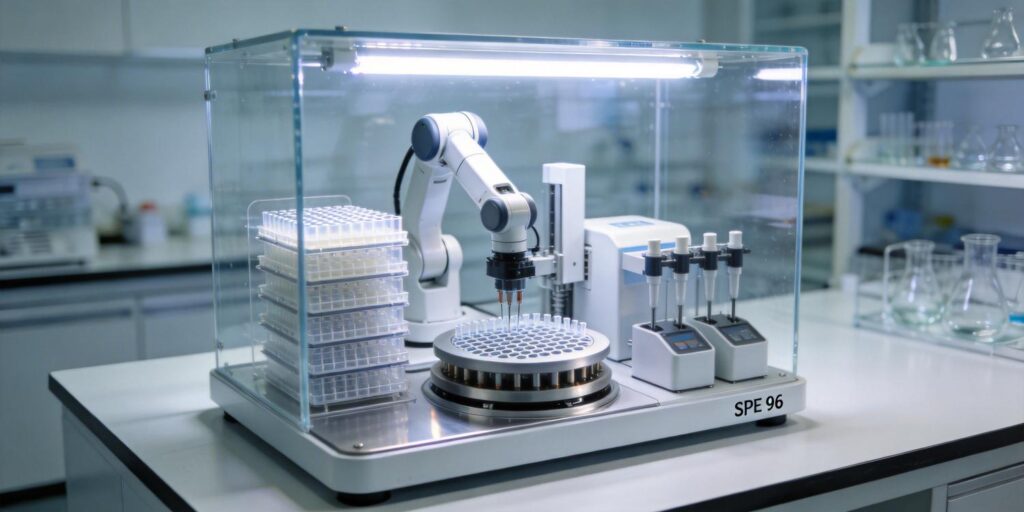
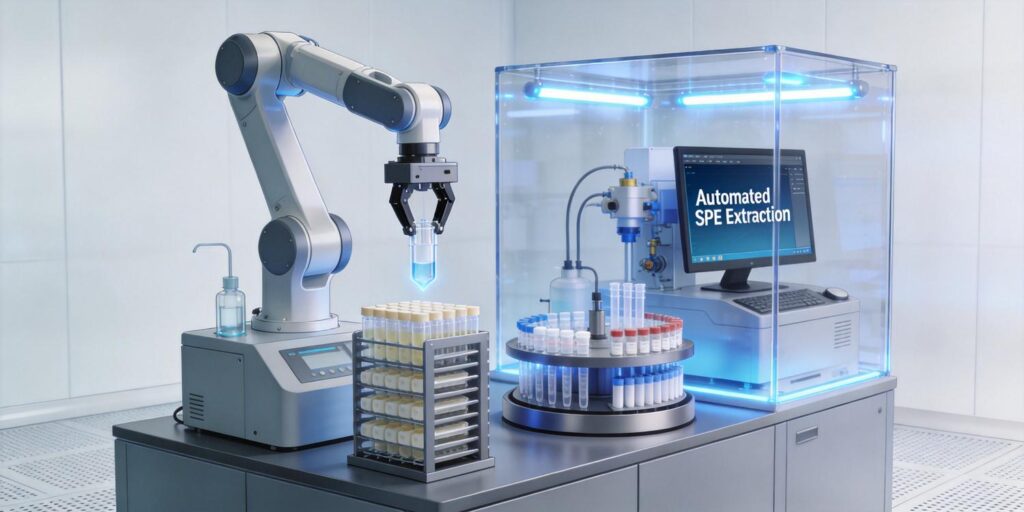
Modern robotic liquid handlers for SPE automation consist of several integrated components designed to replicate and optimize manual extraction processes. The core system typically includes a robotic arm or XYZ tracking system for precise movement, fluid handling modules with syringe pumps or peristaltic pumps, and specialized SPE processing stations. These systems can be configured for either batch processing (all samples processed one step at a time) or serial processing (complete extraction performed on individual samples sequentially).
The fluid path design represents a critical consideration in robotic SPE systems. Unlike manual vacuum boxes where fluid paths consist primarily of the SPE cartridge itself, automated workstations often incorporate common fluid paths that handle both samples and reagents. This design requires careful consideration of reagent compatibility with system materials and proper sequencing to prevent precipitation or carryover issues. Manufacturers typically provide detailed specifications about wetted materials to guide method development.
Advanced systems incorporate features such as liquid level detection, pressure monitoring, and automated cartridge positioning. Some workstations, like the ASPEC system described in SPE literature, utilize X-Y-Z tracking probes that deliver all reagents and samples to cartridges contained in moving blocks. Others employ robotic arms to transfer sample and elution tubes between collection racks and processing stations, with weight sensors monitoring sample loading and analyte elution.
Essential Robotic Components
- Motion Control System: Robotic arms or XYZ stages for precise positioning
- Fluid Handling Modules: Syringe pumps, peristaltic pumps, or positive displacement systems
- SPE Processing Stations: Specialized holders for cartridges or 96-well plates
- Liquid Level Detection: Sensors to monitor reagent volumes and prevent dry running
- Control Software: Programming interfaces for method development and execution
- Waste Management: Integrated systems for collecting and disposing of extraction waste
Integration with SPE Plates
The evolution from individual SPE cartridges to 96-well plate formats has been a game-changer for automation compatibility. Robotic liquid handlers excel at processing high-density plate formats, enabling simultaneous extraction of up to 96 samples. This parallel processing capability dramatically increases throughput compared to serial cartridge processing. The standardized dimensions of SPE plates ensure compatibility with most robotic platforms, simplifying integration and method transfer between laboratories.
SPE plate designs have evolved to address automation-specific requirements. Modern plates feature optimized bed dimensions, frit designs, and sealing mechanisms that prevent leakage during robotic handling. The transition to plate formats has been particularly beneficial for bioanalytical applications where sample volumes are decreasing while throughput requirements are increasing. As noted in SPE technology reviews, 96-well plate systems represent the current standard for high-throughput applications in pharmaceutical and clinical laboratories.
Integration considerations extend beyond physical compatibility to include flow rate optimization, solvent compatibility, and waste handling. Robotic systems must accommodate the specific flow characteristics of plate formats, which may differ from traditional cartridge designs. Proper sealing mechanisms prevent cross-contamination between wells, while optimized waste collection systems handle the increased volume of solvents and samples processed simultaneously.
Plate Format Advantages
| Feature | Benefit | Automation Impact |
|---|---|---|
| Standardized Dimensions | Compatibility with robotic platforms | Simplified integration and method transfer |
| Parallel Processing | 96 simultaneous extractions | Dramatically increased throughput |
| Reduced Dead Volumes | Minimized reagent consumption | Lower operating costs |
| Integrated Sealing | Prevention of cross-contamination | Improved data quality and reliability |
| Compatible with MS Autosamplers | Direct injection capability | Streamlined workflow from extraction to analysis |
Programming Extraction Steps
Effective programming represents the bridge between manual SPE methods and automated execution. Modern robotic systems offer sophisticated software interfaces that allow users to translate manual protocols into automated sequences. The programming process typically involves defining each step of the SPE process—conditioning, sample loading, washing, drying, and elution—with precise control over parameters such as flow rates, volumes, incubation times, and liquid handling sequences.
Advanced programming capabilities enable optimization of extraction parameters that would be impractical to investigate manually. Systems can automatically screen multiple sorbents, evaluate different solvent combinations, and test various flow rates to identify optimal conditions. This automated method development capability, as demonstrated in SPE research, allows systematic investigation of variables while maintaining consistent execution. The mass balance approach to method development—collecting and analyzing fractions from each extraction step—is particularly well-suited to automated implementation.
Programming considerations extend beyond basic extraction steps to include error handling, system monitoring, and data logging. Robust programs incorporate checks for common issues such as clogged cartridges, insufficient reagent volumes, or pressure deviations. Modern software platforms often include templates for common SPE applications, reducing programming time and ensuring best practices are followed. The ability to save and recall methods facilitates method transfer between instruments and laboratories.
Programming Best Practices
- Start with Validated Methods: Begin automation with well-characterized manual methods
- Change One Variable at a Time: Systematic optimization prevents confounding results
- Incorporate Quality Checks: Program verification steps for critical parameters
- Document Programming Decisions: Maintain records of optimization experiments
- Validate Automated Methods: Compare automated results with manual benchmarks
- Consider Carryover Prevention: Program adequate washing between samples
Improving Reproducibility
Reproducibility represents one of the most significant advantages of automated SPE workflows. Robotic systems eliminate the human variability inherent in manual methods, ensuring consistent execution of every extraction step. This consistency translates directly to improved data quality, with reduced coefficients of variation and enhanced confidence in analytical results. In regulated environments, this reproducibility is essential for method validation and compliance with quality standards.
The reproducibility benefits extend beyond simple consistency to include systematic optimization of extraction parameters. Automated systems can maintain precise control over flow rates, which research has shown significantly impacts recovery rates, particularly for ion-exchange mechanisms. By eliminating the flow rate variability common in manual methods, robotic systems ensure optimal mass transfer and binding efficiency throughout the extraction process. This control is particularly important for methods sensitive to flow rate variations during loading and elution steps.
Long-term reproducibility requires attention to system maintenance and calibration. Regular verification of liquid handling accuracy, pressure calibration, and positional precision ensures sustained performance. Modern systems often include self-diagnostic routines and calibration protocols that simplify maintenance. The electronic documentation generated by automated systems provides objective evidence of consistent performance, supporting quality assurance programs and regulatory submissions.
Factors Enhancing Reproducibility
- Consistent Flow Rates: Precise control eliminates manual variability in solvent application
- Accurate Volume Delivery: Automated dispensing reduces volumetric errors
- Timing Precision: Consistent incubation and processing times
- Positional Accuracy: Repeatable cartridge positioning and liquid delivery
- Reduced Human Intervention: Minimized operator-dependent variables
- Comprehensive Documentation: Electronic records of all extraction parameters
Conclusion
The integration of robotic liquid handlers with SPE workflows represents a significant advancement in analytical sample preparation. By combining the selectivity of solid-phase extraction with the precision and consistency of automation, laboratories can achieve unprecedented levels of productivity and data quality. The transition from manual methods to automated systems requires careful consideration of system components, plate compatibility, programming approaches, and reproducibility factors, but the benefits justify the investment for laboratories processing significant sample volumes.
As SPE technology continues to evolve, the synergy between advanced sorbent chemistries and sophisticated automation platforms will drive further improvements in extraction efficiency and analytical performance. Laboratories implementing automated SPE systems should approach the transition as a partnership between analytical expertise and technological capability, recognizing that successful automation enhances rather than replaces the critical thinking and method development skills of experienced analysts.
For laboratories considering automation, thorough evaluation of workflow requirements, sample volumes, and regulatory needs will guide selection of appropriate systems. The investment in automated SPE technology typically yields returns through increased throughput, improved data quality, reduced labor costs, and enhanced regulatory compliance—making robotic liquid handlers an essential component of modern analytical laboratories.