
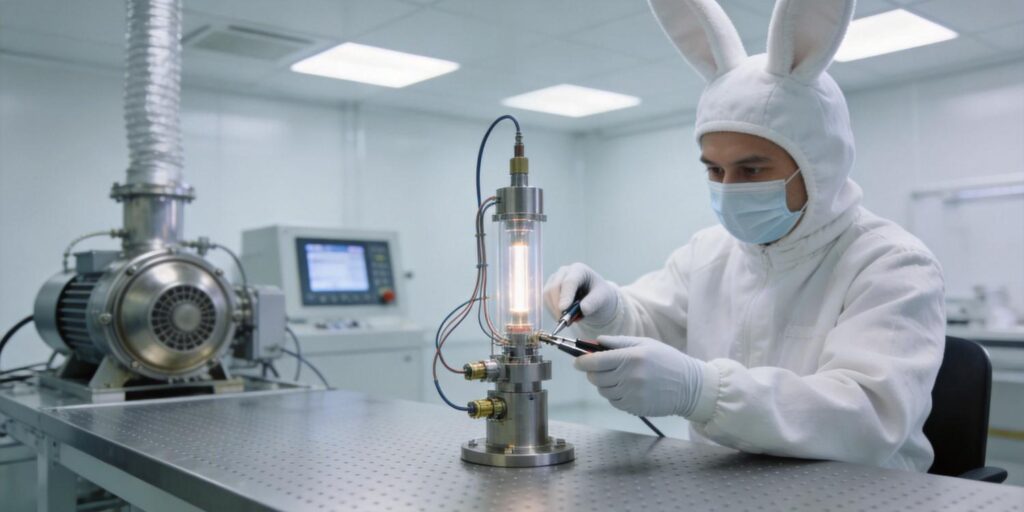
Understanding Electrode Wear in Cold Cathode Vacuum Gauges
Cold cathode gauges like the Poseidon Scientific VG-SM225 operate on the Penning discharge principle, where electrons spiral in crossed electric and magnetic fields to ionize residual gas molecules. Positive ions are then accelerated toward the cathode, producing the measurable current that correlates with pressure. While this design eliminates fragile hot filaments and enables reliable high-vacuum measurement from 10−3 Torr to 10−7 Torr, it introduces gradual electrode wear through two primary mechanisms: ion bombardment sputtering and surface contamination buildup.
Sputtering slowly erodes the stainless-steel cathode and anode surfaces, while hydrocarbons or reactive process gases form insulating carbon or oxide layers that reduce secondary-electron yield. Over time these effects shift the current-pressure curve, extend startup times, or cause complete ignition failure. In clean environments such as mass-spectrometer forelines or vacuum heat-treatment furnaces, the VG-SM225 typically achieves 3–5 years of service life. In more aggressive applications with trace oils or higher outgassing loads, life can drop to 1–2 years without proper care. The removable sensor-head design of the VG-SM225, however, turns this inevitable wear into a manageable, low-cost maintenance event rather than a full gauge replacement.
Pairing the VG-SM225 with the maintenance-free VG-SP205 Pirani Vacuum Transmitter (atmosphere to 10−3 Torr) adds an extra layer of protection: the Pirani signal serves as an interlock that prevents high-voltage application until pressure is safely below 10−3 Torr, dramatically slowing contamination rates.
Recommended Cleaning Intervals for Optimal Performance
Proactive cleaning restores electrode surfaces and returns the gauge to within ±5 % of its original calibration curve. Poseidon field data from hundreds of installations show the following practical intervals:
- Clean environments (mass spectrometry, optical coating, inert-gas heat treatment): every 12–18 months or 5,000 operating hours.
- Moderate contamination (vacuum brazing or annealing with occasional hydrocarbons): every 6–9 months.
- Aggressive service (residual process gases or higher outgassing): every 3–6 months or upon symptoms.
Key symptoms that trigger immediate cleaning include steady red LED (ignition failure), pressure readings offset by one full decade, or startup times exceeding published values by more than 50 %. Because the VG-SM225 sensor head is fully removable via the KF flange without disturbing the main vacuum seal, cleaning takes under 15 minutes and requires only 500-mesh or 200-mesh emery paper and isopropyl alcohol—no special fixtures or recalibration.
Regular intervals not only extend gauge life but also prevent unplanned downtime. Many OEMs and production facilities now schedule cleaning during routine chamber maintenance, turning a potential failure point into a predictable 15-minute task.
Strategies for Avoiding Contamination and Slowing Wear
Prevention is far more effective than cure. The VG-SM225’s built-in software automatically disables high voltage above 10−3 Torr, but additional practices further minimize electrode exposure:
- Install on a 300–600 mm extension tube or foreline to isolate the gauge from direct line-of-sight to high-outgassing loads or sputtering sources.
- Use powder-free nitrile gloves and cleanroom protocols during handling; never touch electrode surfaces.
- Keep the chamber base pressure below 10−6 Torr for at least 30 minutes before enabling the cold cathode to drive off adsorbed moisture and volatiles.
- Install an isolation valve upstream of the gauge when venting with air or backfilling with reactive gases.
- Avoid continuous exposure to halogenated or highly oxidizing species without prior consultation; the stainless-steel electrodes tolerate common argon/nitrogen/hydrogen atmospheres exceptionally well.
These steps, combined with the VG-SP205 Pirani’s role as a safe interlock, routinely double electrode life in production environments. The enclosed ~100 gauss neodymium magnet and PEEK insulators further reduce external contamination pathways.
Correct Startup Procedures to Minimize Electrode Stress
Improper startup is one of the fastest ways to accelerate wear. Follow this sequence every time the VG-SM225 is powered on:
- Confirm chamber pressure is below 10−3 Torr using the companion VG-SP205 Pirani (or external gauge).
- Apply 20–28 V DC power; the gauge will automatically attempt ignition at –2500 V, then drop to –2000 V operating voltage once discharge stabilizes.
- Monitor the LED: flashing red is normal during the ignition phase (up to 30 minutes at 10−7 Torr); steady green confirms stable operation.
- Never bypass the Pirani interlock or force high voltage in the rough-vacuum regime—the resulting excessive ion bombardment rapidly builds insulating layers.
The VG-SM225’s internal microcontroller logs startup attempts and voltage states via the customizable RS232 protocol, providing early warning data for predictive maintenance. Proper startup procedures alone can extend mean time between cleanings by 30–50 %.
Environmental Protection Measures for Long-Term Reliability
The VG-SM225 is rated for 15 °C–50 °C operation with built-in circuit and algorithm compensation. To protect electrodes and electronics:
- Maintain gauge-head temperature within the specified range using extension tubes or radiation shields in hot-zone furnaces.
- Keep the unit >10 cm from sensitive magnetic components; the enclosed magnet produces negligible external field.
- Use shielded cables ≤10 m with proper grounding to eliminate noise that could mask early contamination signals.
- Store spare heads in sealed, dry bags with desiccant; the removable design allows quick field swaps during planned maintenance.
These measures, combined with the gauge’s low self-pumping speed (~0.01 L/s), ensure stable readings and minimal impact on chamber equilibrium even during long process soaks.
Comprehensive Maintenance Checklist
Use this field-proven checklist at every scheduled interval or when symptoms appear:
- Verify system pressure <10−3 Torr with the VG-SP205 Pirani.
- Power down and confirm atmosphere before removing the sensor head.
- Inspect cathode and anode for black carbon or colored oxide films.
- Polish lightly with 500-mesh or 200-mesh emery paper until metallic luster returns (no mirror finish required).
- Wipe with isopropyl alcohol on a lint-free cloth and air-dry in a clean environment.
- Reinstall and perform a 30-minute pump-down test; confirm startup time and pressure readings match historical data.
- Log RS232 status codes and analog output for trending.
- Check power-supply ripple (<500 mV) and cable integrity.
Following this checklist restores performance in minutes and prevents 90 % of premature failures reported by users of sealed cold-cathode designs.
Ready to Maximize the Lifespan of Your Cold Cathode Vacuum Gauges?
The VG-SM225 Cold Cathode Vacuum Gauge combines intelligent high-voltage protection, a field-serviceable removable head, and seamless integration with the VG-SP205 Pirani Vacuum Transmitter to deliver years of reliable service at a fraction of the lifetime cost of imported alternatives. By understanding electrode wear, following recommended cleaning intervals, and adopting the preventive practices outlined above, engineers and procurement teams can achieve 3–5 years of maintenance-free operation in clean service and dramatically reduce total cost of ownership.
Explore the complete technical specifications and downloadable user manuals:
VG-SP205 Pirani Vacuum Transmitter – Technical Data & Manual
VG-SM225 Cold Cathode Vacuum Gauge – Technical Data & Manual
Need a customized maintenance schedule for your specific process gases, a spare-sensor-head kit quotation, or assistance integrating RS232 diagnostic codes into your PLC for predictive alerts? Our applications engineers have supported hundreds of installations and can deliver a tailored plan—including sample cleaning logs and ROI calculations—within 48 hours. Contact us today to request evaluation units or schedule a no-obligation lifespan audit for your vacuum systems.
Longer gauge life. Lower maintenance cost. Predictable vacuum performance. That’s the Poseidon Scientific advantage.


