
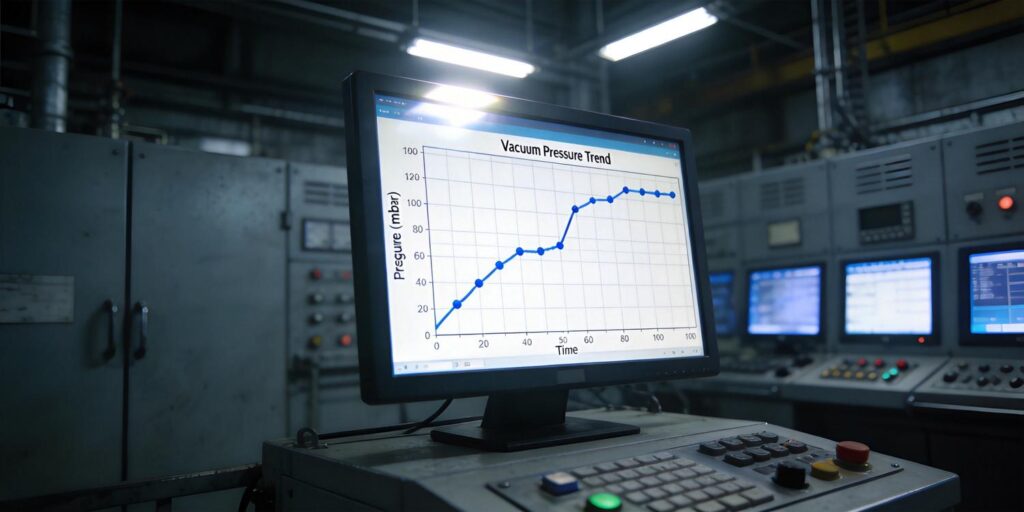
Role of Pressure Data in Quality Control Systems
In quality control systems for vacuum-dependent processes—such as thin-film deposition, heat treatment, and semiconductor manufacturing—pressure data serves as a critical parameter for ensuring product consistency, traceability, and compliance with standards like ISO 9001 and AS9100. Vacuum levels directly influence material properties: in coating applications, a 10 % deviation from setpoint at 5 × 10⁻³ Torr can alter film adhesion or density; in annealing, residual gases above 10−4 Torr risk oxidation and non-uniform hardness. By logging pressure throughout the cycle, engineers can correlate anomalies with batch defects, optimize recipes, and demonstrate process stability during audits.
Poseidon Scientific’s VG-SP205 Pirani Vacuum Transmitter and VG-SM225 Cold Cathode Vacuum Gauge provide the full-range data foundation required for robust QC. The Pirani covers atmosphere to 10−3 Torr for roughing and medium-vacuum phases, while the cold cathode handles 10−3 Torr to 10−7 Torr for high-vacuum soaks. Both deliver temperature-compensated readings (±5 % for Pirani, ±20 % for cold cathode) that align with vacuum metrology principles outlined in foundational texts like Foundations of Vacuum Science and Technology (Lafferty, 1998). Integrating this data into QC systems transforms subjective troubleshooting into data-driven root-cause analysis, reducing scrap rates and enhancing yield.
RS232 Data Collection: Seamless Integration for Logging
The RS232 interface on both Poseidon gauges enables high-fidelity data collection without additional hardware. Operating at 9600 bps with 8 data bits and 1 stop bit, the protocol streams 9-byte frames every 100 ms—fast enough for real-time monitoring yet efficient for long-term storage. Each frame includes pressure value, status codes, error flags, and software version, providing not just raw readings but contextual diagnostics that enrich QC logs.
For the VG-SP205 Pirani, the frame structure is as follows:
| Byte | Function | Description |
|---|---|---|
| 0 | Frame length | 7 (fixed) |
| 1 | Page | 5 (fixed) |
| 2 | Status code | Unit indicators (bits 4-5 for mbar, Torr, Pa) |
| 3 | Error code | Fault indicators (e.g., sensor malfunction) |
| 4 | High byte of measurement | Part of pressure calculation |
| 5 | Low byte of measurement | Part of pressure calculation |
| 6 | Software version | Value / 10 |
| 7 | Sensor type | 10 (fixed) |
| 8 | Checksum | Validation byte |
Pressure is calculated using formulas like P_mbar = 10^((high*256 + low)/4000 – 12.5), ensuring precise conversion. The VG-SM225 follows a similar structure, with analog output scaling V_out = log10(P_mbar)*1.33 + 12.66 for compatibility.
Integration into QC software is straightforward: connect via RJ45 to a serial-to-USB adapter or direct PLC port, then parse frames with a few lines of Python or ladder logic. Poseidon offers customizable protocols (minimum 5–10 units) to match existing systems, eliminating middleware costs. This setup supports 1 Hz logging rates, capturing every pump-down transient for detailed post-process review.
Setting Alarm Thresholds Based on Gauge Outputs
Effective QC relies on proactive alarms that flag deviations before they impact quality. Both Poseidon gauges support threshold-based alerting through their dual outputs: the 0-10 V analog (usable 2-8 V) for hardware interlocks and RS232 for software-defined triggers.
In the analog domain, map voltage to pressure using the gauge’s linear scaling—e.g., set a comparator to trip at 4 V (corresponding to ~10−1 Torr) during roughing. For digital precision, use RS232 status and error codes to define multi-level alarms: a bit flag for unit mismatch might trigger a warning, while a sensor-fault code halts the process entirely.
Recommended thresholds for common applications:
- Rough vacuum (Pirani): Alarm if >1 Torr after 5 minutes pump-down—indicates leak or pump failure.
- Medium vacuum: Trip at ±10 % from setpoint (e.g., 5 × 10⁻³ Torr in sputtering) to prevent film defects.
- High vacuum (cold cathode): Alert on startup delay >2x nominal or pressure drift >5 % during soak.
These thresholds, derived from vacuum literature and field data, integrate seamlessly into PLCs like Siemens S7 or Allen-Bradley ControlLogix. The gauges’ galvanic isolation minimizes noise, ensuring reliable triggering even in EMI-heavy factories.
Data Retention Strategy: Compliance and Analysis
A sound data retention strategy balances regulatory needs with storage efficiency. For QC in regulated industries, retain pressure logs for 7–10 years to support audits and warranty claims—far exceeding the 2-year minimum in many standards. Poseidon’s RS232 frames are compact (~90 bytes/second at 100 ms intervals), allowing a year’s data from a 24/7 line to fit in under 3 GB uncompressed.
Implement tiered storage: real-time buffering in PLC RAM for immediate analysis, daily CSV exports to on-site servers for short-term review, and cloud archiving (e.g., AWS S3) for long-term retention. Use timestamps in each frame to synchronize with other process variables like temperature or gas flow.
Advanced strategies include data compression (e.g., store only deltas during stable phases) and AI-driven anomaly detection on historical logs. Ensure compliance with GDPR or HIPAA by anonymizing metadata and encrypting transfers. This approach not only meets QC demands but enables predictive maintenance—flagging gauge drift before it affects production.
Case Example: Semiconductor Fabrication QC Upgrade
A mid-sized semiconductor fab struggled with inconsistent etch rates traced to vacuum variability in their plasma chambers. Their legacy wide-range gauges provided spotty logs without diagnostics, leading to 15 % scrap and frequent audits.
Retrofitting with VG-SP205 + VG-SM225 pairs per chamber, they logged RS232 data at 100 ms intervals into a central SCADA system. Custom protocol matched their existing Allen-Bradley PLC, with alarms set at ±5 % from 10−5 Torr setpoint. Retention was set to 10 years on encrypted servers, with daily reports correlating pressure to yield metrics.
Results after six months: scrap reduced by 22 %, cycle time shortened by 8 % through optimized pump-down thresholds, and zero audit findings. The error codes flagged two early contamination events, preventing downtime. Total ROI was achieved in under four months, validating the low-cost, high-reliability design of Poseidon gauges.
Ready to Implement Vacuum Data Logging in Your QC Systems?
Pressure data logging is the cornerstone of modern quality control, turning vacuum from a black box into a quantifiable asset. Poseidon Scientific’s VG-SP205 Pirani Vacuum Transmitter and VG-SM225 Cold Cathode Vacuum Gauge deliver the RS232 flexibility, diagnostic depth, and reliability engineers need to build compliant, efficient systems.
Explore the full technical specifications and user manuals:
VG-SP205 Pirani Vacuum Transmitter – Technical Data & Manual
VG-SM225 Cold Cathode Vacuum Gauge – Technical Data & Manual
Need sample parsing code for your PLC, a custom protocol for seamless integration, or a QC-logging architecture review? Our applications team can provide tailored guidance, including ROI models and evaluation units. Contact us today for a free data-logging audit or to request gauges for your next QC upgrade.
Traceable data. Robust QC. Higher yields. That’s the Poseidon Scientific advantage.


