Types of Trace Organic Pollutants in Environmental Samples
Environmental monitoring laboratories routinely encounter a diverse array of trace organic pollutants that require preconcentration before analysis. These contaminants can be broadly categorized into several classes based on their chemical properties and environmental persistence.
Pesticides and Herbicides
Organochlorine pesticides such as DDT, lindane, and heptachlor represent some of the most persistent environmental contaminants. According to EPA Method 8080, these compounds require careful extraction and cleanup procedures to achieve detection limits at parts-per-trillion levels. Modern agricultural practices have introduced newer classes including organophosphates, carbamates, and triazine herbicides, each presenting unique challenges for SPE method development.
Industrial Chemicals
Polycyclic aromatic hydrocarbons (PAHs), polychlorinated biphenyls (PCBs), and phthalates constitute major industrial pollutant classes. These compounds typically exhibit high hydrophobicity (log Pow values ranging from 2.5 to 7), making them ideal candidates for reversed-phase SPE preconcentration. Research by Wells and Michael (1987b) demonstrated that selective desorption during SPE can effectively fractionate these compounds based on their hydrophobicity.
Pharmaceuticals and Personal Care Products
Emerging contaminants including antibiotics, hormones, and synthetic musk compounds present unique analytical challenges due to their polar nature and low environmental concentrations. These compounds often require mixed-mode SPE approaches combining reversed-phase and ion-exchange mechanisms for effective preconcentration.
Disinfection Byproducts
Chlorinated and brominated organic compounds formed during water treatment processes represent another important class of trace pollutants. Their analysis typically requires careful pH control during SPE to maintain appropriate ionization states.
Importance of Analyte Preconcentration
Preconcentration serves as the cornerstone of trace environmental analysis, addressing several critical analytical challenges simultaneously. Environmental chemists routinely work with analyte concentrations at part-per-billion or part-per-trillion levels, necessitating concentration factors of 100 to 1000-fold to achieve detectable signals.
Detection Limit Enhancement
SPE preconcentration enables laboratories to achieve detection limits that would otherwise be impossible with direct injection techniques. For example, Cai et al. (1993) demonstrated that SPE could achieve sub-parts-per-trillion detection limits for atrazine in water samples, representing a significant improvement over conventional liquid-liquid extraction methods.
Matrix Effect Reduction
Environmental samples often contain dissolved organic matter (DOM), particulates, and inorganic salts that can interfere with analytical measurements. SPE serves a dual purpose of concentrating analytes while removing matrix interferences. Landrum et al. (1984) highlighted the importance of understanding DOM-pollutant interactions during SPE method development, as these complexes can affect both retention and recovery.
Method Ruggedness Improvement
By concentrating analytes into smaller volumes, SPE reduces variability associated with large-volume sample handling and improves method precision. This is particularly important for regulatory compliance monitoring where data quality objectives must be consistently met.
Large-Volume Sample Loading with SPE Cartridges
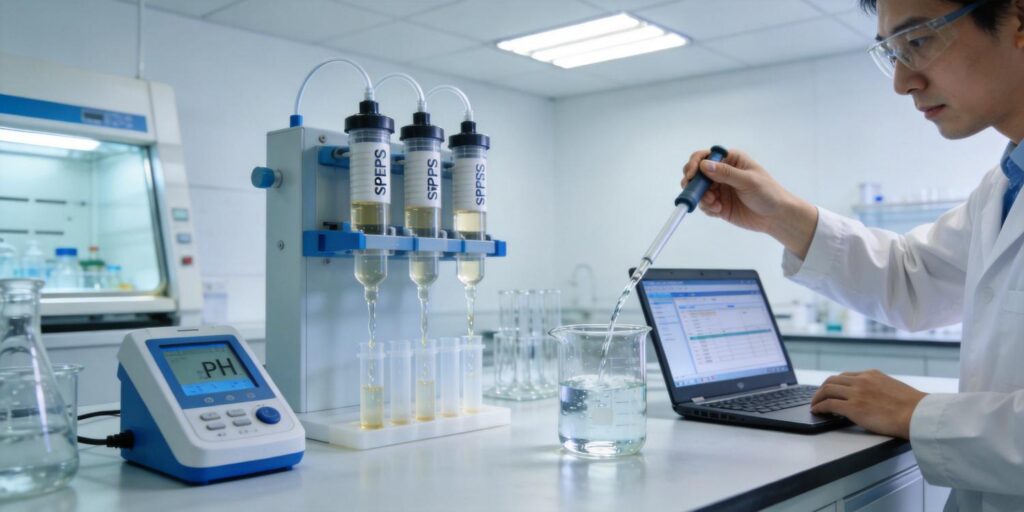
Environmental applications frequently require processing liter-scale samples to achieve necessary preconcentration factors. Successful large-volume SPE requires careful consideration of several operational parameters.
Breakthrough Volume Considerations
The breakthrough volume represents the maximum sample volume that can be processed before analyte loss occurs. This parameter depends on both sorbent characteristics and analyte properties. Larrivee and Poole (1994) developed solvation parameter models to predict breakthrough volumes for various sorbent-analyte combinations, providing valuable guidance for method development.
Flow Rate Optimization
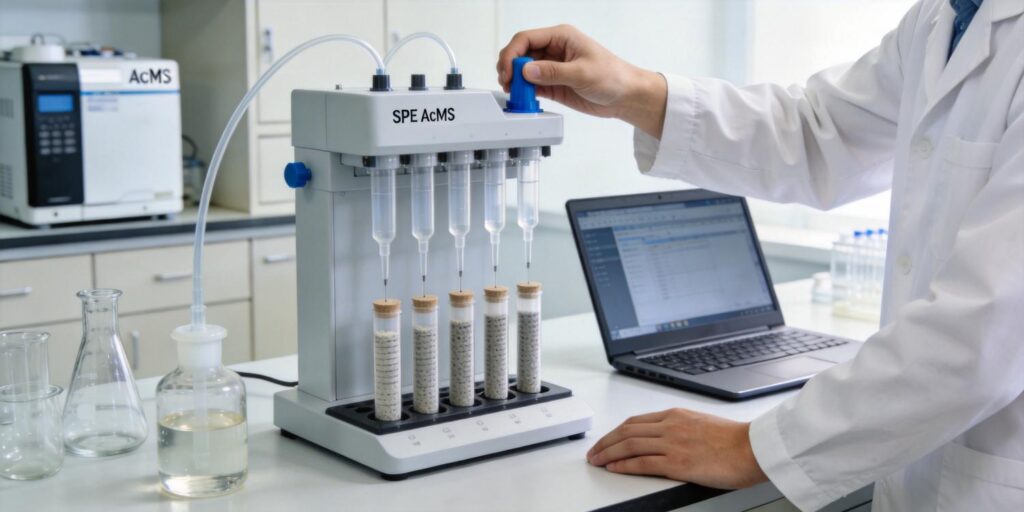
Maintaining appropriate flow rates (typically 1-3 drops per second) during sample loading is critical for achieving quantitative recovery. Excessive flow rates can lead to breakthrough, while overly slow rates reduce throughput. Environmental laboratories often employ vacuum manifolds or positive pressure systems to maintain consistent flow rates during large-volume processing.
Particulate Management
Natural water samples frequently contain suspended solids that can clog SPE cartridges. Prefiltration through glass-fiber filters (0.7 μm followed by 0.45 μm) or the use of depth filters containing diatomaceous earth can prevent cartridge plugging while maintaining analyte recovery.
Sorbent Selection for Organic Pollutants
Choosing the appropriate SPE sorbent represents one of the most critical decisions in method development. The selection should consider analyte properties, sample matrix, and analytical requirements.
Reversed-Phase Sorbents
C18-bonded silica remains the most widely used SPE sorbent, accounting for over two-thirds of all applications according to surveys by Majors (1998). Its high carbon load (typically 12-17%) provides excellent retention for hydrophobic compounds. However, silica-based sorbents have limited pH stability (typically pH 2-8), which can restrict method flexibility.
Polymeric Sorbents
Hydrophilic-lipophilic balanced (HLB) polymers offer significant advantages for environmental applications. These water-wettable sorbents eliminate the need for conditioning and equilibration steps, simplify protocols, and provide stability across the entire pH range (0-14). Oasis HLB, introduced in 1996, revolutionized SPE by providing high capacity for both polar and non-polar compounds.
Mixed-Mode Sorbents
For compounds with ionizable functional groups, mixed-mode sorbents combining reversed-phase and ion-exchange mechanisms provide superior selectivity. The Oasis family includes MCX (mixed-mode cation exchange) for basic compounds, MAX (mixed-mode anion exchange) for acidic compounds, WCX (weak cation exchange) for strong bases, and WAX (weak anion exchange) for strong acids.
Specialty Sorbents
Florisil remains important for pesticide analysis, particularly for organochlorine compounds where its polar surface provides excellent cleanup capabilities. Certified Sep-Pak Florisil cartridges demonstrate significantly lower extractable interferences compared to generic alternatives, as shown in comparative studies of organochlorine pesticide analysis.
Washing Strategies to Remove Background Matrix
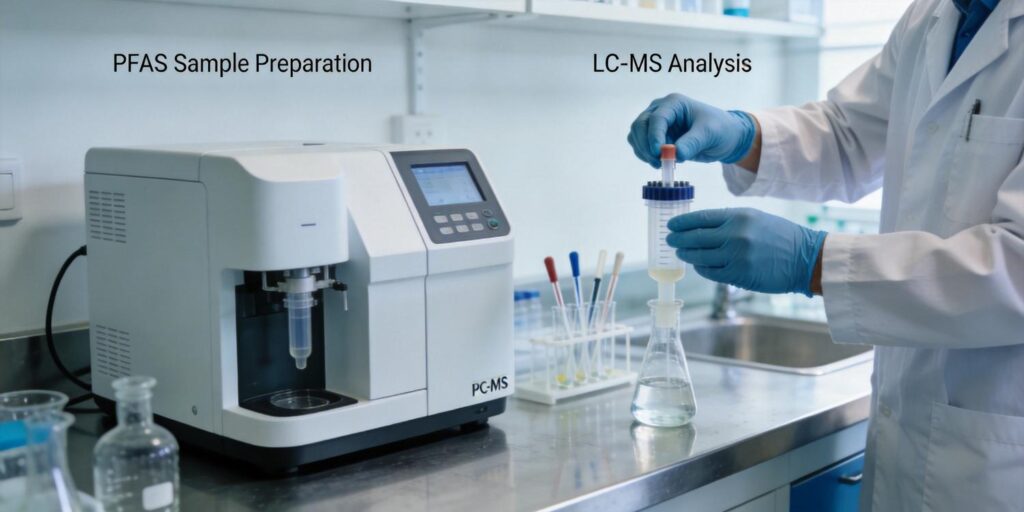
Effective washing represents the key to obtaining clean extracts suitable for sensitive analytical techniques like GC-MS and LC-MS.
Water-Based Washes
Initial washing with water or dilute aqueous buffers removes water-soluble matrix components including salts, sugars, and highly polar organic compounds. For reversed-phase extractions, water washes typically follow sample loading to remove unretained polar interferences.
Organic Solvent Washes
Strategic use of organic solvents can remove weakly retained compounds without eluting target analytes. Research by Ingwersen (unpublished results) demonstrated that acetonitrile washes often provide superior cleanup compared to methanol washes, particularly for compounds retained through hydrogen bonding interactions. Acetonitrile’s aprotic nature makes it less likely to disrupt analyte-sorbent hydrogen bonds while effectively removing many matrix interferences.
pH-Controlled Washes
For ionizable compounds, pH-adjusted washes can selectively remove interferences while maintaining analyte retention. Acidic washes (typically 1-5% formic or acetic acid) effectively remove basic interferences when extracting acidic compounds, while basic washes (ammonium hydroxide solutions) remove acidic interferences during basic compound extraction.
Solvent Strength Optimization
Systematic investigation of wash solvent strength using gradient elution principles can identify optimal conditions. As shown in Figure 5 of SPE methodology literature, connecting an SPE cartridge to a gradient LC system allows direct observation of analyte elution profiles, facilitating selection of wash solvents that remove interferences without affecting target compounds.
Elution Solvent Design for GC-MS or LC-MS Analysis
Elution solvent selection must balance quantitative recovery with compatibility with subsequent analytical techniques.
GC-MS Compatible Solvents
| Solvent | Relative Elution Strength | GC Compatibility | Typical Applications |
|---|---|---|---|
| Ethyl acetate | High | Excellent | Non-polar drugs, pesticides |
| Methylene chloride | High | Good | Broad-spectrum extractions |
| Hexane-ethyl acetate mixtures | Medium-high | Excellent | Steroids, lipid-soluble compounds |
| Methanol (with evaporation) | Medium | Requires evaporation | Polar compounds |
LC-MS Compatible Solvents
For LC-MS applications, elution solvents should be compatible with mobile phase systems. Methanol and acetonitrile represent the most common choices, often modified with volatile acids (0.1% formic acid) or bases (0.1% ammonium hydroxide) to improve recovery of ionizable compounds. When using Oasis HLB sorbents, adding 10-30% methanol to other elution solvents helps disrupt hydrogen bonding and ensure complete recovery.
Mixed-Mode Elution Strategies
For mixed-mode sorbents, sequential elution protocols maximize selectivity. For example, Oasis MCX protocols typically employ methanol elution followed by methanol with 5% ammonium hydroxide to release strongly retained basic compounds. This two-step approach provides cleaner extracts by separating compounds based on their interaction mechanisms.
Minimizing Elution Volume
Small elution volumes (typically 1-3 mL for standard cartridges) maximize concentration factors while ensuring quantitative recovery. μElution plates achieve elution in as little as 25 μL, eliminating evaporation steps and improving throughput for high-sensitivity applications.
Monitoring Applications in Environmental Studies
SPE-based preconcentration has become indispensable for various environmental monitoring programs, enabling detection of contaminants at environmentally relevant concentrations.
Drinking Water Surveillance
Regulatory monitoring programs worldwide employ SPE for detecting pesticides, disinfection byproducts, and emerging contaminants in drinking water. The Japanese Ministry of Health, Labour and Welfare (JMHLW) has established official methods using Sep-Pak C18 and tC18 cartridges for pesticide analysis in water, demonstrating the regulatory acceptance of SPE techniques.
Wastewater Characterization
Industrial and municipal wastewater monitoring benefits from SPE’s ability to handle complex matrices containing high levels of dissolved and particulate matter. Toxicity identification evaluations (TIEs) frequently employ SPE fractionation to isolate bioactive compounds, with modified elution systems using methanol-water and methanol-methylene chloride mixtures successfully extracting compounds with log Pow values from 2.5 to 7.
Ecological Risk Assessment
Monitoring programs assessing contaminant fate and transport in aquatic ecosystems rely on SPE for preconcentrating trace organic pollutants from large water volumes. The ability to process liter-scale samples enables detection of contaminants at levels relevant to ecological effects, supporting risk assessment and management decisions.
Sediment and Soil Analysis
While SPE primarily addresses aqueous samples, soil and sediment extracts often require SPE cleanup after initial extraction. The U.S. EPA Contract Laboratory Program specifies Florisil SPE cleanup for organochlorine pesticide analysis in soil samples, following Soxhlet extraction and additional cleanup steps.
Conclusion
Solid-phase extraction represents a powerful tool for preconcentrating trace organic pollutants in environmental samples, offering significant advantages over traditional liquid-liquid extraction methods. By understanding analyte properties, selecting appropriate sorbents, optimizing washing and elution conditions, and considering analytical requirements, environmental laboratories can develop robust SPE methods that meet stringent detection limit requirements while maintaining data quality. As environmental monitoring programs continue to expand their scope to include emerging contaminants at ever-lower concentrations, SPE-based preconcentration will remain essential for generating reliable environmental data.
Additional Resources
- HLB SPE Cartridges – Hydrophilic-lipophilic balanced sorbents for broad-spectrum extraction
- MAX SPE Cartridges – Mixed-mode anion exchange sorbents for acidic compounds
- MCX SPE Cartridges – Mixed-mode cation exchange sorbents for basic compounds
- WAX SPE Cartridges – Weak anion exchange sorbents for strong acids
- WCX SPE Cartridges – Weak cation exchange sorbents for strong bases
- 96-Well SPE Plates – High-throughput format for automated sample preparation