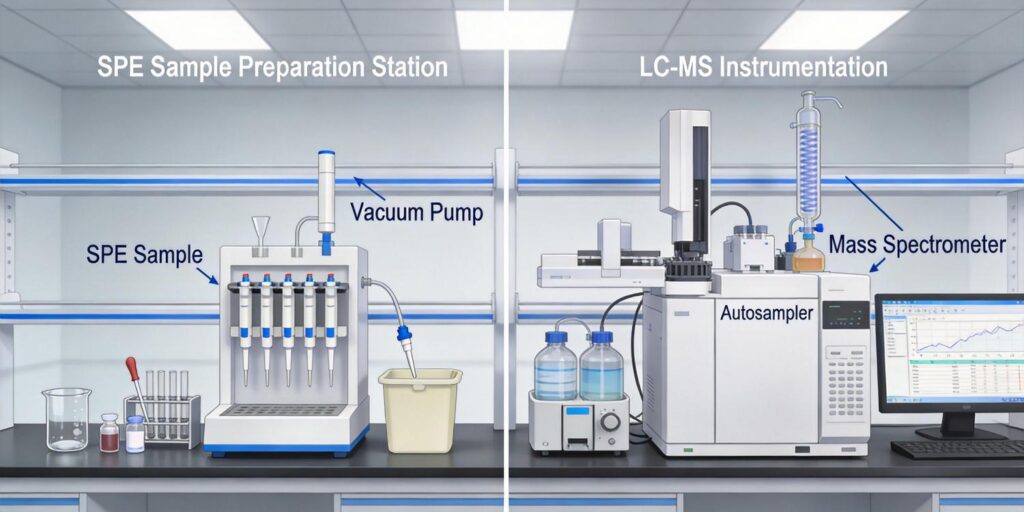
In modern analytical laboratories, the integration of solid-phase extraction (SPE) with liquid chromatography-mass spectrometry (LC-MS) represents a critical advancement for achieving high-quality analytical results. This comprehensive guide explores the strategic integration of SPE sample preparation with LC-MS methodologies, addressing key considerations for analytical chemists, method developers, and laboratory managers.
1. The Foundational Role of SPE in LC-MS Analytical Workflows
Solid-phase extraction serves as the cornerstone of effective LC-MS sample preparation, bridging the gap between complex sample matrices and sensitive analytical instrumentation. As noted in foundational SPE literature, “SPE has been shown to significantly increase gas (GC) and liquid chromatography (LC) column life while reducing the downtime on equipment like gas chromatography and liquid chromatography mass spectrometers (GC-MS and LC-MS) for source cleaning.”
The primary objectives of SPE in LC-MS workflows include:
- Matrix Cleanup: Removal of proteins, lipids, salts, and other interfering compounds that can suppress ionization or cause source contamination
- Analyte Concentration: Enrichment of target compounds to achieve required detection limits
- Solvent Exchange: Conversion of samples into solvents compatible with LC-MS mobile phases
- Desalting: Elimination of inorganic ions that can interfere with electrospray ionization
Compared to traditional liquid-liquid extraction (LLE), SPE offers distinct advantages including improved throughput through parallel processing, decreased organic solvent usage, higher and more reproducible recoveries, cleaner extracts, and easier automation capabilities.
2. Strategic Matching of SPE Eluents with LC-MS Mobile Phases
The compatibility between SPE elution solvents and LC-MS mobile phases is crucial for maintaining chromatographic integrity and ionization efficiency. Research indicates that “elution using a pure organic solvent, without modifiers or buffer ions is desirable, just as it was for off-line LC-MS sample preparation.”
Key considerations for eluent-mobile phase compatibility include:
2.1 Solvent Strength Matching
SPE eluents should be weaker than or equal in strength to the initial LC mobile phase composition to prevent peak distortion. For reversed-phase applications, common strategies involve eluting with methanol or acetonitrile and diluting with water or weak mobile phase before injection.
2.2 Buffer Compatibility
When using ion-exchange SPE phases, residual buffer salts in eluents must be compatible with LC-MS systems. Volatile buffers like ammonium acetate or formic acid are preferred as they minimize ion suppression and source contamination.
2.3 pH Considerations
The pH of SPE eluents should be optimized to maintain analyte stability and compatibility with LC column stationary phases. For basic compounds eluted from mixed-mode SPE cartridges, adding 2-5% ammonium hydroxide to methanol can improve recovery while maintaining MS compatibility.
3. Systematic Reduction of Matrix Effects Before Injection
Matrix effects represent one of the most significant challenges in LC-MS analysis, particularly in electrospray ionization where co-eluting compounds can suppress or enhance analyte ionization. SPE provides multiple mechanisms for matrix effect reduction:
3.1 Selective Retention Mechanisms
Mixed-mode SPE sorbents combining reversed-phase and ion-exchange functionalities offer superior selectivity for removing matrix interferences. As documented in SPE literature, “mixed-mode solid-phase extraction provides the cleanest extracts and best reduction of matrix effects.”
3.2 Wash Optimization
Strategic wash steps using solvents of appropriate strength can remove weakly retained matrix components while maintaining analyte retention. For biological samples, washing with 5% methanol in water containing 2% formic acid or ammonium acetate effectively removes proteins and phospholipids.
3.3 Capacity Management
Proper SPE sorbent mass selection relative to sample load prevents breakthrough of matrix components. The 2 × 4 strategy using only two protocols and four sorbents (HLB, MCX, MAX, WCX/WAX) provides comprehensive coverage for acids, bases, and neutrals across various matrices.
4. Designing Workflows for Automated SPE-LC-MS Integration
Automation represents a critical advancement in SPE-LC-MS integration, addressing throughput requirements while improving reproducibility. As noted in automation literature, “automated SPE sample preparation eliminates many of those variables associated with manual SPE. The result can be improved precision, accuracy and recovery.”
4.1 Platform Selection
Modern SPE automation platforms offer various formats including 96-well plates, μElution plates, and on-line SPE systems. The choice depends on sample volume, throughput requirements, and detection limits. μElution plates are particularly valuable for small sample volumes (10-375 μL) with elution volumes as low as 25 μL, eliminating evaporation and reconstitution steps.
4.2 On-line vs. Off-line Approaches
On-line SPE-LC-MS systems provide complete automation but may limit throughput compared to off-line 96-well plate approaches. However, as research demonstrates, “the on-line approach will never be able to achieve the speed of off-line 96 well SPE plate sample preparation. However, it can still drive the LC-MS system at 100% of its capacity if the SPE extraction time is shorter than the analysis time.”
4.3 Method Transfer Considerations
Successful automation requires careful method optimization addressing flow rates, solvent volumes, and drying times. Automated systems typically require reduced solvent volumes and optimized flow parameters compared to manual methods.
5. Compatibility with Modern UHPLC Systems
The transition to ultra-high performance liquid chromatography (UHPLC) systems with smaller particle sizes and higher pressures necessitates specific SPE considerations:
5.1 Particle Size Matching
Smaller particle size SPE sorbents (30 μm or less) provide improved kinetics and compatibility with UHPLC systems. Research indicates that “the use of smaller particle size SPE sorbents and narrow-bore SPE devices would allow even greater sensitivity.”
5.2 Flow Rate Optimization
SPE conditioning and elution flow rates must be optimized for UHPLC compatibility, typically requiring higher flow rates during sample loading and lower rates during elution to maximize recovery.
5.3 Injection Volume Considerations
SPE eluents for UHPLC analysis often require concentration or solvent exchange to achieve appropriate injection volumes for narrow-bore columns (1.0-2.1 mm ID).
6. Method Validation and Reproducibility Considerations
Robust SPE-LC-MS methods require comprehensive validation addressing recovery, matrix effects, and reproducibility:
6.1 Recovery Assessment
SPE recoveries should exceed 90% for validated methods. As noted in forensic applications, “SPE recoveries should exceed 90% absolute recovery. If you don’t get that kind of recovery you are not adjusting other parameters (such as solubility, pH, and solvent strength) correctly.”
6.2 Matrix Effect Evaluation
Post-extraction addition and post-column infusion experiments should quantify matrix effects, with SPE methods ideally achieving less than 20% ion suppression or enhancement.
6.3 Reproducibility Metrics
Automated SPE systems typically achieve CVs of less than 5% for recovery and less than 10% for matrix effects when properly optimized. Documentation capabilities of automated systems provide formal records of extraction parameters for regulatory compliance.
7. Case Example: Pharmaceutical Bioanalysis Application
A compelling demonstration of SPE-LC-MS integration comes from pharmaceutical bioanalysis, where researchers achieved remarkable sensitivity using automated systems. As documented, “using an ion-spray MS/MS system linked to an auto-sampler and on-line SPE robot the authors were able to develop assays with cycle times of 5 to 7 minutes per sample, which yielded sensitivities of 50 pg/mL for sample sizes of only 200 μL.”
7.1 Method Parameters
This application utilized 30 μm sorbent packed in 2 mm ID SPE cartridges with on-line automation, demonstrating that properly integrated SPE-LC-MS systems can achieve picogram-level detection limits while maintaining high throughput.
7.2 Throughput Achievements
Other pharmaceutical applications have reported sample throughput of 320-960 samples per day for broad-range screening in human plasma, illustrating the efficiency of well-integrated SPE-LC-MS workflows.
Conclusion
The strategic integration of SPE with LC-MS methodologies represents a critical advancement in modern analytical chemistry. By addressing solvent compatibility, matrix effects, automation, and validation considerations, laboratories can develop robust, high-throughput methods that maximize instrument performance and data quality. As SPE technology continues to evolve with new sorbent chemistries and automation platforms, the integration with LC-MS will remain essential for addressing increasingly complex analytical challenges across pharmaceutical, environmental, clinical, and forensic applications.
For laboratories implementing SPE-LC-MS integration, the key success factors include proper sorbent selection based on analyte properties, optimization of elution conditions for MS compatibility, implementation of appropriate automation platforms, and comprehensive method validation addressing both recovery and matrix effects. When these elements are properly addressed, SPE-LC-MS integration provides unparalleled capabilities for trace-level analysis in complex matrices.