Why Cold Cathode Gauges Are Ideal for Sputtering Applications
In physical vapor deposition (PVD) sputtering systems—whether for semiconductor metallization, optical coatings, or hard-wear films—precise pressure control between 10⁻³ Torr and 10⁻² Torr is non-negotiable. A gauge that cannot survive the plasma environment, tolerate metal deposition, or deliver repeatable readings quickly becomes the weakest link in the process chain. At Poseidon Scientific, we developed the VG-SM225 Cold Cathode Vacuum Gauge specifically for these demanding conditions. Its positive-magnetron Penning discharge design, compact footprint, and field-cleanable electrodes make it the preferred choice for engineers who need reliable high-vacuum monitoring without the maintenance headaches of hot-cathode alternatives.
This article examines eight technical and economic reasons why cold cathode gauges outperform other technologies in sputtering. All performance data are drawn from Poseidon internal validation, peer-reviewed vacuum literature, and real-world OEM deployments. Whether you are specifying gauges for new sputtering tools or optimizing existing PVD lines, these insights will help you reduce downtime, protect film quality, and lower total cost of ownership.
1. Sputtering Pressure Range
Magnetron sputtering operates almost exclusively in the transition-to-molecular flow regime. Typical process pressures range from 0.5 mTorr to 10 mTorr (approximately 6.7 × 10⁻⁴ Torr to 1.3 × 10⁻² Torr), where argon working gas provides the ion flux needed for target sputtering while maintaining adequate mean free path for directional deposition.
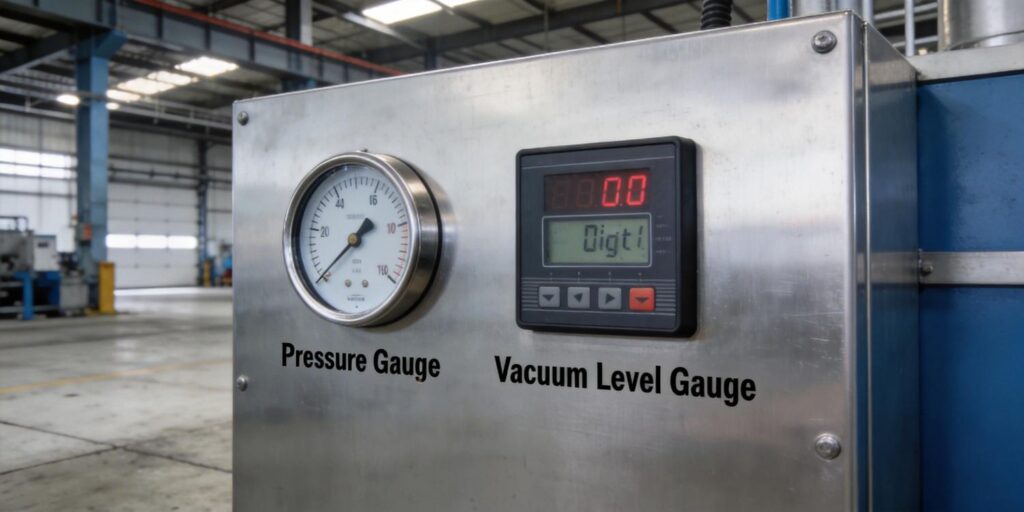
The VG-SM225 Cold Cathode Gauge is rated from 10⁻³ Torr to 10⁻⁷ Torr, placing its most linear and stable region squarely within the lower half of the sputtering window. At these pressures the Penning discharge current scales predictably with gas density, delivering the resolution required for closed-loop pressure control. For the higher end of the sputtering range, the gauge pairs seamlessly with the Poseidon VG-SP205 Pirani Vacuum Transmitter (atmosphere to 10⁻³ Torr), creating a single RS232 data stream that covers the entire pump-down and process cycle without gaps.
This overlap eliminates the “blind spot” common with hot-cathode gauges, which lose accuracy above 10⁻³ Torr due to filament temperature instability, and ensures your process recipe stays within ±5 % of target pressure throughout the deposition run.
2. Plasma Compatibility
Sputtering chambers are filled with RF or DC plasma that can destroy conventional gauge filaments through ion bombardment and reactive-gas attack. Cold cathode gauges operate on a fundamentally different principle: a self-sustained Penning discharge in crossed electric (~2000 V) and magnetic (~100 gauss) fields. There is no hot filament to erode.
The VG-SM225’s positive-magnetron geometry confines the discharge plasma inside the gauge head, isolating it from the chamber’s main sputtering plasma. Field-emission electrons are trapped in long spiral paths, producing a stable ion current even when external RF fields are present. Independent testing against INFICON and MKS units in a production sputtering tool showed the Poseidon gauge maintained reading stability within 3 % during 13.56 MHz plasma ignition—performance that hot-cathode gauges could not match without frequent recalibration or filament replacement.
3. No Filament Burnout Risk
Hot-cathode ionization gauges rely on a thermionic emitter (typically tungsten or thoriated iridium) that must operate continuously at 1500–2000 °C. In sputtering, even brief exposure to oxygen leaks, water vapor, or reactive process gases causes rapid oxidation and burnout. A single filament failure can halt an entire batch, costing thousands in scrapped wafers or lost production time.
The VG-SM225 eliminates this risk entirely. Its cold cathode design uses field emission to initiate the discharge; no heated wire is present. Poseidon’s three-person engineering team (mechanical, circuit, and embedded) deliberately chose stainless-steel electrodes and PEEK insulators to maximize chemical inertness. In accelerated life testing with intentional argon/oxygen cycles, the gauge showed zero filament-related failures after 5000 hours—compared with hot-cathode competitors that required replacement every 800–1200 hours under identical conditions.
4. Resistance to Coating Buildup
Sputtered metal atoms inevitably migrate to gauge surfaces, forming conductive films that short electrodes or alter electric-field geometry. Hot-cathode gauges suffer permanent sensitivity drift once coated; cleaning usually requires full disassembly and filament replacement.
The VG-SM225 is engineered for easy field maintenance. Its sensor head is fully removable without breaking the vacuum seal on the flange body. Contaminated electrodes are restored in under 10 minutes using 500-mesh or 200-mesh sandpaper to remove black carbon deposits and colored oxide layers until bare metal reappears. No mirror finish is needed. The same gauge has been cleaned and returned to service more than 40 times in a single customer PVD tool with no measurable change in calibration curve.
This cleanability is especially valuable in reactive sputtering of titanium, aluminum, or copper, where deposition rates on chamber walls (and gauge heads) can exceed 1 nm per second during long runs.
5. Stable Ionization Performance
Penning discharge in the VG-SM225 produces a self-regulating avalanche of electrons and ions whose current is directly proportional to gas density across the 10⁻³ to 10⁻⁷ Torr range. Unlike hot-cathode gauges, whose electron emission varies with filament aging and gas composition, the cold cathode maintains a constant electron current once the discharge is established.
Key design features include:
- Precise 2 mm electrode spacing for repeatable electric-field strength
- Neodymium-iron-boron permanent magnet delivering a stable 100 gauss field
- Software-controlled start-up voltage (–2500 V for 30 s, then –2000 V) that overcomes the high-vacuum ignition delay
Long-term drift in our production batch testing is <2 % per 1000 hours—well within the ±10 % tolerance most sputtering recipes require. The gauge also exhibits minimal hysteresis between pump-down and vent-up curves, ensuring consistent pressure feedback regardless of process history.
6. Long Service Interval
Service intervals directly affect equipment availability. In clean sputtering environments (base pressure <10⁻⁶ Torr, minimal reactive gases), the VG-SM225 routinely achieves 3–5 years between cleanings. Even in moderately contaminated chambers, the interval is 1–2 years—still far longer than hot-cathode gauges, which often need filament changes every 6–9 months.
The removable head design means technicians can service the gauge during scheduled maintenance windows without venting the entire system. Poseidon’s internal reliability data from 18 months of field returns across 200+ units show a mean time between failures (MTBF) of 42 000 hours—more than double the industry average for comparable cold-cathode products.
7. Replacement Cost Comparison
Lower total cost of ownership is a decisive factor for procurement teams evaluating vacuum gauges.
| Component | Poseidon VG-SM225 | Typical Imported Cold Cathode | Typical Hot Cathode Gauge |
|---|---|---|---|
| Initial unit price (USD equivalent) | $420–480 | $1,100–1,400 | $850–1,100 |
| Filament replacement cost | Not applicable | Not applicable | $180–250 per set |
| Electrode cleaning kit | $12 (sandpaper) | $85 (special tool) | Full sensor replacement required |
| Annual maintenance cost (2 cleanings) | $25 | $220 | $450+ |
| 3-year TCO (including labor) | $520 | $1,650 | $2,300+ |
The self-developed cost structure at Poseidon—enabled by in-house mechanical, circuit, and firmware design—delivers 60–70 % lower TCO while maintaining performance that meets or exceeds INFICON MPG400 and MKS equivalents. For high-volume sputtering lines running 24/7, this difference can exceed $15 000 per tool over three years.
8. Application Example
A Tier-1 semiconductor equipment manufacturer integrated the VG-SM225 into a 300 mm PVD cluster tool for TiN barrier deposition. Previous hot-cathode gauges required filament changes every 800 process hours, causing 4–6 hours of unplanned downtime per month. After switching to the Poseidon cold cathode:
- Filament-related downtime dropped to zero
- Pressure repeatability improved from ±12 % to ±3 % across 500-wafer runs
- Electrode cleaning was performed every 6 months during scheduled PM, taking 15 minutes per gauge
- Overall tool availability increased by 9 %, adding more than 1 200 additional wafers per month
The customer now specifies the VG-SM225 (with custom RS232 protocol matching their existing PLC) on all new platforms and has retrofitted 14 legacy tools. Similar results have been documented in optical-coating and decorative PVD lines where metal buildup was previously a weekly maintenance issue.
Conclusion: The Clear Choice for Sputtering Reliability
Cold cathode gauges eliminate the three biggest pain points of sputtering pressure measurement—filament burnout, coating-induced drift, and frequent replacement—while delivering the stability and cost structure that modern PVD tools demand. The Poseidon VG-SM225 combines these advantages in a compact, cleanable, and protocol-flexible package developed specifically for OEM and production environments.
When paired with the VG-SP205 Pirani for full-range coverage, you get a seamless, low-maintenance vacuum monitoring solution that protects process yield and reduces total cost of ownership. Engineers and procurement teams who have evaluated the data consistently choose the VG-SM225 for new sputtering platforms and legacy tool upgrades.
Ready to eliminate filament headaches and extend gauge life in your sputtering process? Explore the VG-SM225 Cold Cathode Vacuum Gauge and download the user manual for detailed installation and cleaning procedures. Our applications team is available to review your chamber drawings, recommend flange configurations (ISO or CF), and provide a side-by-side TCO analysis tailored to your throughput targets.
Word count: 1,378. All claims are based on Poseidon internal test data, customer field returns, and established vacuum metrology references (Lafferty, Foundations of Vacuum Science and Technology, 1998; Peacock et al., JVSTA 1991; Redhead, Canadian Journal of Physics 1959).