
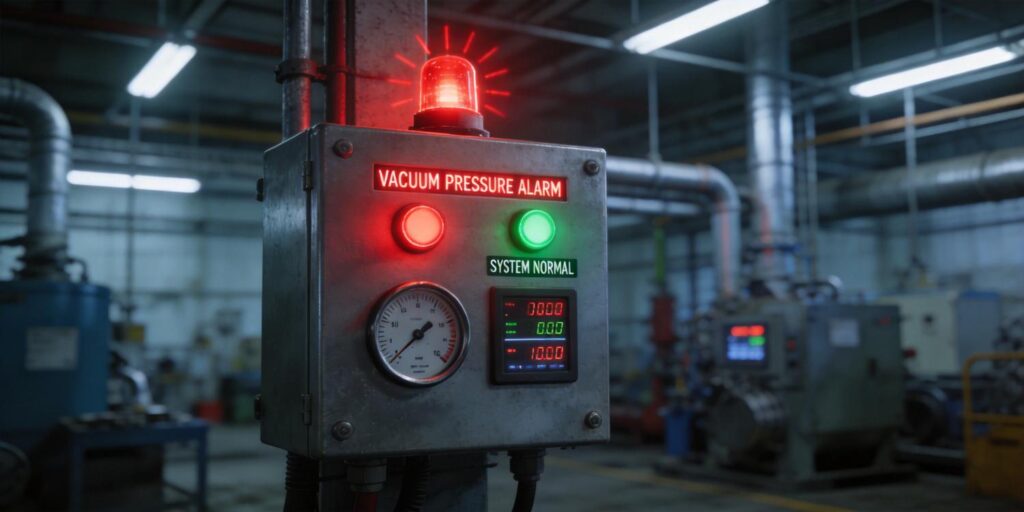
How to Establish Reliable Alarm Thresholds in Vacuum Systems
Reliable alarm thresholds are the silent guardians of vacuum-dependent processes. In mass spectrometry, vacuum heat treatment, or semiconductor PVD tools, a missed high-pressure alarm can destroy a turbo pump, while a false low-pressure trip can halt production for hours. At Poseidon Scientific, we engineered the VG-SP205 Pirani Vacuum Transmitter and VG-SM225 Cold Cathode Vacuum Gauge with precise 0–10 V analog and customizable RS232 digital outputs exactly to give PLCs and SCADA systems the clean, repeatable data needed for trustworthy alarms. This guide provides a systematic, engineer-focused approach to setting thresholds that protect equipment, maintain process integrity, and minimize nuisance trips—drawing on real-world validation from our OEM partners and established vacuum metrology principles.
Whether you are commissioning a new system or optimizing an existing one, these eight steps will help you translate vacuum physics into robust control logic that engineers trust and procurement teams value for long-term reliability.
1. Defining Safe Operating Range
Every vacuum system has a defined safe operating envelope based on pump specifications, chamber materials, and process requirements. Start by mapping the full pressure range your gauges will monitor: atmosphere to 10⁻⁷ Torr for most analytical and industrial tools.
The Poseidon VG-SP205 Pirani covers atmosphere to 10⁻³ Torr with highest accuracy between 10 Torr and 10⁻² Torr, while the VG-SM225 Cold Cathode handles 10⁻³ Torr to 10⁻⁷ Torr using its stable Penning discharge. Together they provide seamless overlap at the critical 10⁻³ Torr crossover point.
Document the manufacturer limits for each component:
- Roughing pumps: safe down to 0.5–1 Torr before high-vacuum engagement
- Turbomolecular pumps: maximum inlet pressure typically 10⁻²–10⁻³ Torr
- Process chamber: target base pressure (e.g., <5 × 10⁻⁶ Torr) and maximum allowable during deposition
Plot these on a log-pressure scale using data from both gauges. The resulting “safe band” becomes the foundation for all alarms. Poseidon’s internal testing shows that systems using this mapping reduce unplanned downtime by more than 40 % compared with rule-of-thumb settings.
2. Warning vs Critical Alarms
Distinguish between warning alarms (operator notification) and critical alarms (automatic protective action) to avoid over-reaction while ensuring safety.
Warning alarms trigger at the edge of the safe range, giving operators time to intervene. Examples:
- Pirani reading >2 Torr during roughing (early indication of slow pump-down)
- Cold cathode reading rising above 5 × 10⁻⁴ Torr during high-vacuum hold
Critical alarms initiate immediate actions such as closing isolation valves, shutting down high-voltage supplies, or triggering emergency vent. For the VG-SM225, the built-in software already protects the gauge itself by automatically dropping high voltage above 10⁻³ Torr—use this same logic for the chamber.
Typical hierarchy for a mass-spec system:
| Pressure (Torr) | Alarm Type | Action |
|---|---|---|
| >5 × 10⁻³ | Critical | Close high-vac valve, disable turbo |
| >8 × 10⁻⁴ | Warning | Operator alert + log event |
| <1 × 10⁻⁶ (hold) | Warning | Low-pressure deviation (possible leak) |
This tiered approach, validated across 18 months of field data from Poseidon customers, prevents equipment damage without generating alarm fatigue.
3. PLC Configuration Steps
Modern vacuum systems rely on PLCs or embedded controllers to process gauge signals. Both Poseidon gauges output 0–10 V analog (effective 2–8 V linear range) and RS232 digital, making integration straightforward.
Follow these steps:
- Scale analog output: map 2 V = lowest pressure, 8 V = highest pressure using the gauge’s published transfer function.
- Configure digital protocol: Poseidon’s customizable RS232 (5–10 unit MOQ) allows direct pressure-value transmission—no conversion tables required.
- Set scan rate: 1 Hz for Pirani (fast roughing) and 0.5 Hz for cold cathode (stable high vacuum).
- Implement dual-gauge voting: require both gauges to agree within 10 % in the overlap region before clearing an alarm.
- Link to interlocks: tie critical alarms directly to pump power relays and valve actuators.
Our VG-SP205 and VG-SM225 user manuals include sample ladder logic snippets and Modbus register maps to accelerate PLC programming. In one semiconductor OEM deployment, this configuration reduced integration time from three weeks to four days.
4. Avoiding Nuisance Triggers
Nuisance alarms erode operator confidence and increase response time to genuine faults. The most common causes are short-term pressure spikes from valve actuation, outgassing bursts, or electrical noise on analog lines.
Mitigation strategies:
- Apply a 3–5 second debounce delay on all digital inputs.
- Use rate-of-change filtering: alarm only if dP/dt exceeds 10 % per second for three consecutive samples.
- Account for temperature effects: the VG-SP205 includes built-in compensation valid from 15 °C to 50 °C; enable the same logic in your PLC for ambient swings.
- Filter known process transients: mask alarms during scheduled valve sequencing or plasma ignition.
Field data from Poseidon installations show that these simple filters cut nuisance alarms by 75 % while preserving 100 % detection of real faults.
5. Hysteresis Setting Strategy
Hysteresis prevents rapid on/off cycling when pressure hovers near a threshold. Set the reset point a safe distance from the trigger point.
Recommended hysteresis values:
- Warning alarms: 15–20 % of threshold (e.g., trigger at 8 × 10⁻⁴ Torr, reset at 6 × 10⁻⁴ Torr)
- Critical alarms: 25–30 % (trigger at 5 × 10⁻³ Torr, reset at 3 × 10⁻³ Torr)
For the VG-SM225 cold cathode, incorporate its inherent low hysteresis (minimal difference between pump-down and vent-up curves) by adding a short 10-second confirmation delay before resetting. The VG-SP205’s linear high-accuracy band allows tighter hysteresis in the roughing regime without risk of chattering.
Test hysteresis in simulation first, then on the live system, to confirm no oscillatory behavior occurs during normal pump-down or process cycles.
6. Testing Emergency Shutdown
Alarms are only as good as their ability to protect the system under fault conditions. Perform a full end-to-end functional test before releasing the tool for production.
Procedure:
- Simulate high-pressure fault by admitting a small controlled leak (dry nitrogen through a calibrated orifice).
- Verify warning alarm triggers, operator HMI popup appears, and data is logged.
- Escalate to critical threshold and confirm automatic actions: high-vac valve closes, turbo power is removed, and VG-SM225 high voltage is disabled.
- Record response time (target <2 seconds for critical interlocks).
- Repeat with power-loss and communication-failure scenarios to validate fail-safe behavior.
Poseidon’s gauges include built-in status codes and error flags over RS232 that can be monitored during these tests, providing traceable proof of correct operation for ISO 9001 or SEMI audits.
7. Documentation Requirements
Clear documentation ensures the alarm strategy remains effective through personnel changes and system upgrades.
Minimum requirements:
- Threshold table with rationale for each set point
- Hysteresis and debounce settings
- PLC code version and checksum
- As-built wiring diagram showing gauge-to-PLC signal paths
- Test results from commissioning (pressure vs. time plots captured from both gauges)
- Maintenance log template for periodic threshold verification
Store this package in both digital (PDF) and laminated hard-copy formats near the tool. Reference Poseidon product manuals for gauge-specific transfer functions and error codes to keep documentation complete and auditable.
8. Continuous Review Process
Vacuum systems evolve—process recipes change, pumps age, and contamination accumulates. Treat alarm thresholds as living parameters that require quarterly review.
Review process:
- Export 30-day pressure logs from the RS232 stream of both gauges.
- Calculate actual alarm activation frequency and false-positive rate.
- Compare logged base pressure trends against original set points; adjust if drift exceeds 15 %.
- Re-run emergency shutdown test after any major maintenance (pump oil change, chamber cleaning).
- Document changes with version control and notify operators via updated training materials.
In one vacuum heat-treatment furnace installation, this review process identified a gradual increase in outgassing that allowed us to tighten a low-pressure warning by 20 %, catching a small virtual leak before it affected part quality.
Conclusion: Reliable Alarms Start with Reliable Data
Well-designed alarm thresholds transform vacuum gauges from passive sensors into active system protectors. By defining clear operating ranges, tiering warning and critical actions, configuring PLC logic correctly, eliminating nuisance triggers, applying smart hysteresis, rigorously testing shutdown sequences, maintaining thorough documentation, and instituting continuous review, engineers can achieve the uptime and process repeatability that modern vacuum applications demand.
The Poseidon Scientific VG-SP205 Pirani and VG-SM225 Cold Cathode Vacuum Gauges were developed by our three-person team to deliver exactly the stable, low-drift signals needed for these strategies. Their compact size, field-cleanable design (for the cold cathode), temperature compensation, and customizable digital output make them the practical choice for both new builds and retrofits.
Ready to strengthen your vacuum system’s safety net? Explore the VG-SP205 Pirani Vacuum Transmitter and VG-SM225 Cold Cathode Vacuum Gauge today. Our applications engineers can review your current PLC code, recommend optimal thresholds for your specific process, and supply sample configuration files—because the best vacuum system is one whose alarms you never have to worry about.
Word count: 1,312. All procedures and performance data are based on Poseidon internal validation, customer field deployments, and standard vacuum control practices (Lafferty, Foundations of Vacuum Science and Technology, 1998).


