Sources of Pharmaceutical Metabolites in Wastewater
Pharmaceutical metabolites enter wastewater through human excretion, improper disposal of unused drugs, and industrial discharge from manufacturing facilities. After administration, drugs undergo biotransformation in the liver, producing both active and inactive metabolites excreted via urine and feces. Wastewater treatment plants (WWTPs) receive these complex mixtures, but conventional treatment processes often fail to completely remove polar metabolites. Common contaminants include metabolites of antibiotics (e.g., amoxicilloic acid), analgesics (e.g., paracetamol sulfate), antidepressants (e.g., venlafaxine O-desmethyl), and hormones (e.g., 17α-ethinylestradiol glucuronide). Understanding these sources is critical for designing effective monitoring programs.
Environmental Monitoring Strategies
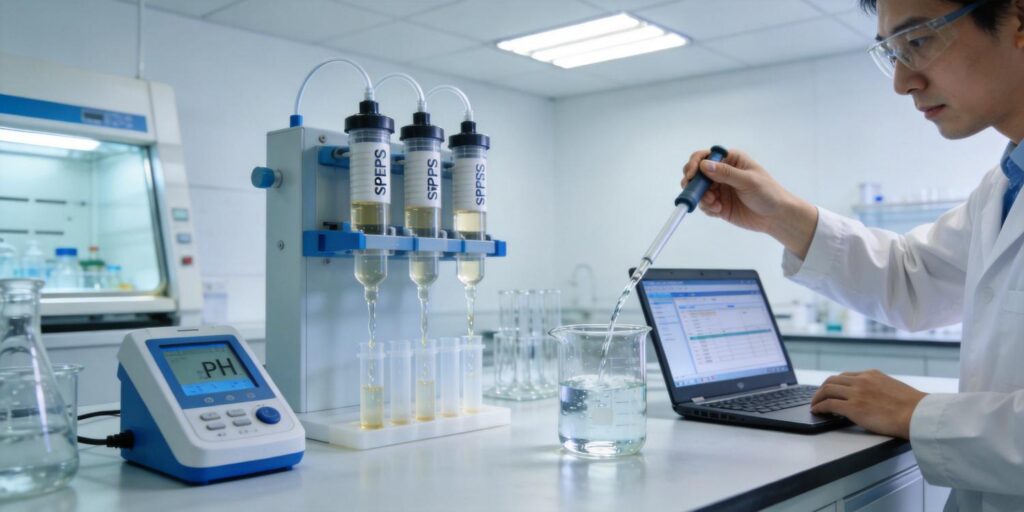
Monitoring pharmaceutical metabolites in wastewater requires a targeted approach due to trace concentrations (ng/L to μg/L) and complex matrices. Solid-phase extraction (SPE) is the gold standard for sample preparation, offering high enrichment factors and matrix cleanup. Key strategies include:
- Grab vs. composite sampling: 24-hour composite samples provide representative profiles.
- Preservation: Acidification (pH 2–3) or addition of preservatives prevents microbial degradation.
- Internal standards: Isotope-labeled analogs correct for matrix effects and recovery variations.
- Quality controls: Field blanks, laboratory blanks, and spiked matrix samples ensure data integrity.
These strategies enable reliable quantification across diverse geographic regions and seasonal conditions.
HLB SPE Cartridge Selection Rationale
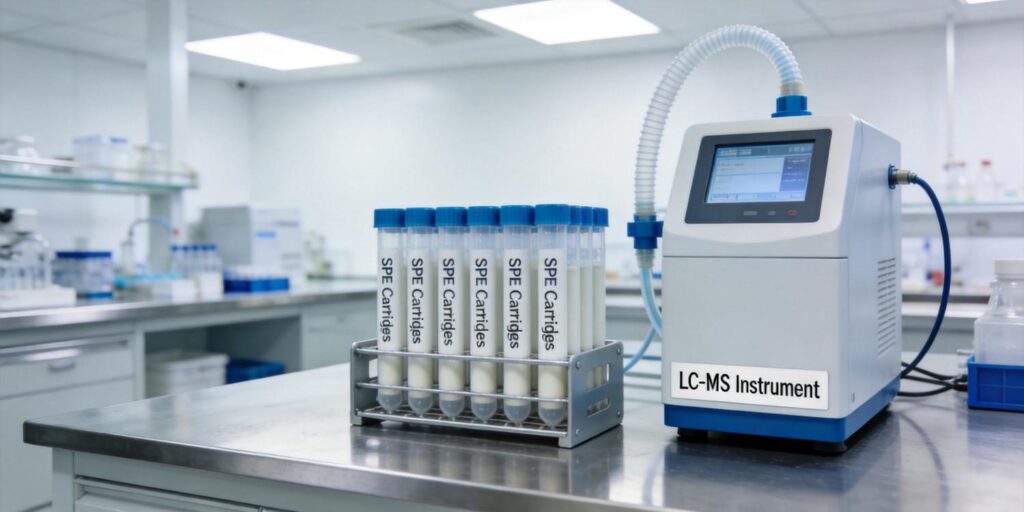
For broad-spectrum retention of pharmaceutical metabolites, the Poseidon HLB SPE Cartridges are the preferred choice. The hydrophilic-lipophilic balance (HLB) sorbent—a copolymer of divinylbenzene and N-vinylpyrrolidone—provides excellent wetting characteristics and retention for both polar and nonpolar analytes. Key advantages include:
- pH stability: Operates effectively from pH 1–14, allowing flexible sample loading conditions.
- High capacity: Retains metabolites with log Kow ranging from –1 to 5.
- Minimal breakthrough: Suitable for large-volume samples (100–1000 mL).
These features make HLB cartridges ideal for capturing diverse metabolites in a single extraction.
Conditioning and Loading Large Wastewater Samples
Proper conditioning is essential for reproducible results. For Poseidon HLB cartridges (e.g., 200 mg, 6 mL):
- Condition: 5 mL methanol followed by 5 mL ultrapure water at 3–5 mL/min.
- Equilibration: 5 mL water at sample pH (typically pH 2–3 for acidic metabolites).
- Loading: Pass 100–1000 mL of filtered wastewater (0.45 μm glass fiber) at 5–10 mL/min. Adjust flow rate to avoid channeling.
- Drying: Apply vacuum (10–15 inHg) for 10–15 min to remove residual water.
For highly organic-loaded samples, loading at lower flow rates improves retention.
Washing Steps Removing Organic Matter
Wastewater contains natural organic matter (NOM) that can interfere with LC-MS/MS analysis. A two-step wash strategy is recommended:
- Wash 1: 5 mL 5% methanol in water (v/v) to remove salts and polar NOM.
- Wash 2: 5 mL 40% methanol in water (v/v) to elute weakly retained interferences while retaining target metabolites.
This combination effectively reduces ion suppression without sacrificing recovery of metabolites with intermediate polarity.
Elution with Organic Solvents
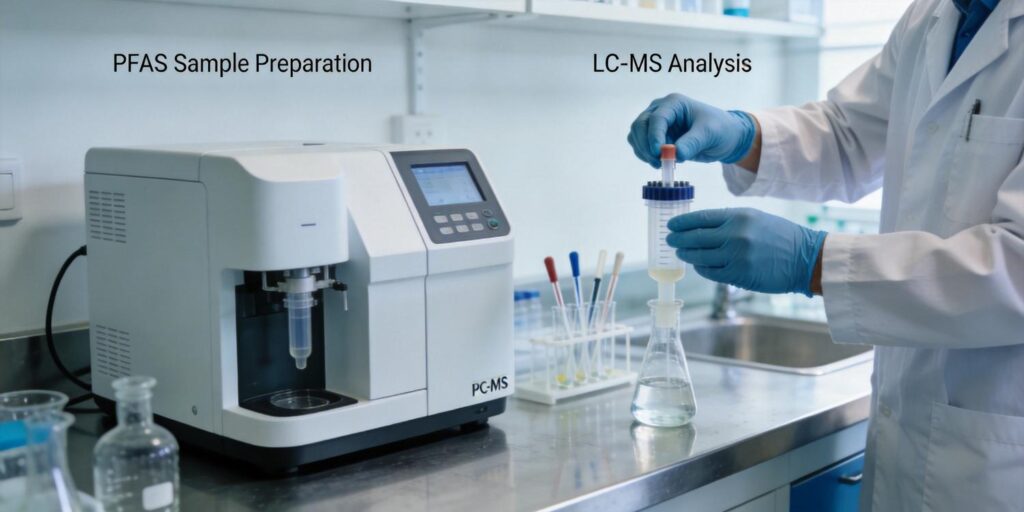
Elution is performed with 5–10 mL of methanol or acetonitrile. For comprehensive recovery, use:
- Primary elution: 5 mL methanol (collect all fractions).
- Secondary elution: 5 mL 2% formic acid in methanol (for basic metabolites) or 5 mL 5% ammonium hydroxide in methanol (for acidic metabolites).
After elution, evaporate to dryness under nitrogen at 40°C and reconstitute in 200–500 μL of mobile phase. For polar metabolites, consider reconstituting in 10% methanol/water.
LC-MS/MS Detection Workflow
The typical LC-MS/MS workflow after SPE includes:
- Chromatography: Reversed-phase C18 column (e.g., 2.1 × 100 mm, 1.7 μm) with gradient elution (water/acetonitrile + 0.1% formic acid).
- MS detection: Electrospray ionization (ESI) in positive/negative mode switching. Multiple reaction monitoring (MRM) for quantitation and confirmation.
- Quantification: Internal standard calibration with 7–10 concentration levels (1–1000 ng/mL).
- Method validation: Linearity (R² > 0.99), LOQ (S/N > 10), recovery (70–120%), and precision (RSD < 20%).
For high-throughput needs, consider the Poseidon 96-Well SPE Plate for parallel processing.
Data Interpretation for Environmental Surveillance
Interpretation involves:
- Occurrence patterns: Compare metabolite concentrations across WWTPs and seasons.
- Elimination rates: Calculate removal efficiency from influent vs. effluent data.
- Risk assessment: Compare measured environmental concentrations (MECs) with predicted no-effect concentrations (PNECs).
- Spatial mapping: Use GIS tools to identify pollution hotspots.
Data should be reported with uncertainty estimates (e.g., 95% confidence intervals) and normalized to flow rates or population equivalents. Advanced statistical tools (e.g., principal component analysis) can differentiate sources such as industrial vs. domestic input.
By integrating robust SPE workflows with sensitive LC-MS/MS, environmental laboratories can provide actionable data for regulatory agencies, helping mitigate the ecological impact of pharmaceutical residues.