SPE Method for Determining Sweeteners in Carbonated Beverages
Carbonated beverages often contain a mix of artificial sweeteners such as aspartame, acesulfame-K, saccharin, sucralose, and neotame to provide sweetness without calories. These compounds are regulated by food safety authorities, requiring accurate and reliable analytical methods for quality control and compliance. Solid-phase extraction (SPE) coupled with liquid chromatography-mass spectrometry (LC-MS) is the gold standard for determining sweeteners in complex soda matrices.
Matrix Challenges from Carbonation and Sugars
The primary challenges in analyzing sodas are the dissolved CO2 (carbonation) and high sugar content. CO2 can cause foaming and volume inaccuracies during sample handling, while sugars (sucrose, high-fructose corn syrup) interfere with retention and ionization in LC-MS. Additionally, coloring agents, preservatives, and flavors add complexity. Effective sample preparation must remove these interferents without losing sweeteners.
Sample Degassing and Dilution Procedures
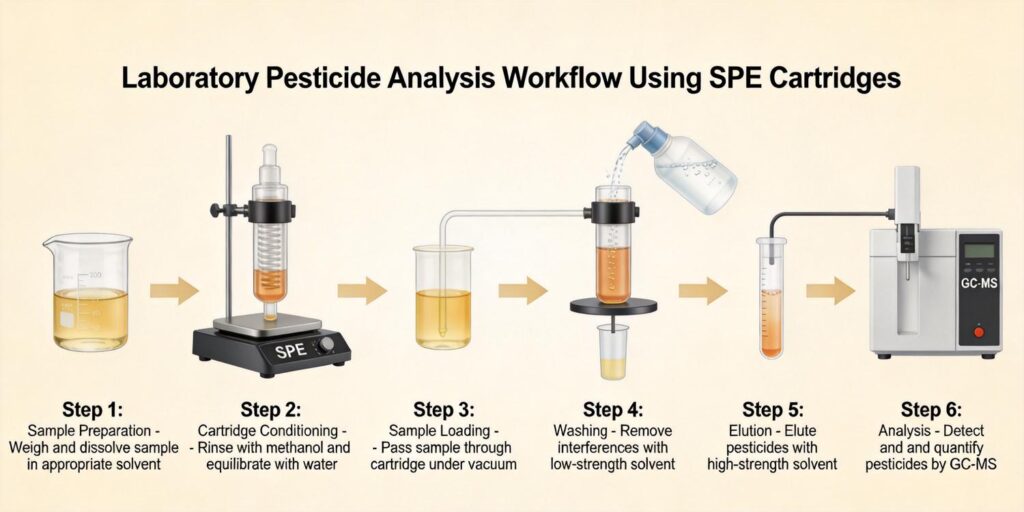
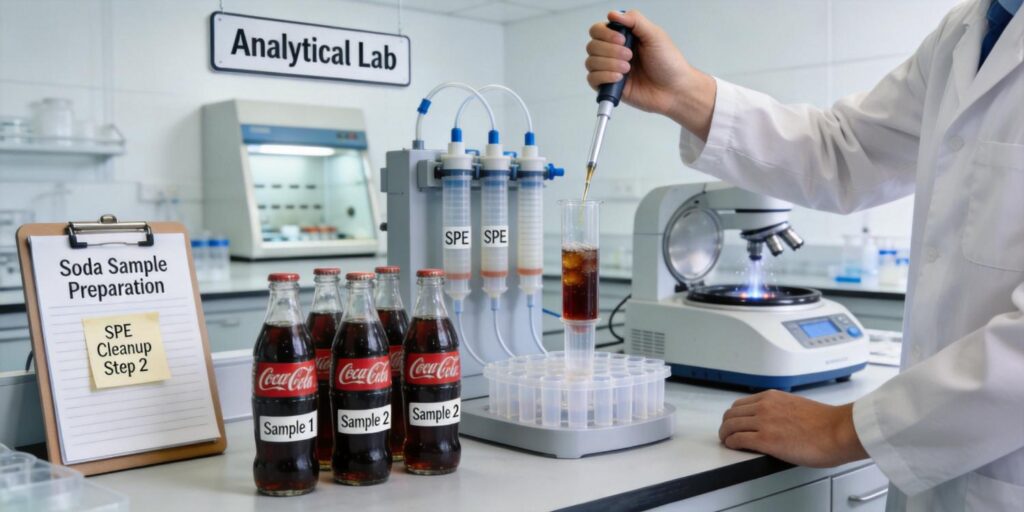
Before SPE, carbonated beverages must be degassed. Pour the sample into a beaker and sonicate for 10–15 minutes, or stir gently at room temperature until no bubbles remain. Alternatively, pass nitrogen gas through the sample. After degassing, dilute the beverage 1:1 (v/v) with deionized water to reduce viscosity and sugar concentration. For diet sodas, direct dilution may suffice; for regular sodas, a 1:2 or 1:3 dilution is recommended to prevent SPE cartridge overloading.
SPE Cartridge Conditioning and Loading
Select a reversed-phase or mixed-mode SPE cartridge. HLB (Hydrophilic-Lipophilic-Balanced) cartridges are ideal due to their broad pH stability and ability to retain both polar and nonpolar sweeteners. Condition the cartridge with 3 mL methanol followed by 3 mL deionized water. Load 2–5 mL of degassed, diluted sample at a flow rate of 1–2 mL/min. To avoid breakthrough, ensure the cartridge capacity is not exceeded.
Washing Steps Removing Sugars
After loading, wash the cartridge with 3 mL of 5% methanol in water (v/v) to elute sugars, organic acids, and highly polar interferences. Alternatively, a wash with 2% formic acid in water can improve retention of acidic sweeteners. The wash volume should be optimized to retain target analytes; typical recoveries exceed 95% for most artificial sweeteners after this step.
Elution with Methanol or Acetonitrile
Elute the retained sweeteners with 3 mL of methanol or acetonitrile. For mixed-mode sorbents like MAX (Mixed-Mode Anion eXchange) cartridges, use acidified methanol (e.g., 2% formic acid) to enhance desorption of acidic compounds such as saccharin and acesulfame-K. Collect the eluate in a glass tube and evaporate to dryness under nitrogen at 40 °C. Reconstitute in 1 mL of mobile phase (e.g., 90:10 water/acetonitrile) for LC-MS analysis.
LC-MS Detection Workflow
Separate sweeteners on a C18 column (2.1 × 100 mm, 1.7 μm) using a gradient of 0.1% formic acid in water (mobile phase A) and acetonitrile (mobile phase B). Typical gradient: 5–95% B over 10 min. Use electrospray ionization (ESI) in negative mode for saccharin, acesulfame-K, and sucralose, and positive mode for aspartame and neotame. Detection is performed with multiple reaction monitoring (MRM) for selectivity. A six-point calibration curve (0.1–50 μg/mL) ensures quantification.
Analytical Validation and QC Procedures
Validate the method per FDA or ICH guidelines. Key parameters include linearity (R² > 0.999), recovery (85–115% for all analytes), precision (RSD < 10%), and limits of detection (0.05–0.5 ng/mL). Include matrix-matched calibration standards and internal standards (e.g., aspartame-d5). Run a blank, a spiked sample, and a duplicate every 10 samples. For high-volume testing, consider 96-well SPE plates to increase throughput.
By following this SPE-LC-MS method, laboratories can achieve reliable sweetener quantification in carbonated beverages despite the challenging matrix. For more details on sorbent selection and method optimization, review our MCX, WAX, and WCX cartridge specifications tailored for acidic and basic analytes.