1. Analytical Challenges in Sugar-Rich Beverages
Analyzing trace contaminants, additives, or natural compounds in sugar-rich beverages like soft drinks, energy drinks, fruit juices, and sports beverages presents unique challenges for LC-MS (Liquid Chromatography-Mass Spectrometry) workflows. These matrices contain high concentrations of carbohydrates—primarily sucrose, glucose, fructose, and high-fructose corn syrup—that can range from 5% to 15% by weight. The sheer abundance of these sugars creates a significant interference problem, as they can overwhelm chromatographic systems, cause ion suppression in mass spectrometers, and lead to rapid column fouling.
Beyond simple sugars, these beverages often contain complex mixtures of organic acids (citric, malic, phosphoric), preservatives (benzoates, sorbates), artificial sweeteners (aspartame, sucralose), colorants, caffeine, and flavor compounds. The combination creates a “matrix effect” where co-eluting compounds alter the ionization efficiency of target analytes, leading to inaccurate quantification. Traditional dilution approaches are insufficient because they reduce analyte concentrations below detection limits while still leaving problematic sugar levels.
2. Matrix Effects Caused by Carbohydrates
Carbohydrates in beverage matrices cause multiple analytical interferences that directly impact LC-MS performance. First, sugars exhibit strong hydrophilic interaction chromatography (HILIC) behavior, causing them to elute early in reversed-phase separations and create broad, tailing peaks that can mask target compounds. Second, during electrospray ionization (ESI), sugars compete for charge and droplet surface area, leading to significant ion suppression—reported reductions in signal intensity of 30-70% for many analytes in sugar-rich matrices.
Third, carbohydrates can precipitate in LC systems when organic solvent concentrations change, potentially clogging columns, frits, and transfer lines. This is particularly problematic with sucrose, which has limited solubility in acetonitrile-rich mobile phases. Fourth, sugars can form adducts with analytes or create background noise across multiple m/z ranges, complicating mass spectral interpretation. Research shows that even after simple protein precipitation, sugar-rich beverages still require additional cleanup to achieve reliable LC-MS results.
3. SPE Sorbent Selection for Removing Sugars While Retaining Analytes
Selecting the appropriate SPE (Solid-Phase Extraction) sorbent is critical for effective sugar removal while maintaining high recovery of target analytes. The strategy typically involves using sorbents that retain sugars through hydrophilic interactions while allowing more hydrophobic analytes to pass through or be eluted separately.
Primary Sorbent Options:
Hydrophilic-Lipophilic Balanced (HLB) Sorbents
Poseidon Scientific’s HLB SPE cartridges provide excellent performance for beverage applications. The balanced chemistry retains a wide range of compounds while allowing highly polar sugars to pass through during the loading and washing steps. HLB’s water-wettable surface maintains consistent flow characteristics even with high-sugar samples.
Mixed-Mode Cation Exchange (MCX) Sorbents
For basic analytes in acidic beverages, MCX cartridges offer dual retention mechanisms. Sugars pass through unretained while basic compounds are retained via cation exchange and reversed-phase interactions. This is particularly effective for energy drinks containing basic stimulants.
Weak Anion Exchange (WAX) Sorbents
WAX cartridges are ideal for acidic compounds in beverages. The weak anion exchange mechanism retains acidic preservatives and organic acids while allowing neutral sugars to elute. The pH-dependent retention provides excellent selectivity.
Polymer-Based Sorbents
For maximum sugar removal, polymer sorbents like divinylbenzene-based materials show superior performance. These sorbents have shown effective removal of plant sugars and acids in food applications, as demonstrated in pesticide residue analysis where “plant sugars and acids are retained on SAX and PSA sorbents while the analytes pass through unretained.”
Sorbent Selection Strategy:
- For neutral analytes: HLB or C18 with optimized washing solvents
- For basic analytes: MCX or WCX (Weak Cation Exchange)
- For acidic analytes: WAX or MAX (Mixed-Mode Anion Exchange)
- For comprehensive cleanup: Sequential or stacked cartridge approaches
4. Example Protocol for Soft Drinks and Energy Drinks
Here’s a validated SPE protocol for analyzing trace contaminants in sugar-rich beverages using Poseidon Scientific products:
Materials:
- Poseidon Scientific HLB SPE cartridges (60 mg, 3 mL)
- Vacuum manifold or 96-well SPE plate for high-throughput
- Methanol (HPLC grade), Water (HPLC grade), Formic acid
- Soft drink or energy drink sample (degassed)
Procedure:
- Sample Preparation: Dilute beverage 1:10 with acidified water (0.1% formic acid) to reduce viscosity and adjust pH.
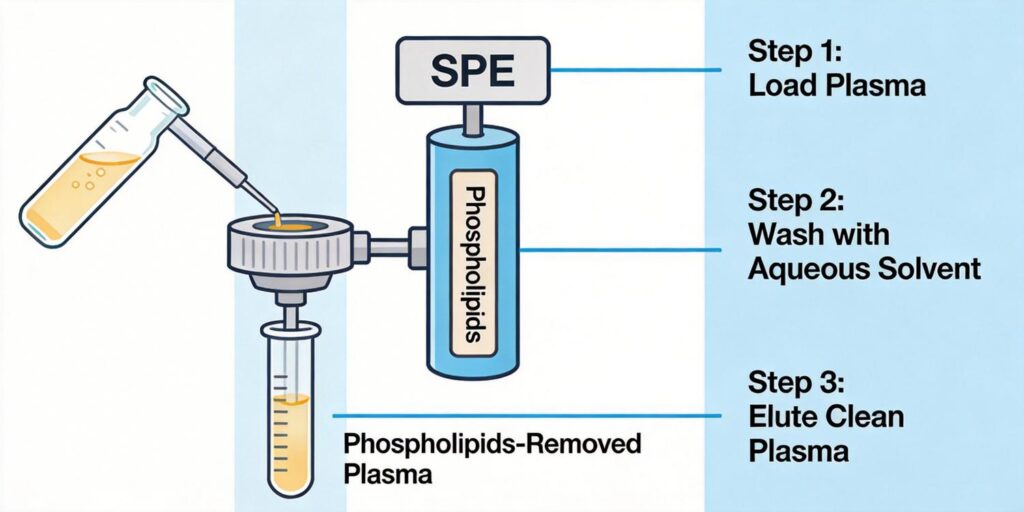
- SPE Conditioning: Condition HLB cartridge with 3 mL methanol followed by 3 mL acidified water (0.1% formic acid).
- Sample Loading: Load 5 mL of diluted sample at 1-2 mL/min flow rate. Sugars and highly polar matrix components pass through.
- Washing: Wash with 3 mL of 5% methanol in water (0.1% formic acid) to remove residual sugars and polar interferences.
- Drying: Apply vacuum for 5 minutes to remove residual water.
- Elution: Elute analytes with 2 × 2 mL methanol. Collect eluate in clean tube.
- Reconstitution: Evaporate to dryness under nitrogen and reconstitute in 200 μL initial mobile phase for LC-MS analysis.
Modifications for Specific Applications:
For Energy Drinks: Use MCX cartridges for basic compounds like caffeine, taurine, and B-vitamins. Adjust pH to 3-4 during loading to protonate basic analytes.
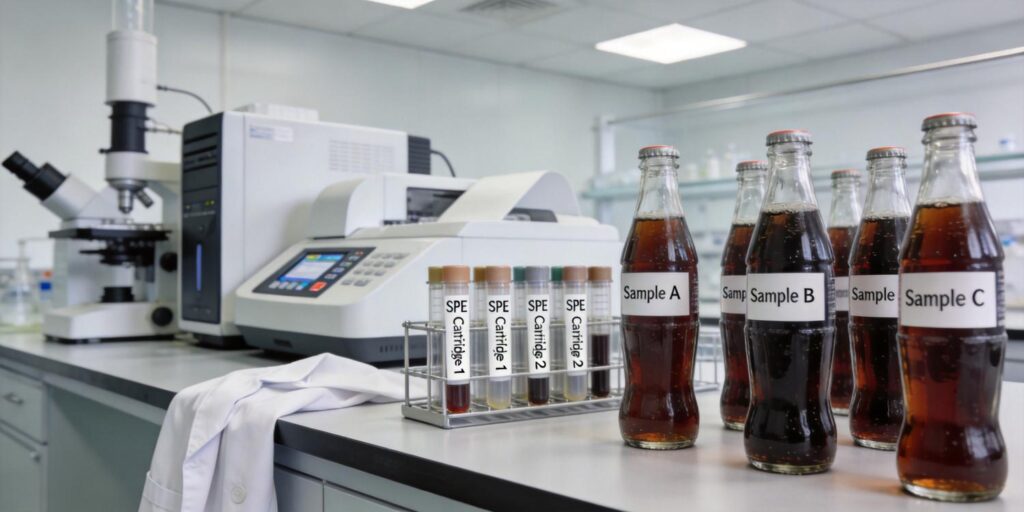
For Fruit Juices: Additional cleanup may be needed for pigments. Consider using MAX cartridges for acidic compounds or a two-cartridge approach as demonstrated in literature where “a two-cartridge extraction using C8 and SCX removed caffeine, aspartame, sodium benzoate, and caramel and color acids from soft drinks.”
5. LC-MS Performance Improvements After SPE Cleanup
Implementing SPE cleanup before LC-MS analysis of sugar-rich beverages delivers substantial improvements across all performance metrics:
Chromatographic Performance:
- Peak Shape: Elimination of sugar interference results in sharper, more symmetrical peaks with improved resolution
- Retention Time Stability: Consistent retention times across batches due to reduced column contamination
- Column Lifetime: Extended column life by preventing sugar accumulation and precipitation
Mass Spectrometric Performance:
- Ion Suppression Reduction: Typically 60-90% reduction in matrix effects, leading to more accurate quantification
- Signal-to-Noise Improvement: 5-10 fold improvement for trace analytes
- Reduced Source Contamination: Less frequent need for ion source cleaning
- Improved Detection Limits: Lower LODs and LOQs due to cleaner backgrounds
Data Quality:
- Better Quantitative Accuracy: More reliable calibration curves with R² values typically >0.995
- Reduced False Positives/Negatives: Cleaner spectra with fewer interfering peaks
- Improved Reproducibility: Consistent results across different beverage batches and brands
As noted in SPE literature, “SPE has been found to have a useful role to play in the clean-up and concentration steps of the analysis” and in some cases “the application of SPE is essential to successful analysis.” This is particularly true for sugar-rich matrices where traditional approaches fail.
6. Quality Control and Reproducibility Considerations
Maintaining consistent SPE performance requires careful attention to quality control parameters:
Method Validation Parameters:
- Recovery Studies: Spike known concentrations of analytes into beverage matrices before and after SPE to determine recovery efficiency (target: 70-120%)
- Matrix Effects: Compare analyte responses in clean solvent vs. post-SPE matrix to quantify remaining ion suppression
- Precision: Run multiple replicates (n≥6) to determine intra-day and inter-day variability
- Carryover Assessment: Run blank samples after high-concentration samples to ensure no contamination
Critical Control Points:
- pH Control: Maintain consistent pH during sample preparation and SPE loading (±0.2 pH units)
- Flow Rate Management: Control loading and elution flow rates (1-3 mL/min optimal) to ensure proper interaction times
- Cartridge Conditioning: Ensure sorbent is properly wetted before sample loading to prevent channeling
- Solvent Quality: Use high-purity solvents to prevent introduction of contaminants
- Evaporation Conditions: Control temperature and gas flow during solvent evaporation to prevent analyte loss
Reproducibility Enhancements:
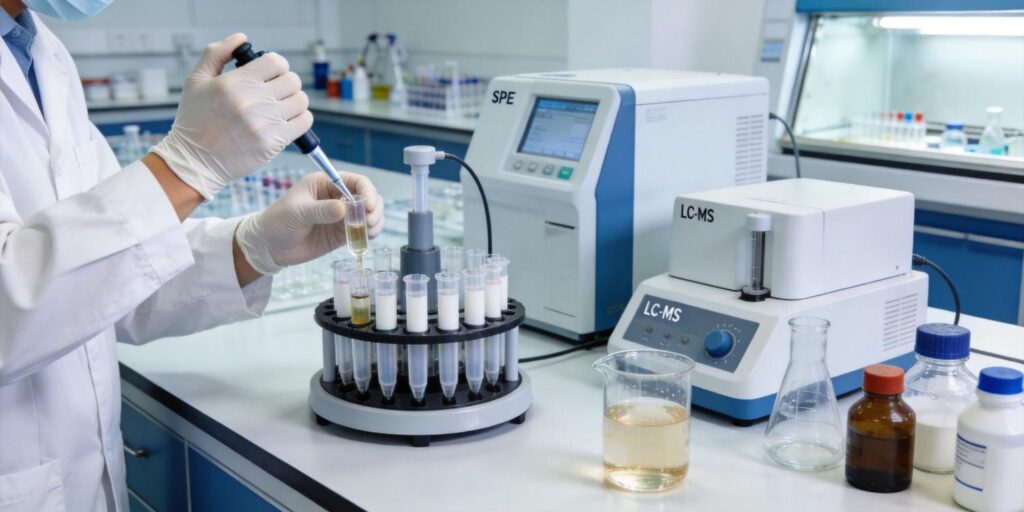
- Automated Systems: Consider using automated SPE workstations or 96-well plates for higher throughput and better reproducibility
- Internal Standards: Use stable isotope-labeled analogs of target analytes as internal standards
- Batch Controls: Include quality control samples in each batch to monitor performance
- Documentation: Maintain detailed records of lot numbers, expiration dates, and performance characteristics
Troubleshooting Common Issues:
- Poor Recovery: Check pH adjustment, ensure proper cartridge conditioning, verify solvent compatibility
- High Background: Increase wash volume or optimize wash solvent composition
- Clogging: Filter samples before SPE or use larger particle size sorbents for viscous samples
- Inconsistent Results: Standardize sample preparation steps and ensure consistent timing between steps
As emphasized in SPE methodology, “the more that is known about the composition of the sample matrix, the greater the opportunity to develop SPE methods that yield cleaner extracts.” This principle is particularly relevant for complex sugar-rich beverage matrices where understanding carbohydrate behavior is key to successful method development.
Conclusion
SPE cleanup represents an essential step in the LC-MS analysis of sugar-rich beverages, transforming challenging matrices into analyzable samples. By selecting appropriate sorbents like Poseidon Scientific’s HLB, MCX, or WAX cartridges and following optimized protocols, laboratories can achieve reliable, reproducible results with significantly improved sensitivity and accuracy. The investment in proper SPE methodology pays dividends through better data quality, reduced instrument maintenance, and increased confidence in analytical results—whether for regulatory compliance, quality control, or research applications.
For laboratories analyzing beverages regularly, establishing validated SPE protocols using quality products like those from Poseidon Scientific ensures consistent performance and reliable data generation. The combination of proper sorbent selection, method optimization, and quality control measures creates a robust analytical workflow capable of handling even the most challenging sugar-rich matrices.